
工程化细胞色素P450酶与P450还原酶之间的电子传递通量以增强大肠杆菌中血清素的产生。
Engineering Electron Transfer Flux between Cytochrome P450 Enzyme and P450 Reductase to Enhance Serotonin Production in Escherichia Coli.
作者信息
Xu Wenzhao, Wei Pengling, Chen Lirong, Gao Ling, Xia Xiaole
机构信息
Key Laboratory of Industrial Biotechnology, Ministry of Education, School of Biotechnology, Jiangnan University, 1800 Lihu Road, Wuxi, Jiangsu, 214122, China.
出版信息
Adv Sci (Weinh). 2025 Aug;12(30):e14859. doi: 10.1002/advs.202414859. Epub 2025 May 23.
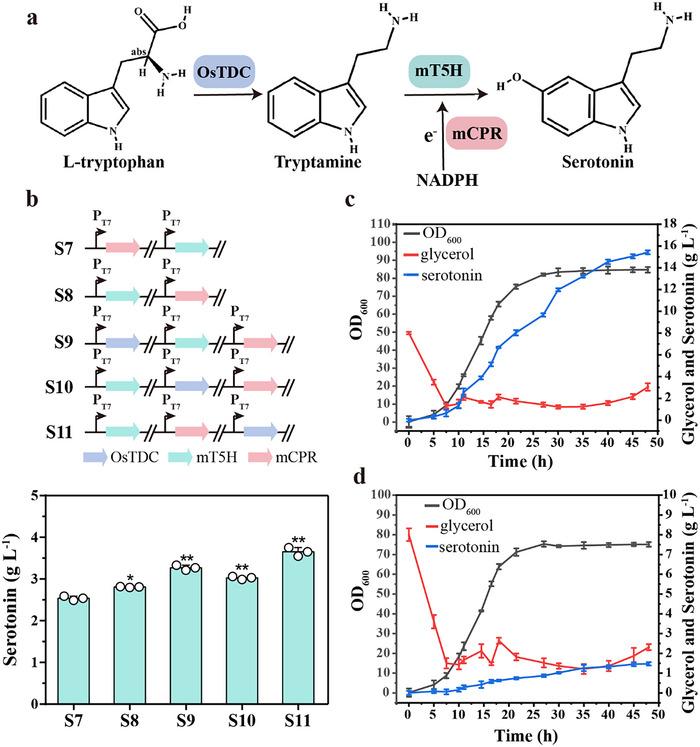
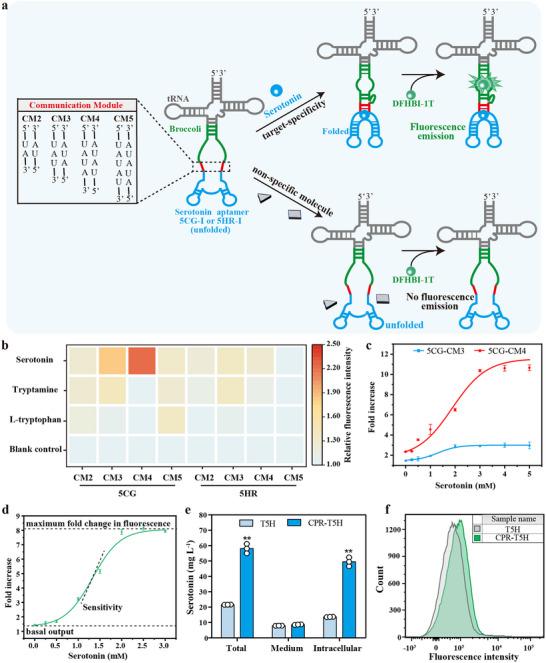
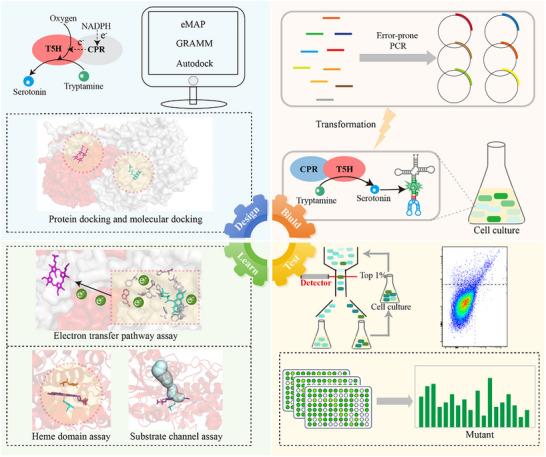
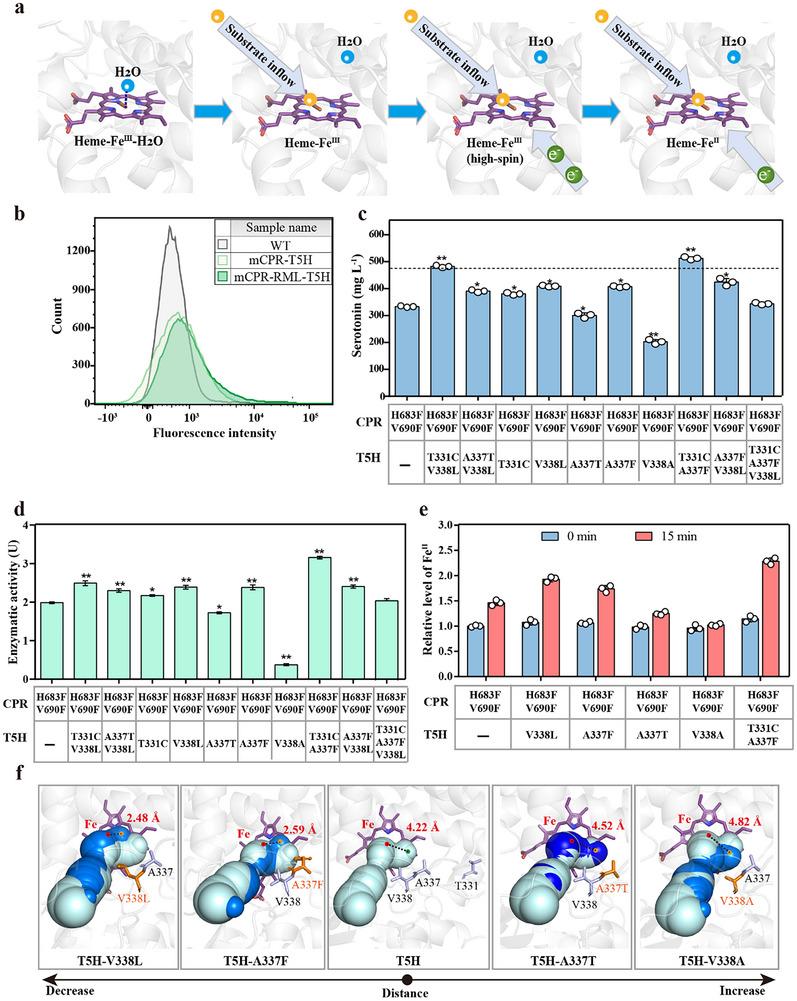
Microbial cell factories produce valuable compounds by exploiting cytochrome P450 catalytic systems. However, the inefficient electron transfer flux (ETF) between P450 and cytochrome P450 reductase (CPR) hinders the efficient synthesis of natural products. Herein, an ETF is systematically engineered by regulating the electron transfer rate, electron-receiving rate, and electron donor NADPH availability for serotonin production. First, a putative electron transfer pathway (ETP) is identified using virtual computing and evolved based on a genetically encoded serotonin RNA biosensor. Subsequently, an intermediate site strategy is developed to shorten the electron-hopping steps and distance in the ETP of CPR for enhancing the electron transfer rate. Next, the heme-binding domain is engineered to reduce the distance between heme-Fe and the substrate channel terminal in T5H for improving the electron-receiving rate. Furthermore, the NADPH pool is enlarged to increase the electron supply for efficient catalysis of P450 systems. Finally, tryptophan-5-hydroxylase (T5H) activity (K/K) in the optimal mutant is 36.62-fold than that of wild-type. The engineered strain E. coli S11 can produce 15.42 g L serotonin in a 7.5-L bioreactor, which is 9.17-fold of the previous reported. This strategy provides a systematic approach for regulating ETF in complex P450 catalytic systems for efficient chemical biosynthesis.
微生物细胞工厂通过利用细胞色素P450催化系统来生产有价值的化合物。然而,P450与细胞色素P450还原酶(CPR)之间低效的电子传递通量(ETF)阻碍了天然产物的高效合成。在此,通过调节电子传递速率、电子接收速率以及电子供体NADPH的可用性来系统地改造ETF,以用于5-羟色胺的生产。首先,利用虚拟计算确定一条假定的电子传递途径(ETP),并基于基因编码的5-羟色胺RNA生物传感器对其进行进化。随后,开发了一种中间位点策略,以缩短CPR的ETP中的电子跳跃步骤和距离,从而提高电子传递速率。接下来,对血红素结合结构域进行工程改造,以缩短T5H中血红素-Fe与底物通道末端之间的距离,从而提高电子接收速率。此外,扩大NADPH库以增加电子供应,从而实现P450系统的高效催化。最后,最佳突变体中的色氨酸-5-羟化酶(T5H)活性(K/K)比野生型高36.62倍。工程菌株大肠杆菌S11在7.5-L生物反应器中可产生15.42 g/L的5-羟色胺,是先前报道产量的9.17倍。该策略为在复杂的P450催化系统中调节ETF以实现高效化学生物合成提供了一种系统方法。


 Zotero 插件