
胶质瘤患者血浆中p53聚集体的检测
Detection of p53 aggregates in plasma of glioma patients.
作者信息
Wu Yunzhao, Lam Jeff Y L, Pitoulias Matthaios, Böken Dorothea, Zhang Ziwei, Chintapalli Renuka, Fertan Emre, Xia Zengjie, Danial John S H, Tsang-Pells Gemma, Fysh Emily, Julian Linda, Brindle Kevin M, Mair Richard, Klenerman David
机构信息
Yusuf Hamied Department of Chemistry, University of Cambridge, Cambridge, UK.
UK Dementia Research Institute, University of Cambridge, Cambridge, UK.
出版信息
Commun Med (Lond). 2025 May 23;5(1):195. doi: 10.1038/s43856-025-00918-3.
BACKGROUND
The tumour-suppressor protein p53 can form amyloid aggregates resulting in loss of tumour-suppressing functions and leading to tumour formation. The detection of p53 aggregates in cancer cells has been demonstrated but these aggregates have not been detected in liquid biopsies to date, due to the lack of sufficiently sensitive methods.
METHODS
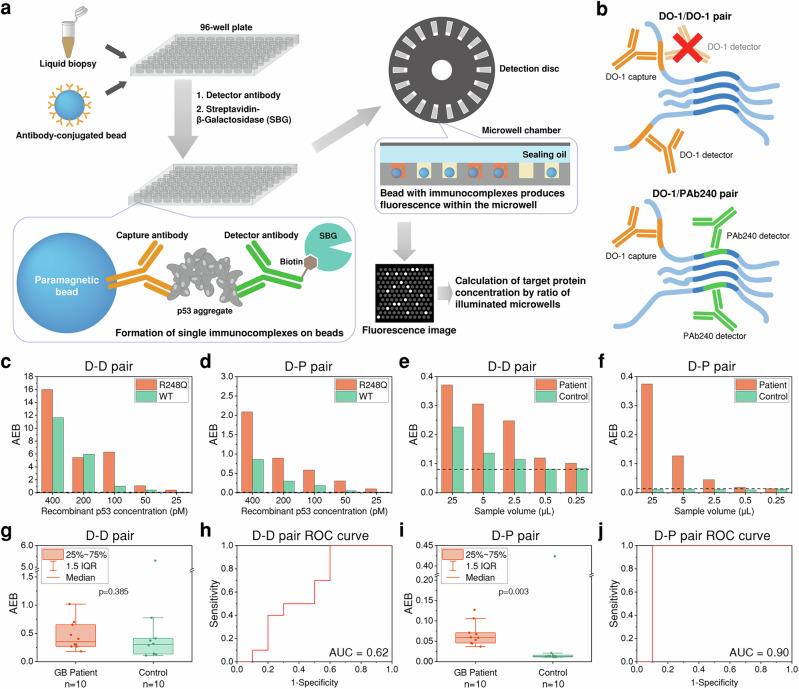
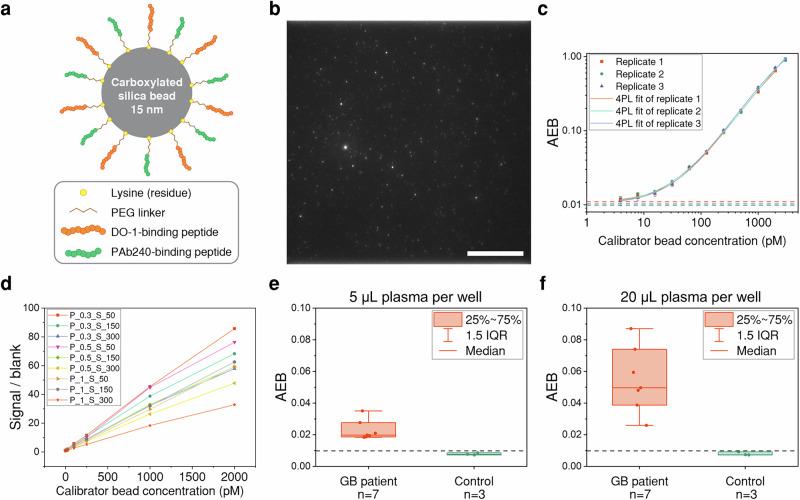
We developed an ultrasensitive immunoassay based on the single-molecule array (SiMoA) technology to detect p53 aggregates in plasma, based on antibody capture of the aggregates. We confirmed that the assay detects p53 aggregates using super-resolution imaging. We then investigated the p53 aggregate concentrations in the plasma of 190 pre-surgery glioblastoma (GB) patients and 22 controls using this assay.
RESULTS
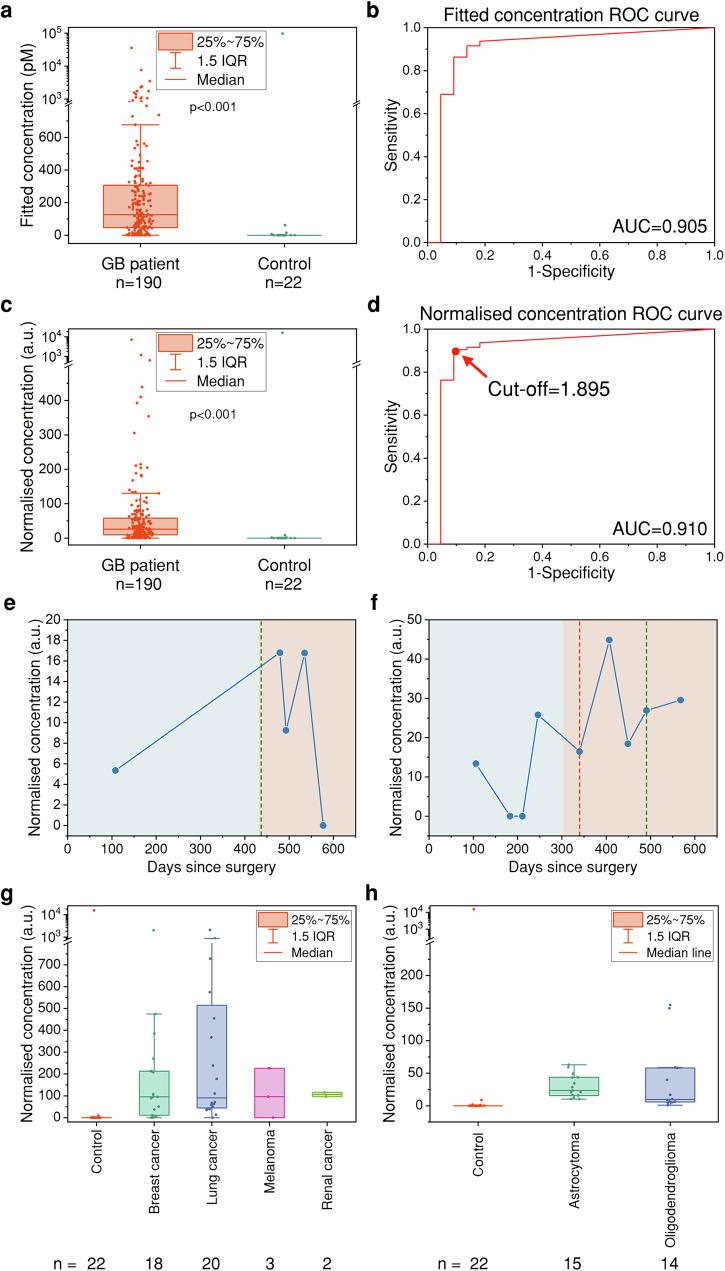
We found that the plasma p53 aggregate levels are significantly elevated in pre-surgery GB patients' plasma compared to controls. Longitudinal study further reveals that p53 aggregate levels may increase before GB recurrence and decrease following treatment. We also observed raised p53 aggregate concentrations in the plasma of cancer patients with brain metastases.
CONCLUSIONS
This study demonstrates the detection of p53 aggregates in liquid biopsies. Our findings highlight the potential of p53 aggregates as a novel biomarker for glioblastoma.
背景
肿瘤抑制蛋白p53可形成淀粉样聚集体,导致肿瘤抑制功能丧失并引发肿瘤形成。癌细胞中p53聚集体的检测已得到证实,但由于缺乏足够灵敏的方法,迄今为止在液体活检中尚未检测到这些聚集体。
方法
我们基于单分子阵列(SiMoA)技术开发了一种超灵敏免疫测定法,通过抗体捕获聚集体来检测血浆中的p53聚集体。我们使用超分辨率成像确认该测定法可检测p53聚集体。然后,我们使用该测定法研究了190例术前胶质母细胞瘤(GB)患者和22例对照者血浆中的p53聚集体浓度。
结果
我们发现,与对照相比,术前GB患者血浆中的p53聚集体水平显著升高。纵向研究进一步表明,p53聚集体水平可能在GB复发前升高,治疗后降低。我们还观察到脑转移癌患者血浆中的p53聚集体浓度升高。
结论
本研究证明了在液体活检中可检测到p53聚集体。我们的发现突出了p53聚集体作为胶质母细胞瘤新型生物标志物的潜力。

 Zotero 插件