
海水老化微塑料对菲律宾帘蛤的毒性效应研究
Study on the toxic effect of seawater-aged microplastics on Philippine curtain clams.
作者信息
Zeng Liqing, Yang Hui, Tong Tong, Chen Jielun, Huang Yujie, Yang Jiaming, Xiao Yuhui, Yang Fan, Chen Yazhen
机构信息
Department of Public Health and Medical Technology, Xiamen Medical College, Xiamen, 361021, China.
School of Mechanical, Electrical and Information Engineering, Xiamen Institute of Technology, Xiamen, 361021, China.
出版信息
Sci Rep. 2025 May 24;15(1):18078. doi: 10.1038/s41598-025-02823-0.
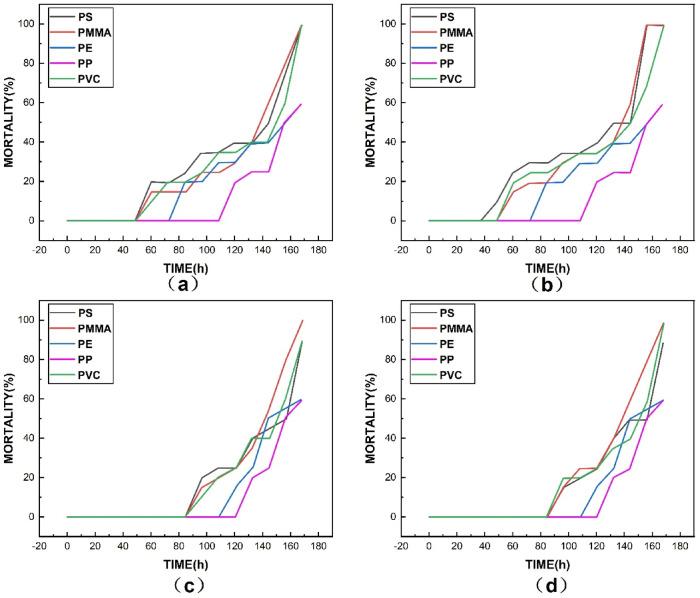
This study delved into the impact of aging on the properties of five common microplastic types, including polymethylmethacrylate (PMMA), polystyrene (PS), polyvinyl chloride (PVC), polyethylene (PE), and polypropylene (PP). The aging process significantly altered the particle size distribution: PS, PP, and PMMA underwent a contraction, with average sizes decreasing by 6.8%, 3.2%, and 1.7%, respectively, whereas PE and PVC experienced an expansion, with increases of 3.1% and 1.7%. Notably, aging generally increased the specific surface area of all microplastics by more than 20%, a change that could influence their environmental interactions. Scanning electron microscopy revealed marked surface cracks and depressions in aged PE and PVC, in contrast to minor surface alterations in PS and PMMA. Fourier transform infrared spectroscopy further indicated modifications in the characteristic peaks of aged PMMA, PP, and PE microplastics. Exposure experiments demonstrates that increasing microplastic concentrations from 100 mg/L to 5000 mg/L accelerated mortality rates in clams, with juveniles exhibiting slower mortality onset compared to adults. Prolonged exposure led to rising mortality rates across all groups, suggesting a cumulative toxic effect from long-term microplastic exposure. These findings underscore the environmental ecological risks associated with the altered physicochemical properties of aged microplastics, particularly for the Philippine clam. This study provides an essential insight for advancing our understanding of microplastic behavior and their ecological impacts, highlighting the need for further research to mitigate these environmental threats.
本研究深入探讨了老化对五种常见微塑料类型性能的影响,这五种微塑料包括聚甲基丙烯酸甲酯(PMMA)、聚苯乙烯(PS)、聚氯乙烯(PVC)、聚乙烯(PE)和聚丙烯(PP)。老化过程显著改变了粒径分布:PS、PP和PMMA粒径收缩,平均尺寸分别减小了6.8%、3.2%和1.7%,而PE和PVC粒径增大,分别增加了3.1%和1.7%。值得注意的是,老化通常使所有微塑料的比表面积增加20%以上,这一变化可能会影响它们与环境的相互作用。扫描电子显微镜显示,老化后的PE和PVC表面有明显的裂纹和凹陷,而PS和PMMA表面只有轻微变化。傅里叶变换红外光谱进一步表明,老化后的PMMA、PP和PE微塑料的特征峰发生了改变。暴露实验表明,将微塑料浓度从100 mg/L提高到5000 mg/L会加速蛤的死亡率,与成年蛤相比,幼蛤的死亡起始速度较慢。长时间暴露导致所有组的死亡率上升,这表明长期接触微塑料具有累积毒性作用。这些发现强调了老化微塑料理化性质改变所带来的环境生态风险,特别是对菲律宾蛤而言。本研究为增进我们对微塑料行为及其生态影响的理解提供了重要见解,突出了进一步开展研究以减轻这些环境威胁的必要性。


 Zotero 插件