
超短柄节段性假体重建在干骺端肿瘤保关节治疗中的应用:25例回顾性分析
Ultra-short stem intercalary prosthetic reconstruction for joint preservation in metaphyseal tumor management: a retrospective review of twenty-five cases.
作者信息
Mou Leming, Liu Dayong, Zhu Wanping, Lun Dengxing, Zhu Shilong, Zhang Jingyu, Liu Yancheng, Hu Yongcheng
机构信息
Clinical School/College of Orthopedics, Tianjin Medical University, Tianjin, China.
WeiFang People's Hospital, Shandong Second Medical University, Weifang, Shandong Province, China.
出版信息
BMC Musculoskelet Disord. 2025 May 24;26(1):513. doi: 10.1186/s12891-025-08780-z.
PURPOSE
This study evaluates the outcomes, survival, and ASL incidence of ultra-short stem intercalary prosthetic reconstruction for tumors involving the metaphysis of bone.
METHODS
A retrospective analysis of 25 patients treated at two centers with wide resection for primary or metastatic bone tumors (femur, tibia, humerus) followed by reconstruction using ultra-short stem intercalary prostheses combined extracortical plates. Clinical outcomes were assessed using the Visual Analogue Scale (VAS) and Musculoskeletal Tumor Society (MSTS) score. Survival rates were calculated using the Kaplan-Meier method, and complications were classified according to the Henderson system.
RESULTS
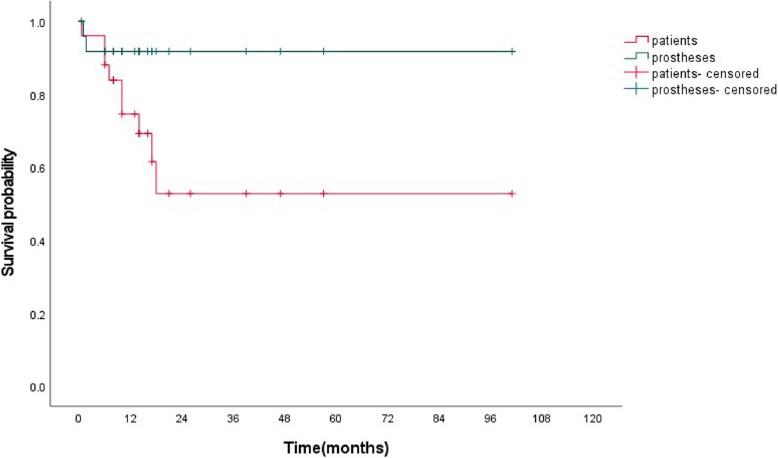
The mean follow-up was 20.2 months (range, 3-101 months). The average length of the ultra-short stems was 41.3 ± 9.6 mm. Mean operative time was 164 ± 61.3 min, blood loss averaged 646.4 ± 375.5 ml and the mean defect size was 122 ± 52.1 mm. Postoperative VAS scores were significantly lower than preoperative levels (P < 0.05). The mean MSTS score was 24.2 ± 3.5 (range, 15-29). Kaplan-Meier analysis revealed prosthesis survival rates at 1, 2, 3, and 5 years of 91.7%, compared to patient survival rates of 74.5%, 52.7%, 52.7%, and 52.7%. Postoperative complications occurred in 12% of patients (3/25), including one case of aseptic loosening (ASL), and two patients required reoperation.
CONCLUSIONS
Ultra-short stem intercalary prostheses with extracortical plates provide a viable, effective option for reconstruction of short bone stumps after tumor resection, offering improved functional outcomes and acceptable prosthesis failure rates.
目的
本研究评估超短柄间置假体重建术治疗累及骨干骺端骨肿瘤的疗效、生存率及无菌性松动(ASL)发生率。
方法
对在两个中心接受广泛切除治疗原发性或转移性骨肿瘤(股骨、胫骨、肱骨),随后使用超短柄间置假体联合皮质外钢板进行重建的25例患者进行回顾性分析。使用视觉模拟量表(VAS)和肌肉骨骼肿瘤学会(MSTS)评分评估临床疗效。采用Kaplan-Meier法计算生存率,并根据亨德森系统对并发症进行分类。
结果
平均随访时间为20.2个月(范围3 - 101个月)。超短柄的平均长度为41.3±9.6毫米。平均手术时间为164±61.3分钟,平均失血量为646.4±375.5毫升,平均缺损大小为122±52.1毫米。术后VAS评分显著低于术前水平(P<0.05)。MSTS平均评分为24.2±3.5(范围15 - 29)。Kaplan-Meier分析显示,假体1年、2年、3年和5年的生存率为91.7%,而患者生存率分别为74.5%、52.7%、52.7%和52.7%。12%的患者(3/25)发生术后并发症,包括1例无菌性松动(ASL),2例患者需要再次手术。
结论
超短柄间置假体联合皮质外钢板为肿瘤切除后短骨残端重建提供了一种可行、有效的选择,功能结局改善,假体失败率可接受。
 Zotero 插件