
梓醇通过调控MiR-126/TWEAK-FN14通路抗心肌再灌注损伤的机制研究:体外及计算机模拟研究
Catalpol Research on the Mechanism of Antimyocardial Reperfusion Injury by Regulating the MiR-126/TWEAK-FN14 Pathway: In Vitro and Computer Simulation Studies.
作者信息
Wang Ting, Shao Chongyu, An Huiyan, Xu Guanfeng, Wan Haitong, Yang Jiehong
机构信息
College of Basic Medical Sciences, Zhejiang Chinese Medical University, Zhejiang, Hangzhou 310053, China.
College of Life Science, Zhejiang Chinese Medical University, Zhejiang, Hangzhou 310053, China.
出版信息
ACS Omega. 2025 May 9;10(19):19538-19551. doi: 10.1021/acsomega.4c11357. eCollection 2025 May 20.
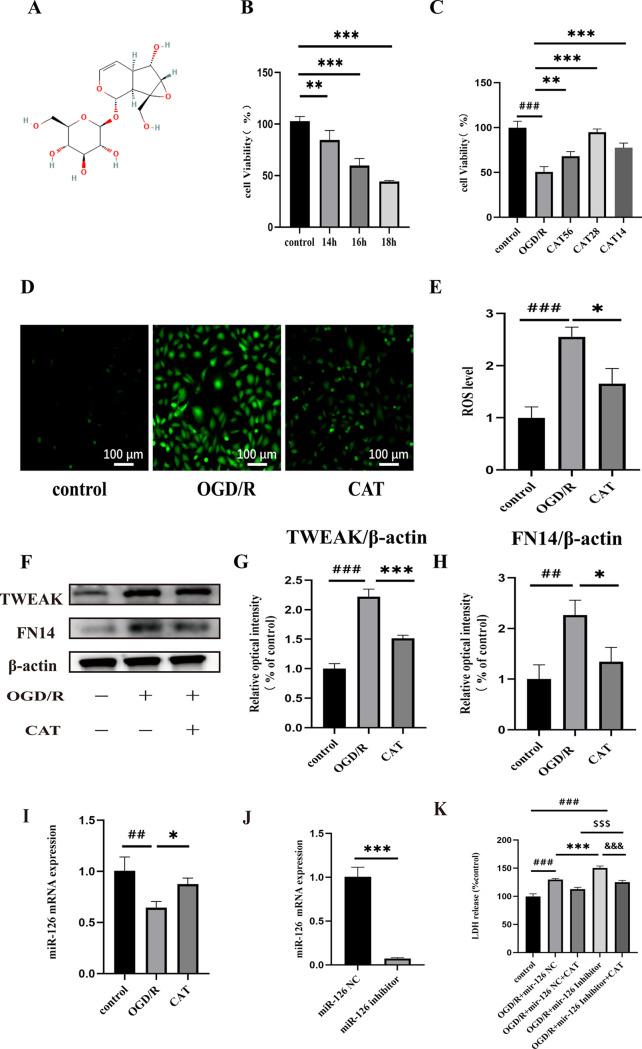
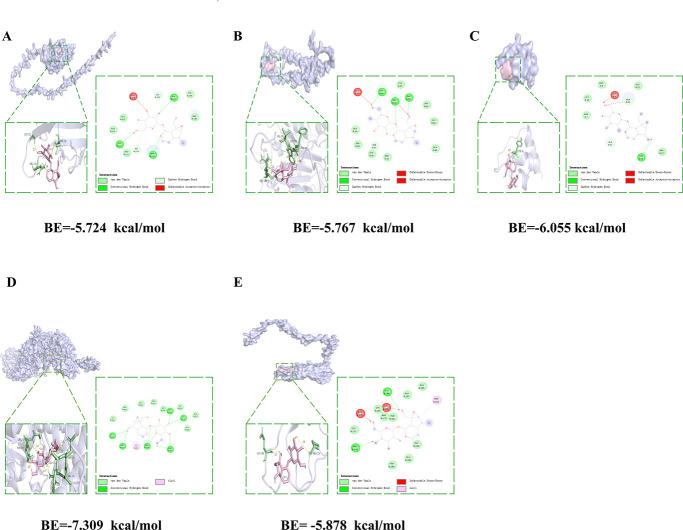
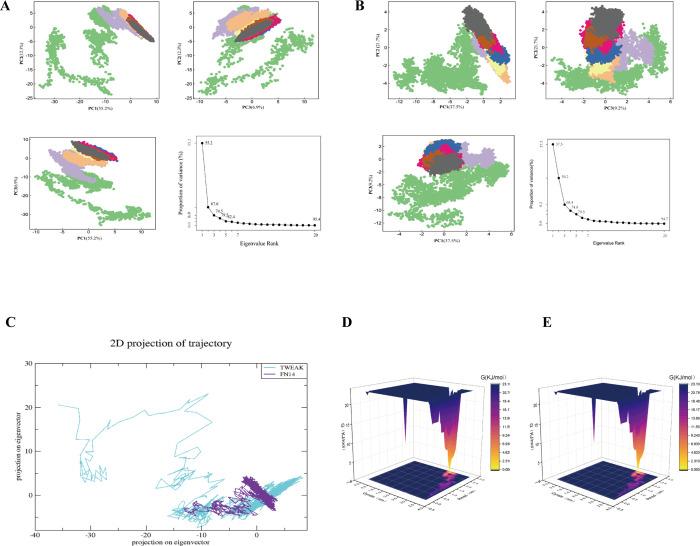
The objective of this study was to investigate the mechanism through which catalpol (CAT) exerts its protective effects in the context of myocardial ischemia-reperfusion injury. Preliminary results showed that Cat significantly attenuated oxygen-glucose deprivation/reoxygenation (OGD/R) damage to H9C2 cells, inhibited intracellular reactive oxygen species levels, and downregulated the protein expression of TWEAK and Fn14 post-OGD/R. The intracellular level of miR-126 was downregulated after OGD/R, and this effect was reversed by CAT administration. To further elucidate its mechanisms, a miR-126 inhibitor was used in the H9C2 cells, and the inhibitory effect was validated using real-time fluorescence quantitative polymerase chain reaction (RT-PCR). Following CAT treatment, lactate dehydrogenase (LDH) levels within the cells were assessed. The results revealed that CAT not only decreased LDH levels but also modulated the miR-126/TWEAK-FN14 signaling axis and the expression of inflammatory-related mediators, as evidenced through RT-PCR and Western blot. Additionally, molecular docking (MD) studies suggested that CAT exhibited a strong binding affinity to both the signaling pathway and inflammatory-related components. Furthermore, molecular dynamics simulations (MDS) demonstrated that the CAT-protein complex exhibited high stability, flexibility, and low binding free energy under physiological conditions. Additionally, CAT showed favorable absorption, distribution, metabolism, excretion, and toxicity characteristics. In summary, this study, through in vitro experimentation, confirmed that CAT regulates the miR-126 and inflammatory proteins within the signaling pathway, with these results being further supported by MD and MDS analyses.
本研究的目的是探讨梓醇(CAT)在心肌缺血再灌注损伤背景下发挥其保护作用的机制。初步结果表明,梓醇显著减轻氧糖剥夺/复氧(OGD/R)对H9C2细胞的损伤,抑制细胞内活性氧水平,并在OGD/R后下调TWEAK和Fn14的蛋白表达。OGD/R后细胞内miR-126水平下调,而梓醇给药可逆转这一效应。为进一步阐明其机制,在H9C2细胞中使用了miR-126抑制剂,并通过实时荧光定量聚合酶链反应(RT-PCR)验证了其抑制作用。梓醇处理后,评估细胞内乳酸脱氢酶(LDH)水平。结果显示,梓醇不仅降低了LDH水平,还调节了miR-126/TWEAK-FN14信号轴以及炎症相关介质的表达,RT-PCR和蛋白质免疫印迹法证实了这一点。此外,分子对接(MD)研究表明,梓醇与信号通路和炎症相关成分均表现出很强的结合亲和力。此外,分子动力学模拟(MDS)表明,在生理条件下,梓醇-蛋白质复合物具有高稳定性、灵活性和低结合自由能。此外,梓醇显示出良好的吸收、分布、代谢、排泄和毒性特征。总之,本研究通过体外实验证实,梓醇可调节信号通路中的miR-126和炎症蛋白,MD和MDS分析进一步支持了这些结果。




 Zotero 插件