
两例恶性黑色素瘤患者在出现脑转移后长期存活
Two Cases of Malignant Melanoma with Long-term Survival after the Appearance of Brain Metastases.
作者信息
Oishi Kyosuke, Fushida Natsumi, Nishio Jiro, Fujii Ko, Horii Motoki, Shimizu Kyoko, Maeda Shintaro, Hamaguchi Yasuhito, Matsushita Takashi
机构信息
Department of Dermatology, Faculty of Medicine, Institute of Medical, Pharmaceutical and Health Sciences, Kanazawa University, Kanazawa, Japan.
出版信息
JMA J. 2025 Apr 28;8(2):654-657. doi: 10.31662/jmaj.2024-0400. Epub 2025 Mar 28.
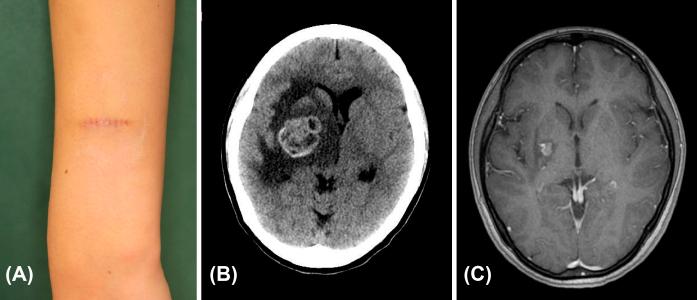
Brain metastases from malignant tumors are generally known to have a poor prognosis. One of the major reasons for this is the lack of efficacy of anti-tumor drugs compared to other organs. One of the major reasons for this is the lack of efficacy of anti-tumor drugs compared to other organs. Malignant melanoma is a highly malignant tumor that occurs mainly in the skin and is relatively prone to brain metastasis. In this case report, we report two cases of malignant melanoma with brain metastases that were treated with a combination of radiotherapy and chemotherapy and had long-term survival. Case 1 was a 51-year-old Japanese man with primary melanoma of the chest; the pathological staging was pT4aN1aM0, stage IIIC. He developed multiple brain metastases two years and three months after the initial resection. Case 2 was a 23-year-old Japanese woman with primary melanoma of the upper extremities; the pathological staging was pT1bN1aM0, stage IIIA. She developed brain metastases one year and nine months after the initial resection. Both patients had positive BRAF gene mutations in their primary tumors. The combination of BRAF inhibitors, immune checkpoint inhibitors, and stereotactic radiotherapy resulted in long-term survival of more than 5 years for Case 1 and more than 6 years for Case 2. With advances in chemotherapy and radiotherapy, the prognosis for patients with brain metastases, not only malignant melanoma, is expected to improve further in the future. Although rare, malignant melanoma is known to occur in various organs other than the skin. We report this case because we believe that our case report will be of interest to physicians who treat the above organs.
恶性肿瘤的脑转移通常预后较差。其中一个主要原因是与其他器官相比,抗肿瘤药物的疗效欠佳。恶性黑色素瘤是一种高度恶性的肿瘤,主要发生于皮肤,相对容易发生脑转移。在本病例报告中,我们报告了两例脑转移恶性黑色素瘤患者,他们接受了放疗和化疗联合治疗并长期存活。病例1是一名51岁的日本男性,患有胸部原发性黑色素瘤;病理分期为pT4aN1aM0,IIIC期。在初次切除术后两年零三个月,他出现了多发脑转移。病例2是一名23岁的日本女性,患有上肢原发性黑色素瘤;病理分期为pT1bN1aM0,IIIA期。在初次切除术后一年零九个月,她出现了脑转移。两名患者的原发性肿瘤中BRAF基因均呈阳性突变。BRAF抑制剂、免疫检查点抑制剂和立体定向放疗联合应用使病例1存活超过5年,病例2存活超过6年。随着化疗和放疗技术的进步,未来不仅是恶性黑色素瘤脑转移患者,其他脑转移患者的预后有望进一步改善。恶性黑色素瘤虽然罕见,但已知可发生于皮肤以外的各种器官。我们报告此病例是因为我们相信我们的病例报告将引起治疗上述器官疾病的医生的兴趣。

 Zotero 插件