
肾脏病大数据预测性与规范性分析技术的适用性评估
Applicability Assessment of Technologies for Predictive and Prescriptive Analytics of Nephrology Big Data.
作者信息
Stojanov Riste, Jovanovik Milos, Gramatikov Sasho, Mishkovski Igor, Zdravevski Eftim, Sasanski Darko, Karapancheva Zorica, Spasovski Goce, Vasileska Ivona, Eftimov Tome, Zhuojun Wu, Jankowski Joachim, Trajanov Dimitar
机构信息
Faculty of Computer Science and Engineering, Ss. Cyril and Methodius University in Skopje, Skopje, North Macedonia.
Institute of Logic and Computation, TU Wien, Vienna, Austria.
出版信息
Proteomics. 2025 Jun;25(11-12):e202400135. doi: 10.1002/pmic.202400135. Epub 2025 May 27.
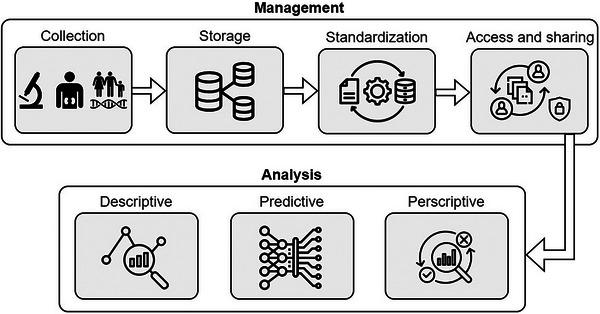
The integration of big data into nephrology research will open new avenues for analyzing and understanding complex biological datasets, driving advances in personalized management of kidney diseases. This paper describes the multifaceted challenges and opportunities by incorporating big data in nephrology, emphasizing the importance of data standardization, advanced storage solutions, and advanced analytical methods. We discuss the role of data science workflows, including data collection, preprocessing, integration, and analysis, in facilitating comprehensive insights into disease mechanisms and patient outcomes. Furthermore, we highlight predictive and prescriptive analytics, as well as the application of large language models (LLMs) in improving clinical decision-making and enhancing the accuracy of disease predictions. The use of high-performance computing (HPC) is also examined, showcasing its role in processing large-scale datasets and accelerating machine learning algorithms. Through this exploration, we aim to provide a comprehensive overview of the current state and future directions of big data analytics in nephrology, with a focus on enhancing patient care and advancing medical research.
将大数据整合到肾脏病学研究中,将为分析和理解复杂的生物数据集开辟新途径,推动肾脏疾病个性化管理的进展。本文描述了将大数据纳入肾脏病学所面临的多方面挑战和机遇,强调了数据标准化、先进存储解决方案和先进分析方法的重要性。我们讨论了数据科学工作流程(包括数据收集、预处理、整合和分析)在促进对疾病机制和患者预后的全面洞察方面的作用。此外,我们强调了预测性和规范性分析,以及大语言模型在改善临床决策和提高疾病预测准确性方面的应用。还探讨了高性能计算的使用,展示了其在处理大规模数据集和加速机器学习算法方面的作用。通过这次探索,我们旨在全面概述肾脏病学中大数据分析的现状和未来方向,重点是加强患者护理和推进医学研究。
 Zotero 插件