
利用人工智能变革微藻生物技术:为高价值化合物和碳中和解锁可持续解决方案。
Harnessing Artificial Intelligence to Revolutionize Microalgae Biotechnology: Unlocking Sustainable Solutions for High-Value Compounds and Carbon Neutrality.
作者信息
Wu Yijian, Shan Lei, Zhao Weixuan, Lu Xue
机构信息
Department of Fundamental Courses, Lianyungang Technical College, Lianyungang 222000, China.
School of Information Engineering, Lianyungang Technical College, Lianyungang 222000, China.
出版信息
Mar Drugs. 2025 Apr 25;23(5):184. doi: 10.3390/md23050184.
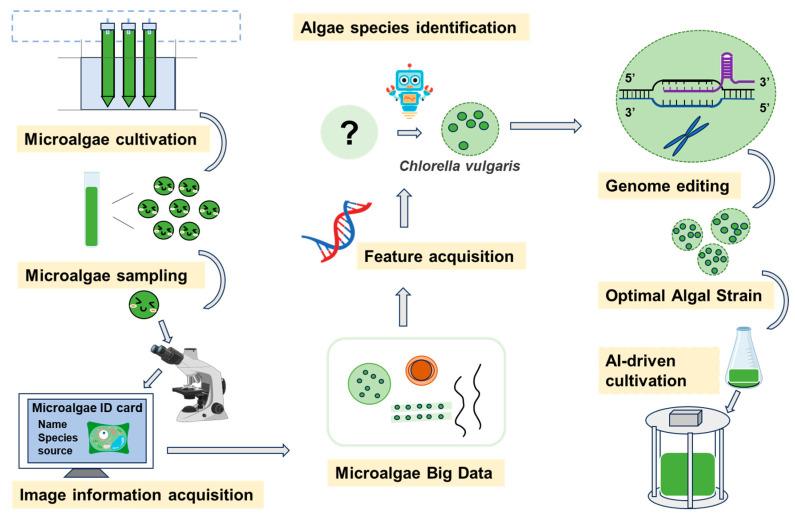
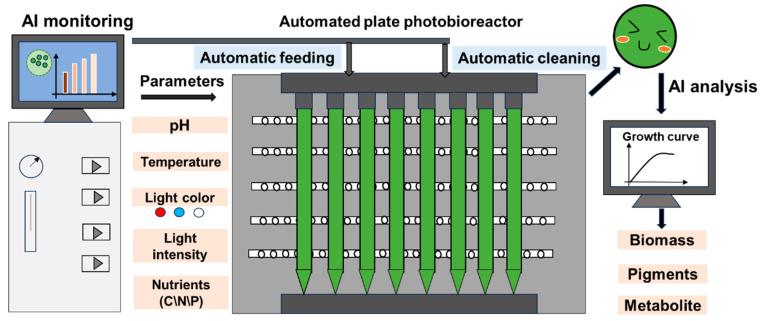
Microalgae offer significant potential in diverse fields, including biofuels, carbon capture, and high-value bioproducts. However, optimizing and scaling microalgae cultivation systems present several challenges due to the dynamic interactions among environmental factors such as light intensity, temperature, pH, nutrient concentration, and CO levels, as well as species-specific biological variability. Recent advancements in artificial intelligence (AI), particularly machine learning (ML) and automation, have provided innovative solutions to these challenges. This review explored the role of AI in enhancing microalgae technology, focusing on optimizing cultivation conditions, improving CO capture, maximizing biomass production, and automating system processes. Key case studies highlight successful applications of AI in biofuel production, carbon capture projects, and high-value compound manufacturing. Key case studies demonstrate that AI-driven models can increase biomass productivity by up to 15-57%, improve CO biofixation efficiency, and enhance lipid and high-value compound yields by more than 20-43% compared to traditional methods. Additionally, we discussed the limitations of current AI models, particularly in data availability and species-specific variability, and suggested future research directions to enhance the integration of AI and microalgae systems. By leveraging AI's potential, microalgae technologies can become more efficient, scalable, and economically viable, addressing global sustainability challenges such as energy production and climate change mitigation.
微藻在包括生物燃料、碳捕获和高价值生物产品在内的多个领域具有巨大潜力。然而,由于光照强度、温度、pH值、营养浓度和二氧化碳水平等环境因素之间的动态相互作用以及物种特异性的生物学变异性,优化和扩大微藻培养系统面临诸多挑战。人工智能(AI),特别是机器学习(ML)和自动化方面的最新进展,为这些挑战提供了创新解决方案。本综述探讨了AI在提升微藻技术方面的作用,重点关注优化培养条件、提高二氧化碳捕获能力、最大化生物量生产以及自动化系统流程。关键案例研究突出了AI在生物燃料生产、碳捕获项目和高价值化合物制造中的成功应用。关键案例研究表明,与传统方法相比,AI驱动的模型可将生物量生产力提高15%至57%,提高二氧化碳生物固定效率,并将脂质和高价值化合物产量提高20%至43%以上。此外,我们讨论了当前AI模型的局限性,特别是在数据可用性和物种特异性变异性方面,并提出了未来的研究方向,以加强AI与微藻系统的整合。通过利用AI的潜力,微藻技术可以变得更高效、可扩展且经济可行,从而应对能源生产和缓解气候变化等全球可持续发展挑战。
 Zotero 插件