
慢性肾脏病患者的高眼病负担及转诊需求增加:迈向个性化医疗的一步
High Ocular Disease Burden and Increased Referral Needs in Patients with Chronic Kidney Disease: A Step Toward Personalized Care.
作者信息
Liem Yulia, Thyagarajan Pavitra, Chee Miao Li, Lim Cynthia Ciwei, Teo Boon Wee, Sabanayagam Charumathi
机构信息
Singapore Eye Research Institute, Singapore National Eye Centre, Singapore 169856, Singapore.
Department of Renal Medicine, Singapore General Hospital, Singapore 169856, Singapore.
出版信息
J Pers Med. 2025 May 19;15(5):204. doi: 10.3390/jpm15050204.
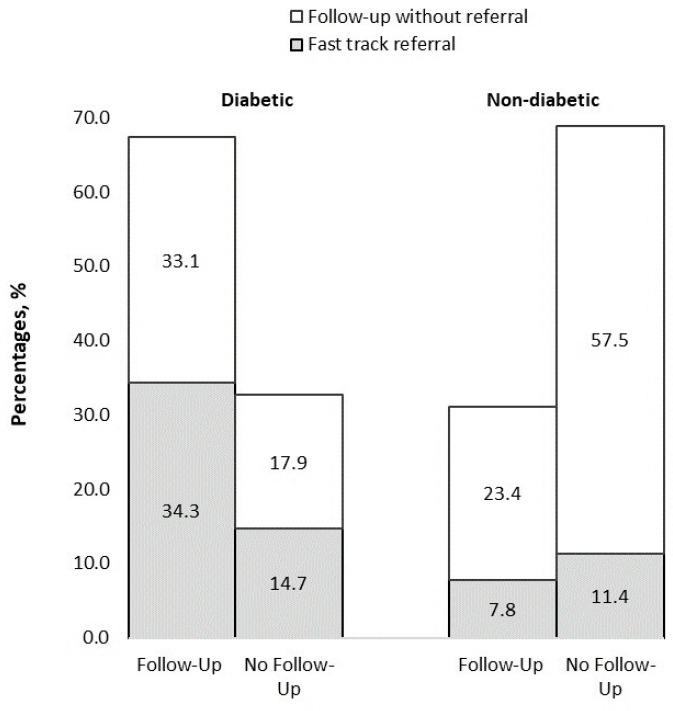
To evaluate the prevalence of eye diseases in patients with confirmed chronic kidney disease (CKD) and their referral patterns to ophthalmologists, with the aim of informing personalized screening and referral strategies. This study involved 528 CKD patients from a tertiary hospital's outpatient renal clinics in Singapore, with CKD defined as an estimated glomerular filtration rate (eGFR) < 60 mL/min/1.73 m. Retinal photographs from each dilated eye were graded for the presence of diabetic retinopathy (DR) and other eye diseases by professional graders. Patients with significant eye conditions were referred to ophthalmologists based on severity and urgency, categorized as urgent (same day or within 24 h), semi-urgent (within 1-2 weeks), fast-track (within 1-3 months), or annual referrals. More than half of the CKD patients (53.7%) had some form of eye disease; 20% were diagnosed with DR, and 29% required fast-track referrals. Of the 251 patients with diabetes, 67% adhered to annual follow-ups; however, despite this regular monitoring, over half required fast-track referrals for severe eye conditions. Among the 167 non-diabetic CKD patients, nearly a third (31%) were on follow-up, with 7.8% requiring fast-track referrals. Notably, 11% of those not on follow-up also needed fast-track referrals. Seven non-diabetic and ten diabetic patients required urgent referral due to critical conditions such as pseudo-holes, impending occlusions, and disc swelling. These findings underscore the high prevalence and severe nature of eye diseases in CKD patients, even those who are under regular annual follow-up. Integrating systematic eye screening into CKD care supports personalized medicine by enabling early detection and tailored interventions, ultimately improving both visual and overall patient outcomes.
为评估确诊慢性肾脏病(CKD)患者的眼病患病率及其向眼科医生的转诊模式,旨在为个性化筛查和转诊策略提供依据。本研究纳入了新加坡一家三级医院门诊肾脏科的528例CKD患者,CKD定义为估计肾小球滤过率(eGFR)<60 mL/min/1.73 m²。由专业分级人员对每只散瞳眼的视网膜照片进行糖尿病视网膜病变(DR)和其他眼病的分级。患有严重眼部疾病的患者根据严重程度和紧急程度被转诊至眼科医生,分为紧急(当天或24小时内)、半紧急(1 - 2周内)、快速通道(1 - 3个月内)或年度转诊。超过一半的CKD患者(53.7%)患有某种形式的眼病;20%被诊断为DR,29%需要快速通道转诊。在251例糖尿病患者中,67%坚持年度随访;然而,尽管进行了定期监测,仍有超过一半的患者因严重眼部疾病需要快速通道转诊。在167例非糖尿病CKD患者中,近三分之一(31%)正在接受随访,7.8%需要快速通道转诊。值得注意的是,未接受随访的患者中有11%也需要快速通道转诊。7例非糖尿病患者和10例糖尿病患者因诸如视网膜裂孔、即将发生的血管阻塞和视盘肿胀等危急情况需要紧急转诊。这些发现强调了CKD患者中眼病的高患病率和严重性,即使是那些接受定期年度随访的患者。将系统的眼部筛查纳入CKD护理通过实现早期检测和针对性干预来支持个性化医疗,最终改善视力和患者总体预后。

 Zotero 插件