
[急性髓系白血病首程疗效预测模型的建立与评估]
[Develop and assessment of a predictive model for the first-course efficacy of acute myeloid leukemia].
作者信息
Zhu F, Zhou Y L, Zhang Y, Mao L P, Zhou D, Ma L Y, Yang C M, Yu W J, Ye X N, Wei J Y, Meng H T, Yang M, Mai W Y, Qian J J, Ren Y L, Lou Y J, Huang J, Xu G X, Xie W Z, Tong H Y, Wang H F, Jin J
机构信息
Department of Hematology, First Affiliated Hospital, Zhejiang University, School of Medicine, Zhejiang Provincial Key Laboratory of Hematopoietic Malignancy, Zhejiang Provincial Clinical Research Center for Hematological Disorders, Hangzhou 310000, China Zhoushan Hospital, Zhoushan 316000, China.
Department of Hematology, First Affiliated Hospital, Zhejiang University, School of Medicine, Zhejiang Provincial Key Laboratory of Hematopoietic Malignancy, Zhejiang Provincial Clinical Research Center for Hematological Disorders, Hangzhou 310000, China.
出版信息
Zhonghua Xue Ye Xue Za Zhi. 2025 Apr 14;46(4):336-342. doi: 10.3760/cma.j.cn121090-20240816-00305.
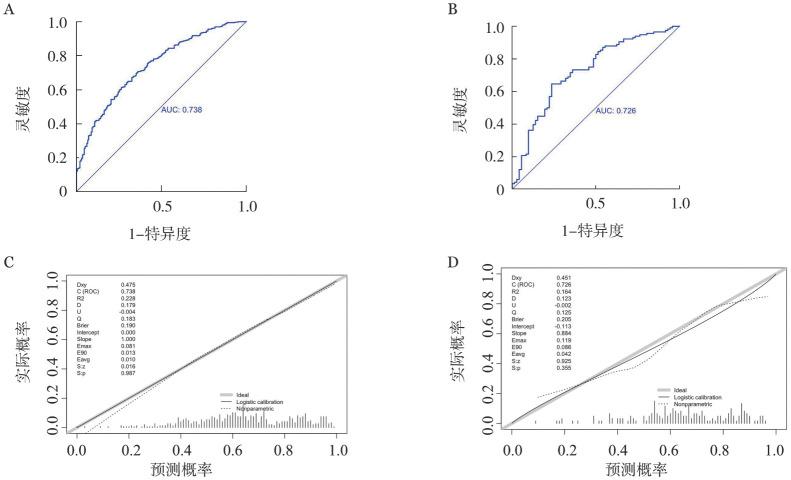
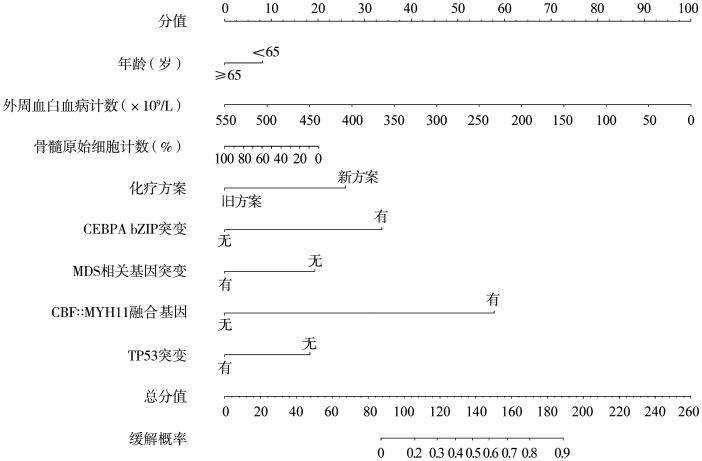
To identify the relevant factors for the first-course remission of acute myeloid leukemia (AML) and to develop a predictive model as well as assess its predictive capability. Clinical data of 749 patients newly diagnosed with AML admitted to the Department of Hematology, the First Affiliated Hospital, Zhejiang University, School of Medicine from January 1, 2019, to April 30, 2023, were collected and randomly divided into training and validation sets. Multivariate logistic regression analysis was conducted to determine variables associated with complete remission in the first course of induction therapy, and a predictive model was established based on these variables. The receiver operating characteristic (ROC) curve of the predictive model was plotted, and the area under the curve (AUC) was calculated. The indicators predicting the first remission course included peripheral blood white blood cell count during onset, CBF::MYH11 fusion gene, CEBPA bZIP region mutation, myelodysplastic syndrome-related gene mutation, and induction chemotherapy regimen selection as independent factors for the first remission course. The model's area under the training and validation curves was 0.738 (95% : 0.696-0.780) and 0.726 (95% : 0.650-0.801), respectively. The Hosmer-Lemeshow test results yielded -values of 0.993 and 0.335, respectively. In this study, the developed model demonstrates a strong predictive capability for the efficacy of the first course of patients with AML, providing valuable guidance to clinicians in assessing patient prognosis and selecting appropriate treatment strategies.
确定急性髓系白血病(AML)首次疗程缓解的相关因素,建立预测模型并评估其预测能力。收集了2019年1月1日至2023年4月30日期间浙江大学医学院附属第一医院血液科收治的749例新诊断AML患者的临床资料,并随机分为训练集和验证集。进行多因素logistic回归分析以确定诱导治疗首个疗程中与完全缓解相关的变量,并基于这些变量建立预测模型。绘制预测模型的受试者工作特征(ROC)曲线,并计算曲线下面积(AUC)。预测首次缓解疗程的指标包括发病时外周血白细胞计数、CBF::MYH11融合基因、CEBPA bZIP区域突变、骨髓增生异常综合征相关基因突变以及诱导化疗方案选择,作为首次缓解疗程的独立因素。该模型在训练曲线和验证曲线下的面积分别为0.738(95%:0.696 - 0.780)和0.726(95%:0.650 - 0.801)。Hosmer-Lemeshow检验结果的P值分别为0.993和0.335。在本研究中,所建立的模型对AML患者首个疗程的疗效具有较强的预测能力,为临床医生评估患者预后和选择合适的治疗策略提供了有价值的指导。
 Zotero 插件