
健康的社会决定因素与抗生素消费
Social Determinants of Health and Antibiotic Consumption.
作者信息
Semenova Yuliya, Akhmetova Kamila, Semenov Daniil, Makalkina Larissa, Surov Vladimir, Pivina Lyudmila, Turgambayeva Assiya, Belikhina Tatiana, Maukayeva Saule, Goremykina Maya, Kumar Praveen
机构信息
Department of Surgery, School of Medicine, Nazarbayev University, Astana 010000, Kazakhstan.
Department of Public Health and Management, Astana Medical University, Astana 010000, Kazakhstan.
出版信息
Antibiotics (Basel). 2025 May 15;14(5):513. doi: 10.3390/antibiotics14050513.
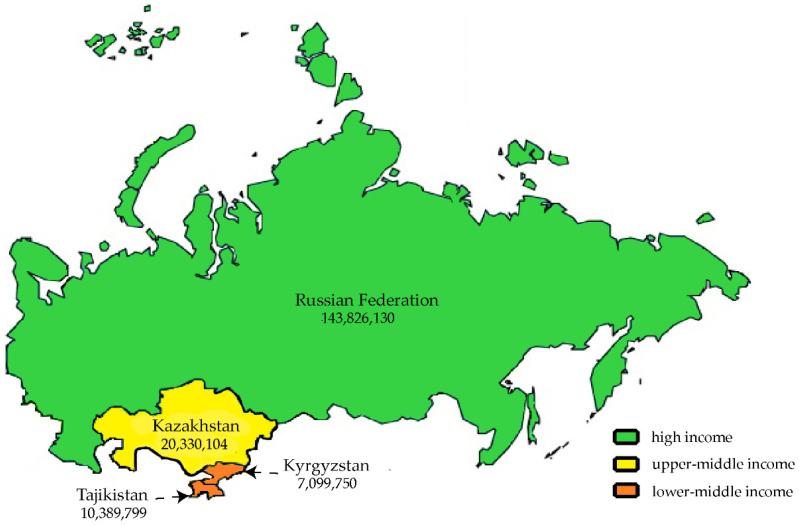
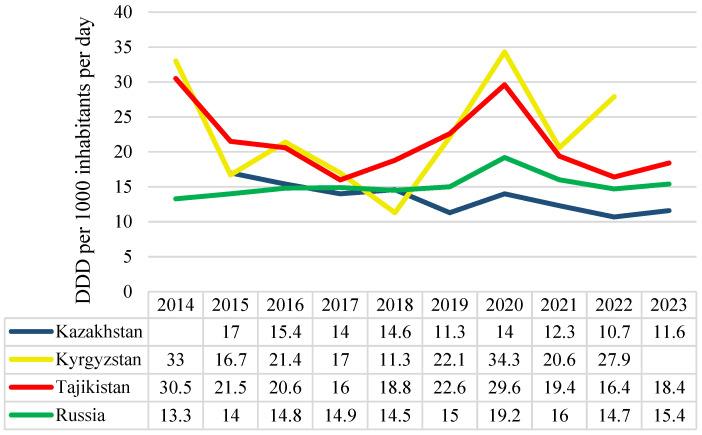
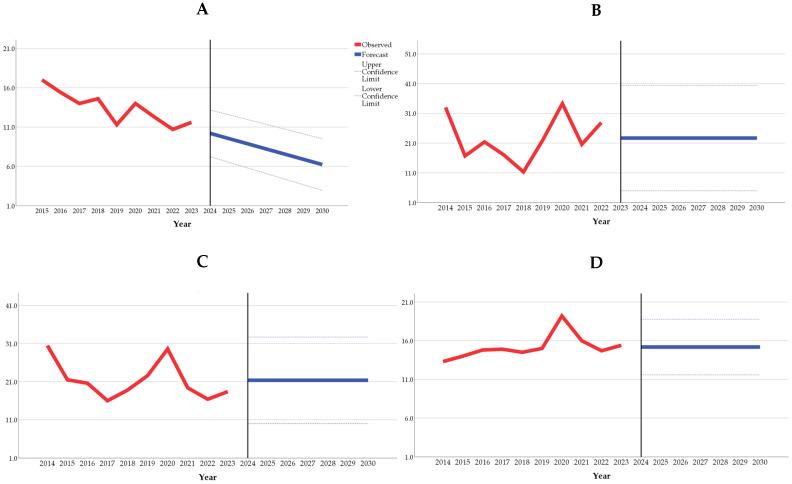
: This study aims to analyze antibiotic consumption trends from 2014 to 2023 in Kazakhstan, Kyrgyzstan, Tajikistan, and Russia; forecast future trends up to 2030; and identify key social and economic factors influencing antibiotic use. : Data on antibiotic consumption were obtained from the World Health Organization Regional Office for Europe Antimicrobial Consumption Network. Social and economic indicators were sourced from the World Bank DataBank. Of the 86 factors initially considered, 35 were included in the analyses. The forecast modeling of antibiotic consumption trends until 2030 and linear regression analysis to assess associations between antibiotic consumption and its predictors were conducted via SPSS. : The lowest antibiotic consumption rates were observed in Kazakhstan and Russia, whereas Kyrgyzstan and Tajikistan presented higher rates. The projected antibiotic consumption rates are expected to decline only in Kazakhstan, with other countries remaining stable. Birth and death rates, as well as under-five mortality rates, were significant determinants of antibiotic consumption in Kazakhstan and Tajikistan. In Russia, per capita GDP was a key determinant, whereas in Kazakhstan, inflation in consumer prices played a significant role. Additionally, cereal production was significantly associated with antibiotic consumption in Kazakhstan. In Kyrgyzstan and Russia, measles immunization rates were important determinants, whereas in Kyrgyzstan, access to clean fuels and technologies for cooking was significantly associated with antibiotic consumption. : The findings of this study provide valuable insights for strengthening antimicrobial stewardship programs by addressing key social and economic determinants of antibiotic use.
本研究旨在分析2014年至2023年哈萨克斯坦、吉尔吉斯斯坦、塔吉克斯坦和俄罗斯的抗生素消费趋势;预测直至2030年的未来趋势;并确定影响抗生素使用的关键社会和经济因素。:抗生素消费数据来自世界卫生组织欧洲区域办事处抗菌药物消费网络。社会和经济指标来源于世界银行数据库。在最初考虑的86个因素中,35个被纳入分析。通过SPSS对直至2030年的抗生素消费趋势进行预测建模,并进行线性回归分析以评估抗生素消费与其预测因素之间的关联。:哈萨克斯坦和俄罗斯的抗生素消费率最低,而吉尔吉斯斯坦和塔吉克斯坦的消费率较高。预计只有哈萨克斯坦的抗生素消费率会下降,其他国家将保持稳定。出生率、死亡率以及五岁以下儿童死亡率是哈萨克斯坦和塔吉克斯坦抗生素消费的重要决定因素。在俄罗斯,人均国内生产总值是关键决定因素,而在哈萨克斯坦,消费价格通胀起到了重要作用。此外,哈萨克斯坦的谷物产量与抗生素消费显著相关。在吉尔吉斯斯坦和俄罗斯,麻疹免疫率是重要决定因素,而在吉尔吉斯斯坦,获得清洁燃料和烹饪技术与抗生素消费显著相关。:本研究结果通过解决抗生素使用的关键社会和经济决定因素,为加强抗菌药物管理计划提供了有价值的见解。
 Zotero 插件