
使用LithoVue™ Elite实时测量肾内压力:关注小口径输尿管鞘及适当的冲洗设置。
Real-Time Measurement of Intrarenal Pressure Using LithoVue™ Elite: Focus on Small Ureteral Access Sheaths and Appropriate Irrigation Settings.
作者信息
Tanaka Naoto, Elises Jose Carlo, Yamamichi Fukashi, Kaku Yasuhiro, Fukiishi Yosuke, Fujita Masaichiro, Inoue Takaaki
机构信息
Department of Urology, Hara Genitourinary Hospital, Kobe City 650-0012, Hyogo, Japan.
Division of Urology, Philippine General Hospital, Manila 1000, Philippines.
出版信息
J Clin Med. 2025 May 20;14(10):3573. doi: 10.3390/jcm14103573.
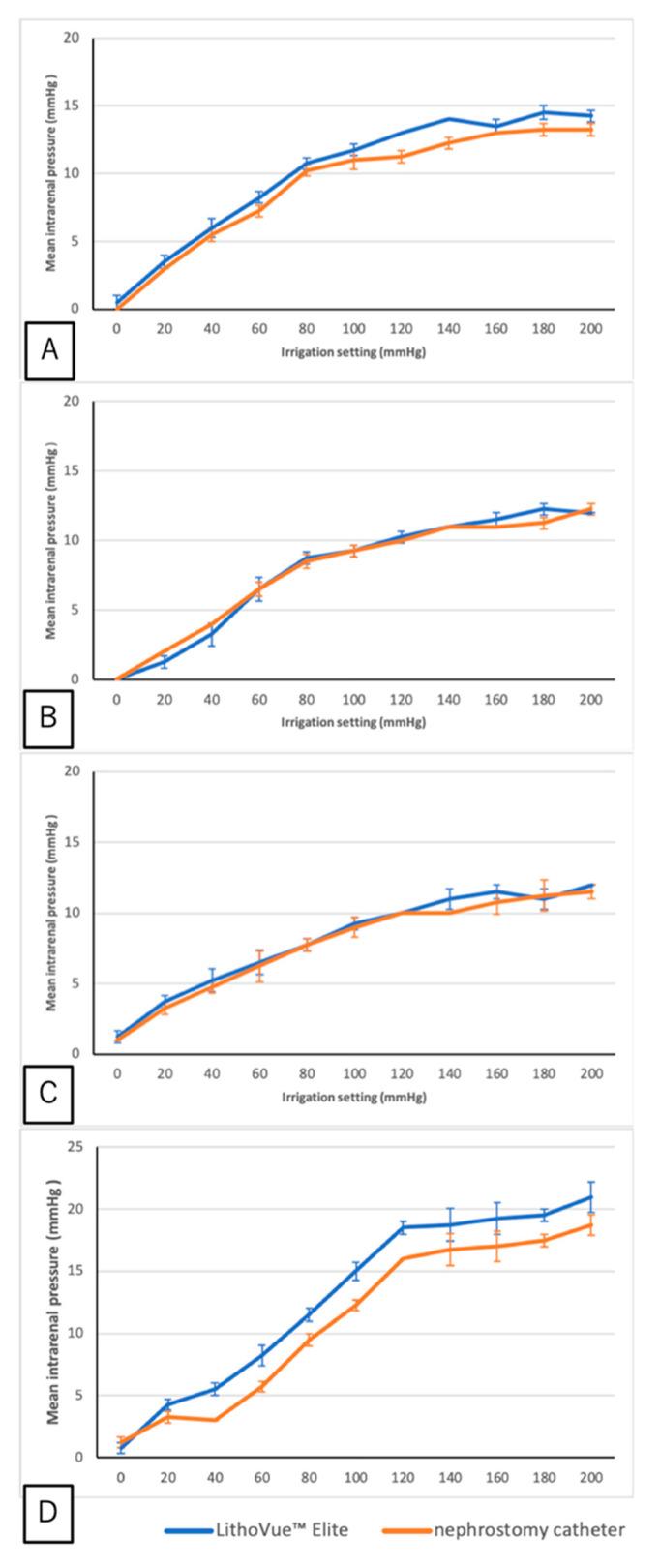
: Intrarenal pressure (IRP) plays a critical role in ensuring the safety of retrograde intrarenal surgery (RIRS), as elevated IRP is associated with complications such as pyelovenous backflow, infection, and renal injury. LithoVue™ Elite (LVE) is the first commercially available ureteroscope (URS) capable of providing real-time IRP measurements. Conventionally, IRP has been measured via a percutaneous nephrostomy catheter (PNC), which may not accurately reflect dynamic changes during endoscopic procedures. Recently, small ureteral access sheaths (UASs) have been increasingly used to minimize ureteral injury risk. This study aimed (1) to assess the accuracy of LVE compared with that of IRP measured by a PNC and (2) to evaluate appropriate irrigation settings suitable for small UASs using porcine kidney models and LVE. : An 11/13-Fr UAS and a 10/12-Fr UAS were inserted into each model, and an automatic irrigation pump (AIP) and hand pumping (HP) with a 20-cc syringe were used. IRP was measured at various LVE tip positions (renal pelvis and upper, middle, and lower calyces) with different irrigation settings, repeated four times in each. Simultaneously, the IRP via the PNC located in the upper calyx and renal pelvis was measured. : LVE showed high concordance with the PNC across the upper, middle, and lower calyces ( > 0.05). However, at the renal pelvis, LVE measured IRP values that were significantly higher than the PNC by a mean of 1.93 ± 0.93 mmHg ( < 0.001). For the 11/13-Fr UAS, the IRP remained below 30 mmHg across all irrigation settings with an AIP and HP. In contrast, the 10/12-Fr UAS maintained 30 mmHg only with limited AIP settings, while HP resulted in high IRP, exceeding 100 mmHg at any location. Intergroup comparisons demonstrated that the IRP with the 10/12-Fr UAS was significantly higher than that with the 11/13-Fr UAS at any irrigation pressure setting across all URS tip positions ( < 0.05). Intragroup comparisons indicated a significant pressure difference between the upper, middle, and lower calyces and the renal pelvis in both models at all irrigation settings ( < 0.05). : LVE provided accurate IRP measurements compared to the PNC. The IRP was significantly influenced by UAS size, irrigation setting, and URS tip position. When using small UASs, selecting appropriate irrigation settings is essential to maintain the safe threshold.
肾内压(IRP)在确保逆行性肾内手术(RIRS)的安全性方面起着关键作用,因为肾内压升高与诸如肾盂静脉逆流、感染和肾损伤等并发症相关。LithoVue™ Elite(LVE)是首款能够提供实时肾内压测量的商用输尿管镜(URS)。传统上,肾内压是通过经皮肾造瘘导管(PNC)进行测量的,这可能无法准确反映内镜手术过程中的动态变化。最近,小型输尿管通路鞘(UASs)越来越多地被用于将输尿管损伤风险降至最低。本研究旨在:(1)评估LVE与通过PNC测量的肾内压的准确性;(2)使用猪肾模型和LVE评估适合小型UASs的适当冲洗设置。
将一个11/13-Fr的UAS和一个10/12-Fr的UAS插入每个模型中,并使用自动冲洗泵(AIP)和用20毫升注射器进行手动推注(HP)。在不同的冲洗设置下,在LVE尖端的各个位置(肾盂以及上、中、下肾盏)测量肾内压,每个位置重复测量四次。同时,测量位于上肾盏和肾盂的PNC的肾内压。
LVE在上、中、下肾盏与PNC显示出高度一致性(>0.05)。然而,在肾盂处,LVE测量的肾内压值比PNC显著高,平均高1.93±0.93 mmHg(<0.001)。对于11/13-Fr的UAS,在使用AIP和HP的所有冲洗设置下,肾内压均保持在30 mmHg以下。相比之下,10/12-Fr的UAS仅在有限的AIP设置下维持在30 mmHg,而手动推注导致肾内压升高,在任何位置都超过100 mmHg。组间比较表明,在所有URS尖端位置的任何冲洗压力设置下,10/12-Fr UAS的肾内压均显著高于11/13-Fr UAS的肾内压(<0.05)。组内比较表明,在所有冲洗设置下,两个模型的上、中、下肾盏与肾盂之间在压力上均存在显著差异(<0.05)。
与PNC相比,LVE提供了准确的肾内压测量。肾内压受UAS尺寸、冲洗设置和URS尖端位置的显著影响。使用小型UASs时,选择合适的冲洗设置对于维持安全阈值至关重要。



 Zotero 插件