
共病精神疾病和物质使用障碍对青少年和青年阿片类物质使用障碍患者预后的影响:一项回顾性队列研究。
Impact of Co-Occurring Psychiatric Comorbidities and Substance Use Disorders on Outcomes in Adolescents and Young Adults with Opioid Use Disorder: A Retrospective Cohort Study.
作者信息
Liu Ligang, McKnight Erin R, Bonny Andrea E, Tao Heqing, Zhao Pujing, Nahata Milap C
机构信息
Institute of Therapeutic Innovations and Outcomes (ITIO), College of Pharmacy, The Ohio State University, Columbus, OH 43210, USA.
Division of Adolescent Medicine, Nationwide Children's Hospital, Columbus, OH 43210, USA.
出版信息
Pharmaceuticals (Basel). 2025 Apr 23;18(5):609. doi: 10.3390/ph18050609.
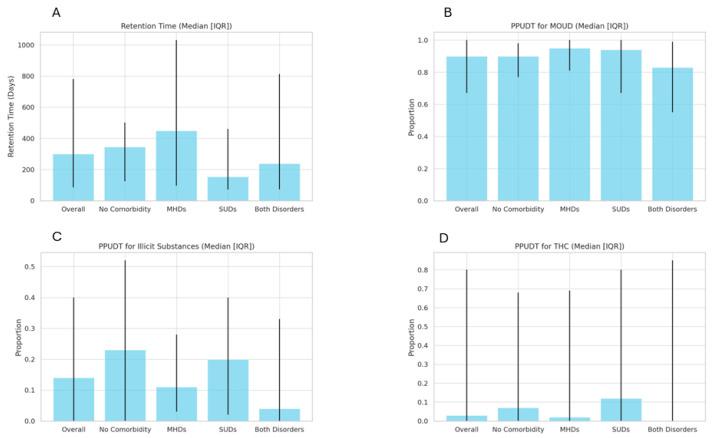
Adolescents and young adults (AYAs) with opioid use disorder (OUD) frequently have co-occurring psychiatric conditions and substance use disorders (SUDs). This study evaluated the association of psychiatric comorbidities and other SUDs with treatment retention and urine drug test (UDT) results in AYAs with OUD. This retrospective cohort study included AYAs enrolled in the Substance Use Treatment and Recovery clinic from 2009 to 2022. Participants were categorized into four groups: no comorbidities, only mental health disorders, only other SUDs, and both disorders. Treatment outcomes included retention time and UDT results for medication for OUD (MOUD) and illicit substances, including tetrahydrocannabinol (THC). Kruskal-Wallis tests were used to evaluate differences across groups, and regression models identified variables associated with outcomes. Statistical significance was set at < 0.05. Among 157 patients, the median retention time was 300 days. Depression ( = 0.04), post-traumatic stress disorder ( = 0.002), and alcohol use disorder ( = 0.04) were associated with prolonged retention, whereas cannabis use disorder predicted shorter retention ( = 0.02). The median proportion of positive UDTs was 0.9 for MOUD, 0.1 for illicit substances, and 0.0 for THC. Older age ( = 0.02) and the use of antidepressants and anxiolytics were associated with greater adherence to MOUD. Cannabis use disorder ( = 0.02) and male sex ( = 0.04) predicted positive UDTs for THC, while MOUD use was linked to lower THC positivity ( = 0.02). The main limitations of this study were related to its retrospective study design and single-center setting. Psychiatric and substance use comorbidities significantly influence retention and treatment adherence in AYAs with OUD. Integrated treatment may improve engagement and outcomes. Further research is needed to tailor interventions for AYAs with co-occurring disorders.
患有阿片类物质使用障碍(OUD)的青少年和青年(AYAs)经常同时患有精神疾病和物质使用障碍(SUDs)。本研究评估了精神疾病共病和其他SUDs与患有OUD的AYAs的治疗保留率和尿液药物检测(UDT)结果之间的关联。这项回顾性队列研究纳入了2009年至2022年在物质使用治疗与康复诊所登记的AYAs。参与者被分为四组:无共病、仅患有精神健康障碍、仅患有其他SUDs以及同时患有这两种障碍。治疗结果包括OUD药物(MOUD)和非法物质(包括四氢大麻酚(THC))的保留时间和UDT结果。使用Kruskal-Wallis检验来评估各组之间的差异,回归模型确定与结果相关的变量。统计学显著性设定为<0.05。在157名患者中,中位保留时间为300天。抑郁症(=0.04)、创伤后应激障碍(=0.002)和酒精使用障碍(=0.04)与保留时间延长有关,而大麻使用障碍预示着保留时间较短(=0.02)。MOUD的UDT阳性的中位比例为0.9,非法物质为0.1,THC为0.0。年龄较大(=0.02)以及使用抗抑郁药和抗焦虑药与对MOUD的更高依从性相关。大麻使用障碍(=0.02)和男性(=0.04)预示着THC的UDT阳性,而使用MOUD与较低的THC阳性率相关(=0.02)。本研究的主要局限性与其回顾性研究设计和单中心设置有关。精神疾病和物质使用共病显著影响患有OUD的AYAs的保留率和治疗依从性。综合治疗可能会改善参与度和治疗结果。需要进一步研究为患有共病的AYAs量身定制干预措施。
 Zotero 插件