
钠通道阻滞剂抗癫痫药物拉莫三嗪和拉科酰胺的心脏电生理效应
Cardiac Electrophysiological Effects of the Sodium Channel-Blocking Antiepileptic Drugs Lamotrigine and Lacosamide.
作者信息
Wolfes Julian, Achenbach Philipp, Wegner Felix K, Rath Benjamin, Eckardt Lars, Frommeyer Gerrit, Ellermann Christian
机构信息
Department of Cardiology II (Electrophysiology), University Hospital Münster, Albert-Schweitzer-Campus 1, 48149 Münster, Germany.
出版信息
Pharmaceuticals (Basel). 2025 May 15;18(5):726. doi: 10.3390/ph18050726.
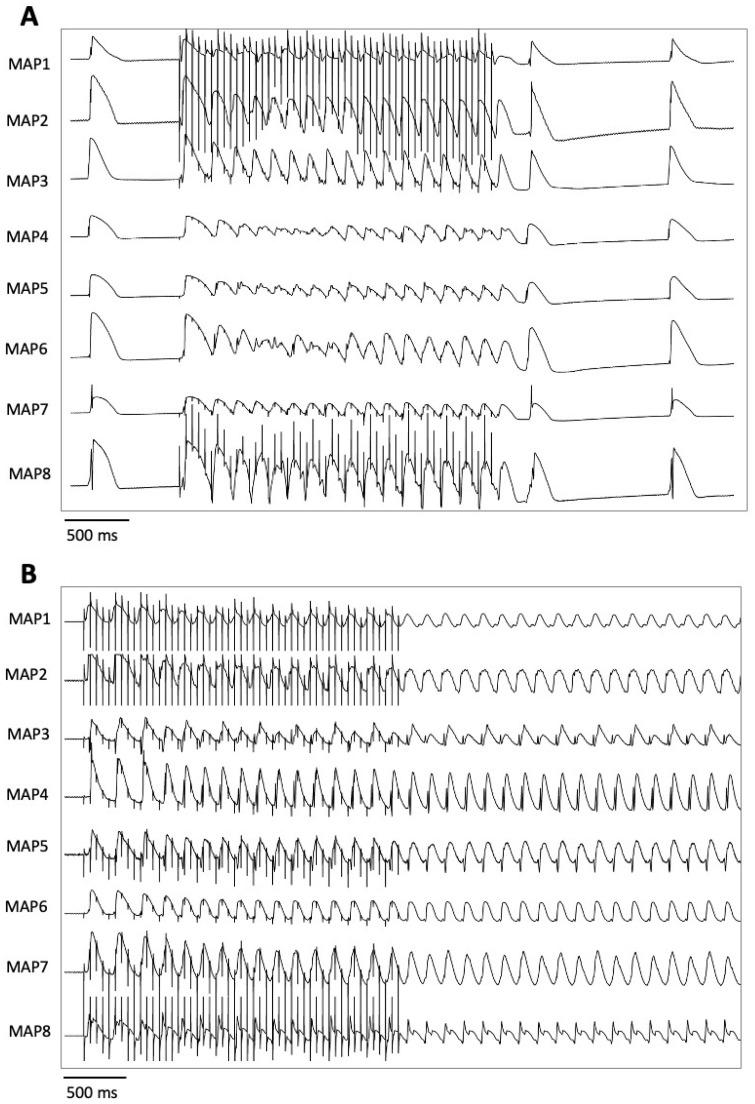
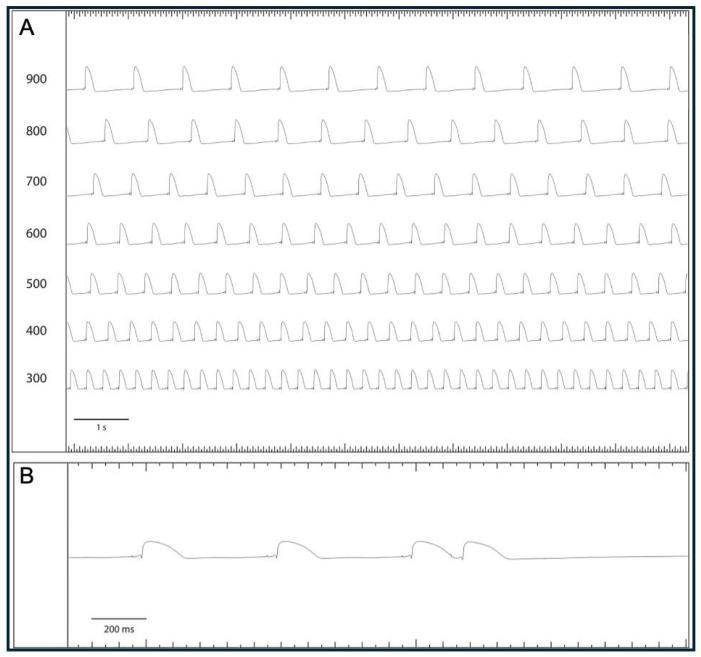
The two antiepileptic drugs lacosamide and lamotrigine exert their antiepileptic effect by inhibiting sodium channels. Lacosamide enhances the inactivation of sodium channels, while lamotrigine inhibits the activation of the channel. Interactions with sodium channels also play an interesting role in cardiac pro- and antiarrhythmia, with inhibition of inactivation, in particular, being regarded as potentially proarrhythmic. Therefore, the ventricular electrophysiologic effects of lacosamide and lamotrigine were investigated in an established experimental whole-heart model. A total of 67 rabbit hearts were allocated to four groups. Retrograde aortic perfusion was performed using the Langendorff setup. The action potential duration at 90% repolarization (APD), QT intervals, spatial dispersion of repolarization, effective refractory period, post-repolarization refractoriness, and VT incidence were determined. The electrophysiological effects of lacosamide and lamotrigine were investigated in increasing concentrations on the natively perfused heart. On the other hand, perfusion with the I-blocker sotalol was performed to increase arrhythmia susceptibility, followed by perfusion with lacosamide or lamotrigine to investigate the effects of both in a setting of increased arrhythmia susceptibility. Perfusion with lacosamide and lamotrigine tended to decrease APD and QT-interval. As expected, perfusion with sotalol led to a significant increase in APD, QT interval, and arrhythmia incidence. Additive perfusion with lacosamide led to a further increase in arrhythmia incidence, while additive perfusion with lamotrigine led to a decrease in VT incidence. In this model, lacosamide showed proarrhythmic effects, especially in the setting of an additive prolonged QT interval. Lamotrigine showed no significant proarrhythmia under baseline conditions and rather antiarrhythmic effects with additive QT prolongation.
两种抗癫痫药物拉科酰胺和拉莫三嗪通过抑制钠通道发挥抗癫痫作用。拉科酰胺增强钠通道的失活,而拉莫三嗪抑制通道的激活。与钠通道的相互作用在心脏促心律失常和抗心律失常中也发挥着有趣的作用,特别是抑制失活被认为具有潜在的促心律失常作用。因此,在一个成熟的实验性全心脏模型中研究了拉科酰胺和拉莫三嗪的心室电生理效应。总共67只兔心脏被分为四组。使用Langendorff装置进行逆行主动脉灌注。测定90%复极化时的动作电位时程(APD)、QT间期、复极化空间离散度、有效不应期、复极化后不应期和室性心动过速(VT)发生率。在天然灌注的心脏上,研究了拉科酰胺和拉莫三嗪在浓度增加时的电生理效应。另一方面,灌注β受体阻滞剂索他洛尔以增加心律失常易感性,然后灌注拉科酰胺或拉莫三嗪以研究两者在心律失常易感性增加情况下的作用。灌注拉科酰胺和拉莫三嗪倾向于缩短APD和QT间期。正如预期的那样,灌注索他洛尔导致APD、QT间期和心律失常发生率显著增加。加用拉科酰胺灌注导致心律失常发生率进一步增加,而加用拉莫三嗪灌注导致VT发生率降低。在该模型中,拉科酰胺显示出促心律失常作用,尤其是在QT间期延长叠加的情况下。拉莫三嗪在基线条件下未显示明显的促心律失常作用,在QT间期延长叠加时反而具有抗心律失常作用。



 Zotero 插件