
硝呋齐特和4-羟基苯腙衍生物作为新型抗寄生虫和抗菌剂。
Nifuroxazide and 4-Hydroxybenzhydrazone Derivatives as New Antiparasitic ( and ) and Anti- Agents.
作者信息
Delgado-Maldonado Timoteo, Navarrete-Carriola Diana V, Vázquez-Jiménez Lenci K, Paz-González Alma D, Wan Baojie, Franzblau Scott, Mohammed Othman Mueen, Rodríguez-Páez Lorena, Aguirre-Alvarado Charmina, Alcántara-Farfán Verónica, Cordero-Martínez Joaquín, Bandyopadhyay Debasish, Moreno-Rodríguez Adriana, Rivera Gildardo
机构信息
Laboratorio de Biotecnología Farmacéutica, Centro de Biotecnología Genómica, Instituto Politécnico Nacional, Reynosa 88710, Mexico.
Institute for Tuberculosis Research, College of Pharmacy, University of Illinois at Chicago, 833 S. Wood St., Chicago, IL 60612, USA.
出版信息
Pharmaceutics. 2025 May 7;17(5):621. doi: 10.3390/pharmaceutics17050621.
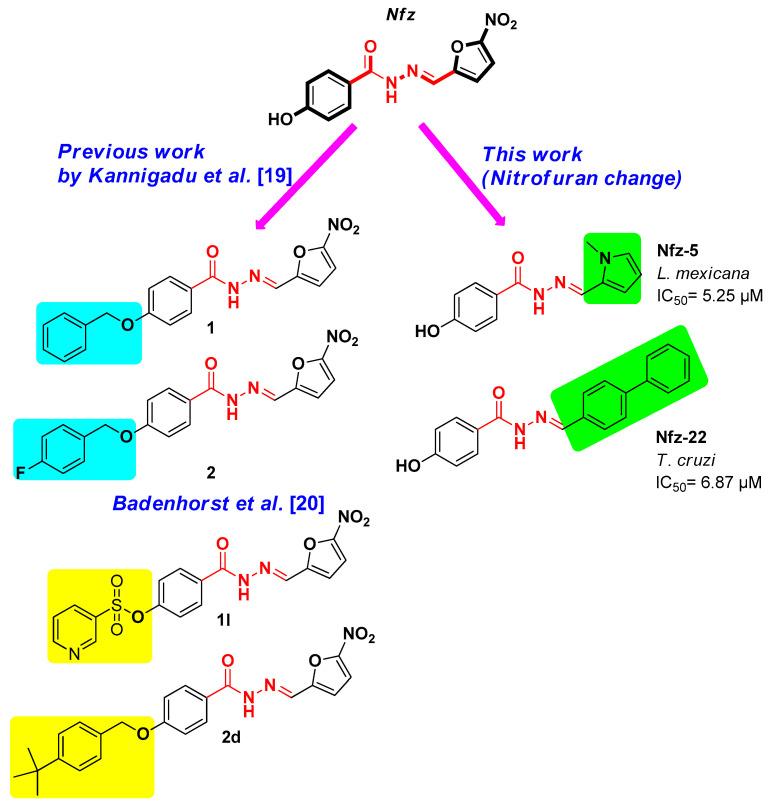
Nifuroxazide (Nfz) is a drug that has been used as a scaffold for designing antimicrobial and antiparasitic agents. This study aimed to synthesize and evaluate in vitro of Nfz and twenty-five 4-hydroxybenzhydrazone derivatives as potential anti-, anti-, and anti- agents. The compounds were synthesized by condensing 4-hydroxybenzhydrazide with appropriate aldehydes in acidic conditions and structurally confirmed by spectroscopic techniques. All compounds were evaluated in vitro against strains (NINOA and A1), (M379 and FCQEPS strains), and (H37Rv strain), followed by enzymatic assays against cysteine proteases. Compound (IC = 6.8 μM) had better trypanocidal activity than the reference drugs benznidazole (IC > 30 μM) and nifurtimox (IC > 7 μM) against the NINOA strain, and (IC = 7.2 μM) was the compound most active against the A1 strain with a high inhibition of cysteine proteases (IC = 4.6 μM) and low cytotoxic effects (CC >100 μM). On the other hand, compound (IC = 5.2 μM) had a 25-fold better leishmanicidal effect than glucantime (IC > 125 μM) against the M379 strain, and compound had the best leishmanicidal effects (IC = 10.2 μM) against the FCQEPS strain. Finally, , , and had minimum inhibitory concentration (MIC) values of 12.3, 5.1, and 18.8 μg/mL against , respectively. In summary, these results suggest that the compounds , , , , , , , and are candidates for further studies to develop new and more potent anti-, anti-leishmaniasis, and anti- agents.
硝呋柳氮(Nfz)是一种药物,已被用作设计抗菌和抗寄生虫药物的骨架。本研究旨在合成并体外评估Nfz和25种4-羟基苯腙衍生物作为潜在的抗[具体病原体1]、抗[具体病原体2]和抗[具体病原体3]药物。这些化合物是通过在酸性条件下将4-羟基苯甲酰肼与适当的醛缩合而成,并通过光谱技术进行结构确认。所有化合物均针对[具体病原体1]菌株(NINOA和A1)、[具体病原体2](M379和FCQEPS菌株)和[具体病原体3](H37Rv菌株)进行体外评估,随后针对[具体病原体1]半胱氨酸蛋白酶进行酶活性测定。化合物[具体编号1](IC = 6.8 μM)对NINOA菌株的杀锥虫活性优于参考药物苯硝唑(IC > 30 μM)和硝呋莫司(IC > 7 μM),化合物[具体编号2](IC = 7.2 μM)是对A1菌株活性最高的化合物,对[具体病原体1]半胱氨酸蛋白酶具有高抑制作用(IC = 4.6 μM)且细胞毒性低(CC >100 μM)。另一方面,化合物[具体编号3](IC = 5.2 μM)对M379菌株的杀利什曼原虫效果比葡糖胺锑(IC > 125 μM)好25倍,化合物[具体编号4]对FCQEPS菌株具有最佳的杀利什曼原虫效果(IC = 10.2 μM)。最后,[具体编号5]、[具体编号6]和[具体编号7]对[具体病原体3]的最低抑菌浓度(MIC)值分别为12.3、5.1和18.8 μg/mL。总之,这些结果表明化合物[具体编号1]、[具体编号2]、[具体编号3]、[具体编号4]、[具体编号5]、[具体编号6]、[具体编号7]和[具体编号8]是进一步研究开发新型、更有效的抗[具体病原体1]、抗利什曼病和抗[具体病原体3]药物的候选物。


 Zotero 插件