
限时进食作为一种间歇性禁食方法对轮班工人葡萄糖代谢的有效性:系统评价和荟萃分析。
The Effectiveness of Time-Restricted Eating as an Intermittent Fasting Approach on Shift Workers' Glucose Metabolism: A Systematic Review and Meta-Analysis.
作者信息
Koh Jia Ying Jennell, Tan Celine Yu Han, Li Meng, Liu Mei Hui, Chew Han Shi Jocelyn
机构信息
Alice Lee Centre for Nursing Studies, Yong Loo Lin School of Medicine, National University of Singapore, Singapore 117543, Singapore.
Department of Endocrinology and Metabolism, First Affiliated Hospital of Xi'an Jiaotong University, Xi'an 710061, China.
出版信息
Nutrients. 2025 May 15;17(10):1689. doi: 10.3390/nu17101689.
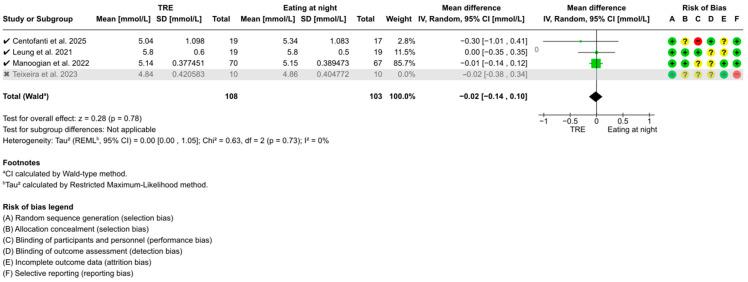
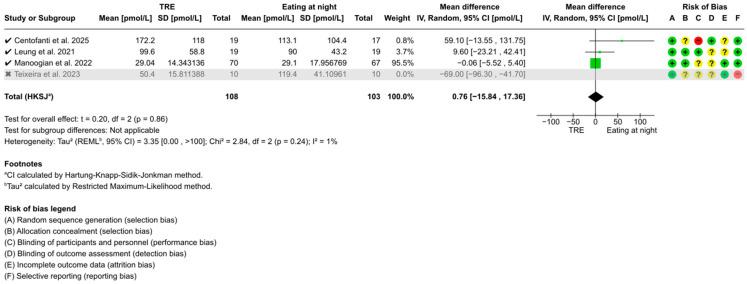
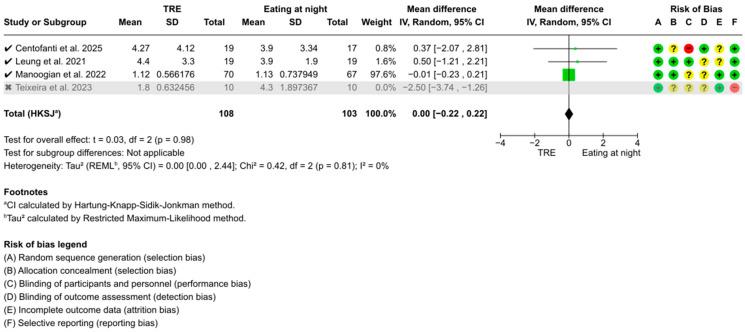
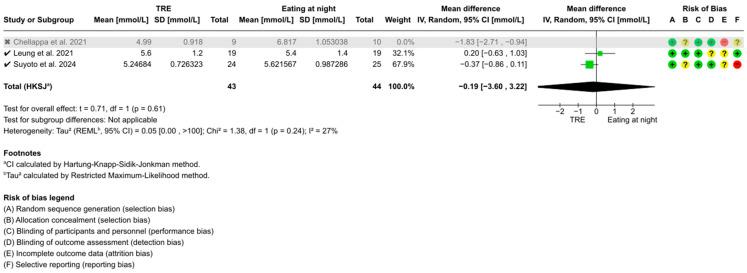
: Shift workers face higher risks of impaired glucose metabolism due to irregular eating habits and circadian misalignment. Time-restricted eating (TRE) could improve glucose metabolism by aligning food intake with the circadian clock, but its effectiveness remains unclear. : Ten electronic databases (PubMed, EMBASE, Cochrane Library, CINAHL, PsycINFO, Scopus, Web of Science, ProQuest Dissertations and Theses, Science.gov, and ClinicalTrials.gov) were searched from journal inception to September 2024. Only randomized controlled trials (RCTs) involving shift workers were included. Meta-analyses with sensitivity analyses were conducted using a random-effects model to pool glucose metabolism and sleep outcomes, with heterogeneity and quality assessments performed. : Six RCTs were included. TRE demonstrated positive but non-significant effects on glucose metabolism outcomes: fasting blood glucose (weighted mean difference [WMD]: -0.02 mmol/L, 95% confidence interval [CI]: -0.13 to 0.10, = 0%), fasting blood insulin (WMD: -5.77 pmol/L, 95% CI: -85.62 to 74.08, = 92%), HOMA-IR (WMD: -0.50, 95% CI: -2.76 to 1.76, = 82%), 2 h postprandial glucose (WMD: -0.65 mmol/L, 95% CI: -3.18 to 1.89, = 86%), total sleep time ( = 0.07, 95% CI: -0.23 to 0.37, = 0%), and sleep efficiency ( = -0.05, 95% CI: -0.63 to 0.53, = 62%). Sensitivity analyses yielded similar findings, and overall certainty of evidence was rated 'very low'. : While TRE shows potential for improving the glucose metabolism in shift workers, current evidence remains inconclusive due to small sample sizes and study limitations. Future research should prioritize well-powered TRE RCTs in shift workers that adhere to a 6-10 h eating window. Incorporating early-TRE schedules with sleep hygiene may optimize metabolic outcomes, with circadian biomarkers analyzed to better elucidate the mechanistic pathway implicated.
轮班工作者由于饮食习惯不规律和昼夜节律失调,面临着葡萄糖代谢受损的更高风险。限时进食(TRE)可以通过使食物摄入与昼夜节律同步来改善葡萄糖代谢,但其有效性仍不明确。
从创刊到2024年9月,检索了十个电子数据库(PubMed、EMBASE、Cochrane图书馆、CINAHL、PsycINFO、Scopus、科学网、ProQuest学位论文库、Science.gov和ClinicalTrials.gov)。仅纳入涉及轮班工作者的随机对照试验(RCT)。使用随机效应模型进行荟萃分析及敏感性分析,以汇总葡萄糖代谢和睡眠结果,并进行异质性和质量评估。
纳入了六项RCT。TRE对葡萄糖代谢结果显示出积极但不显著的影响:空腹血糖(加权平均差[WMD]:-0.02 mmol/L,95%置信区间[CI]:-0.13至0.10,I² = 0%)、空腹血胰岛素(WMD:-5.77 pmol/L,95% CI:-85.62至74.08,I² = 92%)、稳态模型评估的胰岛素抵抗(HOMA-IR)(WMD:-0.50,95% CI:-2.76至1.76,I² = 82%)、餐后2小时血糖(WMD:-0.65 mmol/L,95% CI:-3.18至1.89,I² = 86%)、总睡眠时间(I² = 0.07,95% CI:-0.23至0.37,I² = 0%)和睡眠效率(I² = -0.05,95% CI:-0.63至0.53,I² = 62%)。敏感性分析得出了类似的结果,证据的总体确定性被评为“非常低”。
虽然TRE显示出改善轮班工作者葡萄糖代谢的潜力,但由于样本量小和研究局限性,目前的证据仍然不确定。未来的研究应优先在轮班工作者中开展有足够效力的TRE RCT,坚持6至10小时的进食窗口。将早期TRE时间表与睡眠卫生相结合可能会优化代谢结果,分析昼夜生物标志物以更好地阐明其中涉及的机制途径。



 Zotero 插件