
安大略省居家新冠临床初级护理路径的实施与评估。
The implementation and evaluation of the Ontario COVID@Home Clinical Primary Care Pathway.
作者信息
Mangin Dee, Salerno Jennifer, Clark Rebecca, Datta Julie, Lawson Jennifer, Dempsey Mara, Elston Dawn, Hafid Shuaib, Price David, Kaplan David, Risdon Cathy, Irvin Casey, Beaulieu Erin
机构信息
Department of Family Medicine, Faculty of Health Sciences, McMaster University, David Braley Health Sciences Centre, 100 Main Street West, Hamilton, Ontario L8P 1H6, Canada.
Department of General Practice, University of Otago, 2 Riccarton Avenue, Christchurch 8140, New Zealand.
出版信息
Fam Pract. 2025 Apr 12;42(3). doi: 10.1093/fampra/cmaf022.
BACKGROUND
The COVID@Home Clinical Care Pathway (the Pathway) was developed and implemented as an evidence-based remote monitoring clinical care pathway for the integrated management of coronavirus disease 2019 (COVID-19) in the province of Ontario, Canada. We examine its effectiveness and rapid large-scale implementation.
METHODS
Using a prospective longitudinal study design, we used electronic medical record clinical data, provider and patient surveys, web analytics, healthcare and provincial utilization, and government holdings data to evaluate reach, effectiveness, adoption, implementation, and maintenance outcomes, including patient mortality and health equity.
RESULTS
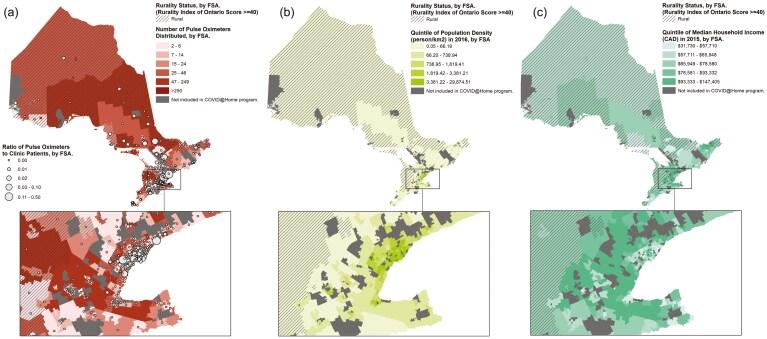
The Pathway was widely accessed (19 474 Ontario unique users), contributed 28 816 oxygen saturation monitors, and achieved coverage across income levels and geography. Two-thirds of patients had > 1 encounter, monitored for a median of 4 days (Range: 1-57). Fifty percent of patients had > 1 chronic condition. Patients receiving Pathway care were less likely to die by 0.44% (20/4556), two times lower compared to the total mortality of a population-based representative patient cohort over a parallel time period in Ontario of 0.86% (1820/212 326, P = .0023). Patients were very satisfied with their care, and felt care was accessible, safe, and clear. Providers were very satisfied with the Pathway resources and reported strengthened relationships across the health system.
CONCLUSIONS
Primary care (PC) rapidly implemented a clinical care pathway during the COVID-19 crisis. The Pathway demonstrated the beneficial role and effectiveness of PC when patients are provided with timely, accessible, and comprehensive care. Public health responses should explicitly collaborate with PC to address population health.
背景
“居家抗疫临床护理路径”(以下简称“路径”)是作为一种基于证据的远程监测临床护理路径而制定和实施的,用于加拿大安大略省对2019冠状病毒病(COVID-19)进行综合管理。我们对其有效性和快速大规模实施情况进行了研究。
方法
采用前瞻性纵向研究设计,我们使用电子病历临床数据、提供者和患者调查、网络分析、医疗保健和省级利用情况以及政府持有数据,以评估覆盖范围、有效性、采用情况、实施情况和维持结果,包括患者死亡率和健康公平性。
结果
该“路径”被广泛访问(19474名安大略省独立用户),提供了28816台血氧饱和度监测仪,并实现了不同收入水平和地域的覆盖。三分之二的患者有超过1次就诊,监测时间中位数为4天(范围:1 - 57天)。50%的患者患有超过1种慢性病。接受“路径”护理的患者死亡可能性降低0.44%(20/4556),与安大略省同期基于人群的代表性患者队列0.86%(1820/212326)相比,降低了两倍(P = 0.0023)。患者对其护理非常满意,并认为护理可及、安全且清晰。提供者对“路径”资源非常满意,并报告称整个卫生系统内的关系得到了加强。
结论
在COVID-19危机期间,初级保健迅速实施了临床护理路径。当为患者提供及时、可及且全面的护理时,该“路径”展示了初级保健的有益作用和有效性。公共卫生应对措施应与初级保健明确协作以解决人群健康问题。

 Zotero 插件