
阿拉伯联合酋长国大学生能量饮料消费的患病率、知识与态度:一项横断面研究。
Prevalence, Knowledge, and Attitudes of Energy Drink Consumption Among University Students in the United Arab Emirates: A Cross-Sectional Study.
作者信息
Faqeeh Shooq, Mansour Saif Eddin, Darwish Raghd, Alhariri Nafe, Alsebai Haya, Alkalbani Khulood, Saleh Mohamed A, Hussein Amal
机构信息
Clinical Sciences Department, College of Medicine, University of Sharjah, Sharjah, ARE.
Family and Community Medicine Department, College of Medicine, University of Sharjah, Sharjah, ARE.
出版信息
Cureus. 2025 Apr 27;17(4):e83073. doi: 10.7759/cureus.83073. eCollection 2025 Apr.
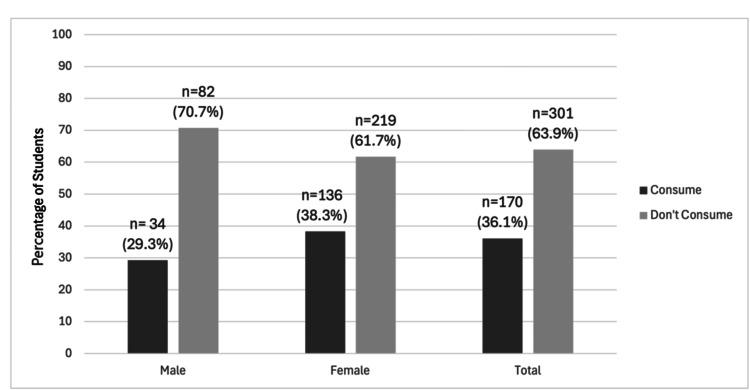
Background The consumption of energy drinks (EDs) among university students in the United Arab Emirates (UAE) has not been extensively studied. Therefore, this cross-sectional study aimed to investigate the prevalence, attitudes, and knowledge regarding EDs among university students in the UAE. Objective The primary objective of this study was to evaluate the prevalence, attitudes, motives, consumption patterns, and practices toward ED consumption among university students in the UAE. Furthermore, knowledge levels of ingredients and side effects were assessed. Methods This cross-sectional study was conducted via non-probability volunteer sampling to collect data from undergraduate university students in the UAE between February and April 2022. An online self-administered questionnaire was developed for data collection, and data were analyzed using IBM SPSS Statistics for Windows, version 28.0 (IBM Corp., Armonk, NY). Results A total of 471 participants completed the survey, of whom 355 (75.4%) were female. In all, 170 (36.1%) participants were current ED consumers, and taurine and caffeine-based EDs were the most commonly consumed type (n = 107, 62%). No participants displayed good knowledge of ingredients present in EDs; however, 234 (49.7%) demonstrated good knowledge of their potential side effects. Gender was significantly associated with the frequency of ED consumption (p = 0.027), and younger students (<18 years) were 2.36 times more likely to be consumers of EDs (confidence interval = 95%). Conclusion These results highlight insufficient knowledge and poor practices regarding proper ED consumption, despite a significant portion of university students being consumers. There is a need for interventions that increase awareness about the potential negative effects of ED consumption among university students in the UAE. Our findings also suggest that younger students may be more susceptible to consuming EDs, indicating a need for targeted interventions aimed at this population. Overall, this study provides valuable insight into the prevalence, attitudes, and knowledge of ED consumption among university students in the UAE.
背景
阿拉伯联合酋长国(阿联酋)大学生对能量饮料的消费情况尚未得到广泛研究。因此,这项横断面研究旨在调查阿联酋大学生中能量饮料的流行情况、态度和相关知识。
目的
本研究的主要目的是评估阿联酋大学生对能量饮料消费的流行情况、态度、动机、消费模式及行为。此外,还评估了他们对能量饮料成分和副作用的了解程度。
方法
本横断面研究通过非概率自愿抽样进行,于2022年2月至4月收集阿联酋大学生的数据。为此开发了一份在线自填式问卷,并使用IBM SPSS Statistics for Windows 28.0版(IBM公司,纽约州阿蒙克)对数据进行分析。
结果
共有471名参与者完成了调查,其中355名(75.4%)为女性。总体而言,170名(36.1%)参与者目前正在饮用能量饮料,以牛磺酸和咖啡因为主的能量饮料是最常饮用的类型(n = 107,62%)。没有参与者对能量饮料中的成分有充分了解;然而,234名(49.7%)参与者对其潜在副作用有充分了解。性别与能量饮料消费频率显著相关(p = 0.027),年龄较小的学生(<18岁)饮用能量饮料的可能性是其他学生的2.36倍(95%置信区间)。
结论
这些结果表明,尽管有相当一部分大学生饮用能量饮料,但他们对能量饮料的正确消费知识不足且行为不当。有必要采取干预措施,提高阿联酋大学生对饮用能量饮料潜在负面影响的认识。我们的研究结果还表明,年龄较小的学生可能更容易饮用能量饮料,这表明需要针对这一人群进行有针对性的干预。总体而言,本研究为阿联酋大学生能量饮料消费的流行情况、态度和知识提供了有价值的见解。

 Zotero 插件