
骨骼健康:质量与数量
Bone health: Quality versus quantity.
作者信息
Docaj Anxhela, Carriero Alessandra
机构信息
Department of Biomedical Engineering, The City College of New York, New York, NY, USA.
出版信息
J Pediatr Soc North Am. 2024 Apr 7;7:100054. doi: 10.1016/j.jposna.2024.100054. eCollection 2024 May.
UNLABELLED
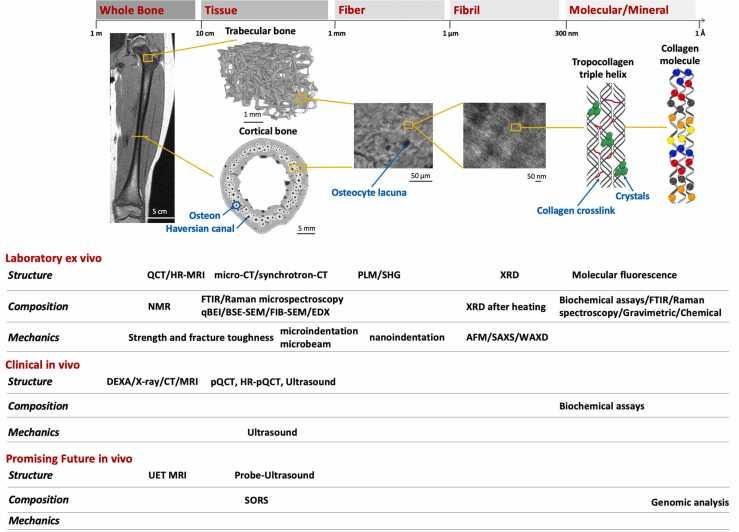
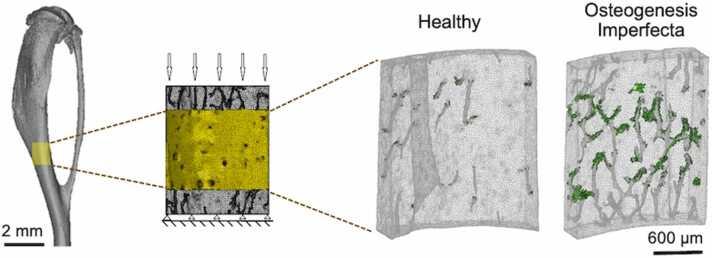
Healthy bone has the ability to resist deformation and fracture while adapting to applied mechanical loads. These properties of bone depend on characteristics of its extracellular matrix. This review focuses on the contribution of bone quality and quantity to bone health and highlights current and promising future clinical approaches to measure bone health in the pediatric population. Bone's unique material properties are derived from its highly organized, hierarchical composite structure, together with its modeling and remodeling dynamics and microdamage mechanisms. Pediatric bone diseases and disorders affect the biological processes that regulate its quality, negatively impacting the extracellular matrix and causing bone fragility. Laboratory bone analysis from human biopsies or animal models of human bone diseases allows high detail examination of the mechanisms contributing to bone fragility. Conversely, clinical measurements of bone fragility are difficult and limited due to the inaccessibility of the material. Because bone quality directly affects fracture resistance, both structure and composition should be used in fracture risk calculation rather than bone mineral density or bone quantity alone. Thus, to advance clinical evaluation of bone fragility, future studies are needed to determine which characteristics of bone quality can be applied to clinical practice to predict bone fragility. New and effective clinical tools are needed to predict fracture risk taking bone quality into consideration.
KEY CONCEPTS
(1)Bone quality and bone quantity are both fundamental for resistance to deformity and fracture.(2)Pediatric bone diseases and disorders alter bone's composition and structure, compromising bone quality and increasing vulnerability to fracture.(3)Current clinical approaches to assess bone fragility and fracture risk rely mainly on bone quantity measurements from DEXA scans.(4)DEXA bone mineral density poorly correlates with bone's resistance to fracture, both in adults and children.(5)Future clinical approaches to measure bone health should account for bone quality in order to predict fracture risk.
未标注
健康的骨骼能够在适应施加的机械负荷的同时抵抗变形和骨折。骨骼的这些特性取决于其细胞外基质的特征。本综述重点关注骨质量和骨量对骨骼健康的贡献,并强调当前和未来有望用于测量儿科人群骨骼健康的临床方法。骨骼独特的材料特性源于其高度有序的分层复合结构,以及其建模、重塑动力学和微损伤机制。儿科骨骼疾病会影响调节其质量的生物学过程,对细胞外基质产生负面影响并导致骨骼脆弱。对人类活检或人类骨骼疾病动物模型进行实验室骨骼分析,可以对导致骨骼脆弱的机制进行高度详细的检查。相反,由于材料难以获取,骨骼脆弱性的临床测量既困难又有限。由于骨质量直接影响抗骨折能力,因此在骨折风险计算中应同时使用结构和成分,而不是仅使用骨矿物质密度或骨量。因此,为了推进骨骼脆弱性的临床评估,未来的研究需要确定哪些骨质量特征可应用于临床实践以预测骨骼脆弱性。需要新的有效临床工具来在考虑骨质量的情况下预测骨折风险。
关键概念
(1)骨质量和骨量对于抵抗畸形和骨折都至关重要。(2)儿科骨骼疾病会改变骨骼的组成和结构,损害骨质量并增加骨折易感性。(3)当前评估骨骼脆弱性和骨折风险的临床方法主要依赖于双能X线吸收法(DEXA)扫描测量骨量。(4)DEXA骨矿物质密度与成人和儿童骨骼的抗骨折能力相关性较差。(5)未来测量骨骼健康的临床方法应考虑骨质量以预测骨折风险。





 Zotero 插件