
一项旨在减少儿童肱骨髁上骨折手术治疗后阿片类药物处方的质量改进举措。
A Quality Improvement Initiative to Reduce Opioid Prescriptions Following Surgical Treatment of Supracondylar Humerus Fractures in Children.
作者信息
Rupp Garrett E, Langner Joanna L, Manhard Claire E, Bryl Amy, Upasani Vidyadhar V
机构信息
University of California, San Diego, San Diego, CA.
Department of Orthopedic Surgery, Rady Children's Hospital, San Diego, CA.
出版信息
J Pediatr Soc North Am. 2024 Feb 12;5(3):696. doi: 10.55275/JPOSNA-2023-696. eCollection 2023 Aug.
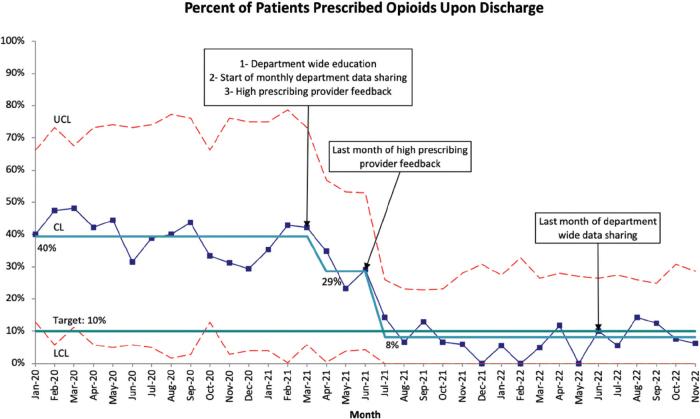
Opioid abuse and overdose are in epidemic range in the United States and medical prescriptions, including those for postoperative analgesia, are a large contributing source to this misuse. Our quality improvement initiative aimed to reduce the opioid prescribing of pediatric orthopaedic surgeons in the postoperative setting. The aim was to decrease the percentage of children with surgically treated supracondylar humerus (SCH) fractures who are prescribed opioid medications at discharge from a baseline of 40% to 10% within 6 months. The study took place at an urban level 1 trauma center at a children's hospital. The orthopaedic team completed closed reduction and percutaneous pinning for SCH fractures over a 14-month baseline period. Forty percent of these patients were discharged with an opioid prescription. After assessing baseline prescription rates, a multidisciplinary team of health professionals developed a key driver diagram. Primary interventions included orthopaedic department-wide pain management education, reporting of prescription rates during monthly conferences, and provider-specific feedback. The primary measure was the percentage of patients prescribed opioids upon discharge following closed reduction and percutaneous pinning of Type II and III SCH fractures. As a balancing measure, we tracked the use of a 24-hour nurse triage line for pain-related follow-up in the intervention period. We used statistical process control to examine changes in measures over time. The percentage of patients receiving opioid prescriptions upon discharge following surgically treated SCH fractures decreased from 40% to 8% over 5 months and sustained for an additional 16 months. Through provider education, feedback, and regular reporting, we decreased the number of pediatric patients with surgically treated SCH fractures that were discharged with any opioid prescription by 80% over 5 months while ensuring adequate pain control via postoperative follow-up visits and tracking calls to our nurse triage line.
在美国,阿片类药物滥用和过量使用已达到流行程度,而包括术后镇痛处方在内的医疗处方是这种滥用的一个主要促成来源。我们的质量改进计划旨在减少小儿骨科医生在术后开具阿片类药物的情况。目标是将接受手术治疗的肱骨髁上骨折(SCH)患儿出院时开具阿片类药物的比例在6个月内从基线的40%降至10%。该研究在一家儿童医院的城市一级创伤中心进行。骨科团队在14个月的基线期内完成了对SCH骨折的闭合复位和经皮穿针固定。这些患者中有40%出院时开具了阿片类药物处方。在评估基线处方率后,一个由健康专业人员组成的多学科团队绘制了关键驱动因素图。主要干预措施包括全骨科部门的疼痛管理教育、在月度会议上报告处方率以及针对医生的具体反馈。主要衡量指标是II型和III型SCH骨折闭合复位和经皮穿针固定后出院时开具阿片类药物的患者百分比。作为一项平衡措施,我们在干预期跟踪了用于疼痛相关随访的24小时护士分诊热线的使用情况。我们使用统计过程控制来检查各项指标随时间的变化。接受手术治疗的SCH骨折患者出院时接受阿片类药物处方的百分比在5个月内从40%降至8%,并在接下来的16个月内保持这一水平。通过对医生的教育、反馈和定期报告我们在5个月内将接受手术治疗的SCH骨折出院时开具任何阿片类药物处方的小儿患者数量减少了80%,同时通过术后随访和对我们护士分诊热线的跟踪呼叫确保了充分的疼痛控制。

 Zotero 插件