
利用消减基因组学鉴定新型药物靶点和针对……的新免疫原性候选物:一项……研究
Exploiting subtractive genomics to identify novel drug targets and new immunogenic candidates against : an study.
作者信息
Khazani Asforooshani Mahshid, Noori Goodarzi Narjes, Shahbazi Behzad, Rezaie Rahimi Nayereh, Mahdavian Kimia, Rohani Mahdi, Badmasti Farzad
机构信息
Department of Bacteriology, Pasteur Institute of Iran, Tehran, Iran.
Department of Microbiology, Faculty of Biological Sciences, Alzahra University, Tehran, Iran.
出版信息
Front Bioinform. 2025 May 13;5:1570054. doi: 10.3389/fbinf.2025.1570054. eCollection 2025.
BACKGROUND
, the causative agent of whooping cough, remains a significant global health concern despite the widespread availability of vaccines. The persistent reemergence of pertussis is driven by the bacterium's ongoing genomic evolution, shifting epidemiological patterns, and limitations in current vaccine strategies. These challenges highlight the urgent need to identify novel drug targets and immunogenic candidates to enhance therapeutic and preventive measures against .
METHODS
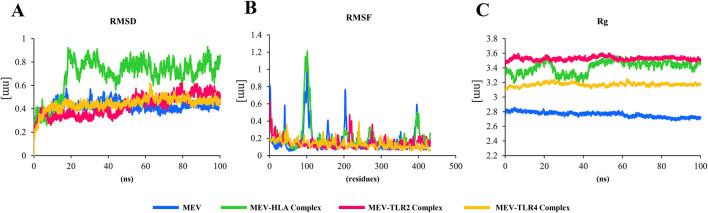
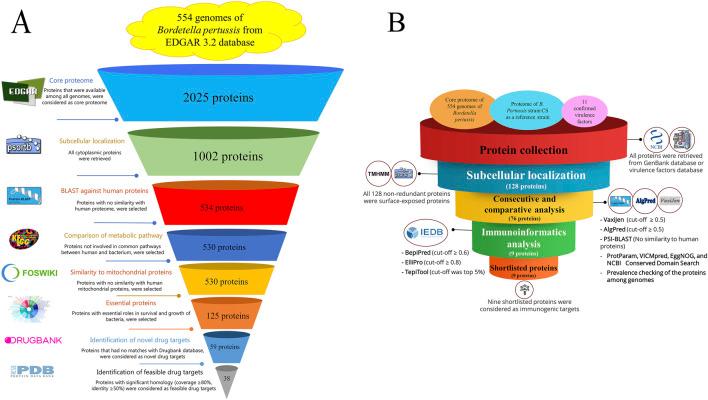
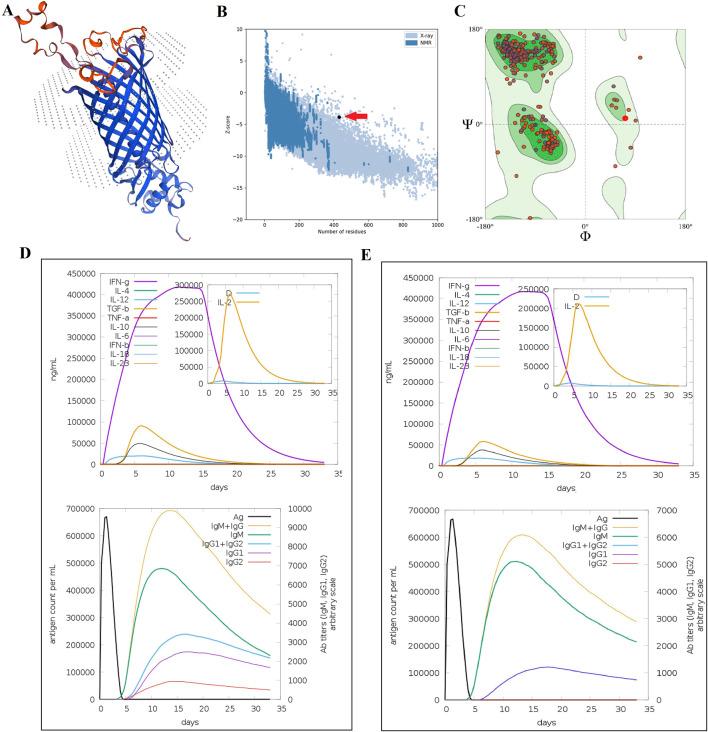
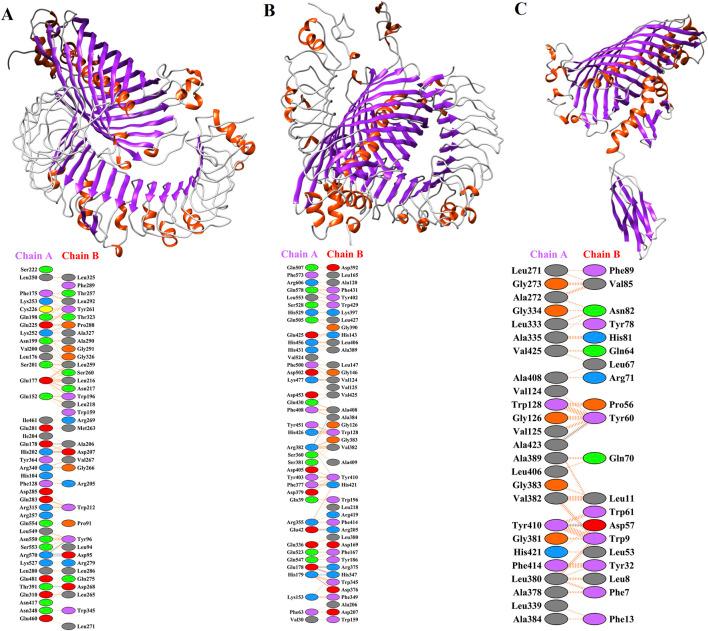
Identification of novel drug targets and the detection of immunogenic factors as potential vaccine candidates were performed. Cytoplasmic proteins were evaluated for their similarity to the human proteome, metabolic pathways, and gut microbiota. On the other hand, surface-exposed proteins were evaluated as immunogenic targets using a reverse vaccinology approach. A multi-epitope vaccine (MEV) was designed based on the immunogenic linear B-cell epitopes of three autotransporters and the beta domain of SphB2 as a scaffold for MEV. Molecular docking, immune simulation results, and molecular dynamics simulations were performed to evaluate the binding affinity and feasibility of interaction between chimeric MEVs and immune receptors.
RESULTS
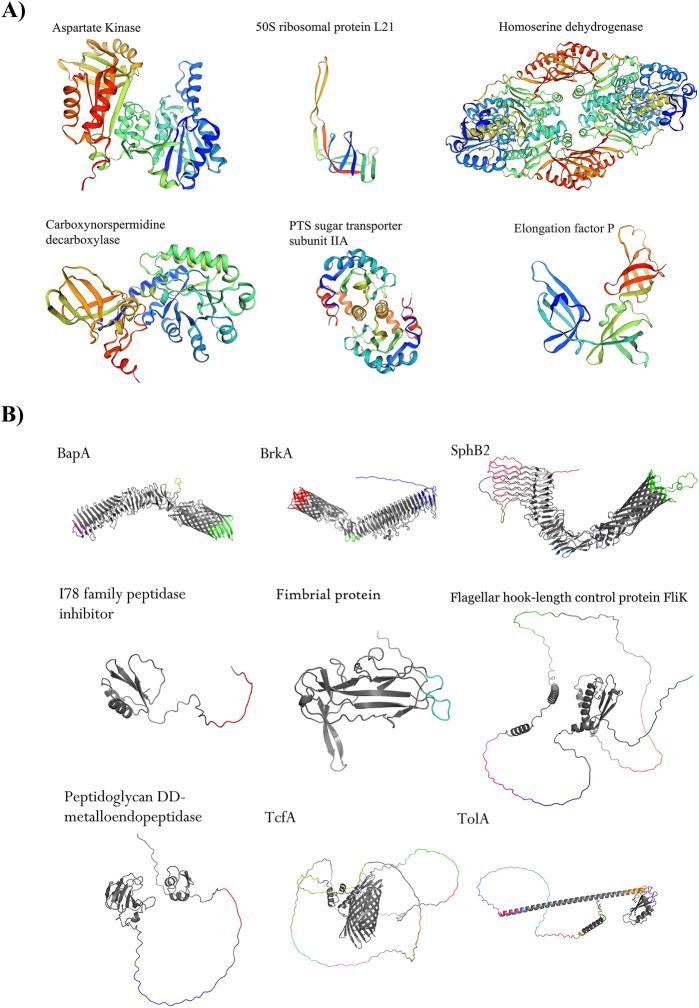
Six proteins were identified as excellent potential drug targets, including elongation factor P (WP_003810194.1), Aspartate kinase (WP_010930633.1), 50S ribosomal protein L21 (WP_003807462.1), Homoserine dehydrogenase (WP_003813074.1), Carboxynorspermidine decarboxylase (WP_003814461.1), and PTS sugar transporter subunit IIA (WP_010929966.1). On the other hand, reverse vaccinology identified nine immunogenic proteins, including BapA (WP_010930805.1), BrkA (WP_010931506.1), SphB2 (WP_041166323.1), TcfA (WP_010930243.1), FliK (WP_041166144.1), Fimbrial protein (WP_010930199.1), TolA (WP_010931418.1), DD-metalloendopeptidase (WP_003811022.1), and an I78 family peptidase inhibitor protein (WP_003812179.1). SphB2-based MEV was designed using six linear B-cell epitopes of the extracellular loops of the autotransporters. The binding affinity and feasibility of the interaction between MEV and TLR2, TLR4, and HLA-DR-B were computationally confirmed by molecular dynamics.
CONCLUSION
It appears that proteins involved in translation and metabolism can be considered novel drug targets. Furthermore, this study highlights autotransporter proteins as promising immune targets. There is no doubt that experimental work should be conducted to confirm the results in the future.
背景
百日咳杆菌作为百日咳的病原体,尽管疫苗已广泛可得,但仍然是全球重大的健康问题。百日咳的持续再现是由该细菌持续的基因组进化、流行病学模式的变化以及当前疫苗策略的局限性所驱动的。这些挑战凸显了迫切需要识别新的药物靶点和免疫原性候选物,以加强针对百日咳杆菌的治疗和预防措施。
方法
进行了新药物靶点的鉴定以及作为潜在疫苗候选物的免疫原性因子的检测。评估了细胞质蛋白与人蛋白质组、代谢途径和肠道微生物群的相似性。另一方面,使用反向疫苗学方法将表面暴露蛋白评估为免疫原性靶点。基于三种自转运蛋白的免疫原性线性B细胞表位以及SphB2的β结构域作为多表位疫苗(MEV)的支架,设计了一种多表位疫苗。进行了分子对接、免疫模拟结果和分子动力学模拟,以评估嵌合MEV与免疫受体之间相互作用的结合亲和力和可行性。
结果
鉴定出六种蛋白质为优秀的潜在药物靶点,包括延伸因子P(WP_003810194.1)、天冬氨酸激酶(WP_010930633.1)、50S核糖体蛋白L21(WP_003807462.1)、高丝氨酸脱氢酶(WP_003813074.1)、羧基去甲精胺脱羧酶(WP_003814461.1)和磷酸转移酶系统糖转运亚基IIA(WP_010929966.1)。另一方面,反向疫苗学鉴定出九种免疫原性蛋白,包括BapA(WP_010930805.1)、BrkA(WP_010931506.1)、SphB2(WP_041166323.1)、TcfA(WP_010930243.1)、FliK(WP_041166144.1)、菌毛蛋白(WP_010930199.1)、TolA(WP_010931418.1)、DD-金属内肽酶(WP_003811022.1)和一种I78家族肽酶抑制剂蛋白(WP_003812179.1)。基于SphB2的MEV是使用自转运蛋白细胞外环的六个线性B细胞表位设计的。通过分子动力学从计算上证实了MEV与TLR2、TLR4和HLA-DR-B之间相互作用的结合亲和力和可行性。
结论
参与翻译和代谢的蛋白质似乎可被视为新的药物靶点。此外,本研究突出了自转运蛋白作为有前景的免疫靶点。毫无疑问,未来应开展实验工作以证实这些结果。
 Zotero 插件