
从实验室到临床:胃肠道干细胞在健康与疾病中的作用
From bench to bedside: the role of gastrointestinal stem cells in health and disease.
作者信息
Bai Xiaopeng, Ihara Eikichi, Tanaka Yoshimasa, Minoda Yosuke, Wada Masafumi, Hata Yoshitaka, Esaki Mitsuru, Ogino Haruei, Chinen Takatoshi, Ogawa Yoshihiro
机构信息
Department of Medicine and Bioregulatory Science, Graduate School of Medical Sciences, Kyushu University, Fukuoka, Japan.
Faculty of Health Sciences Farncombe Family Digestive Health Research Institute, McMaster University, Hamilton, Canada.
出版信息
Inflamm Regen. 2025 May 28;45(1):15. doi: 10.1186/s41232-025-00378-1.
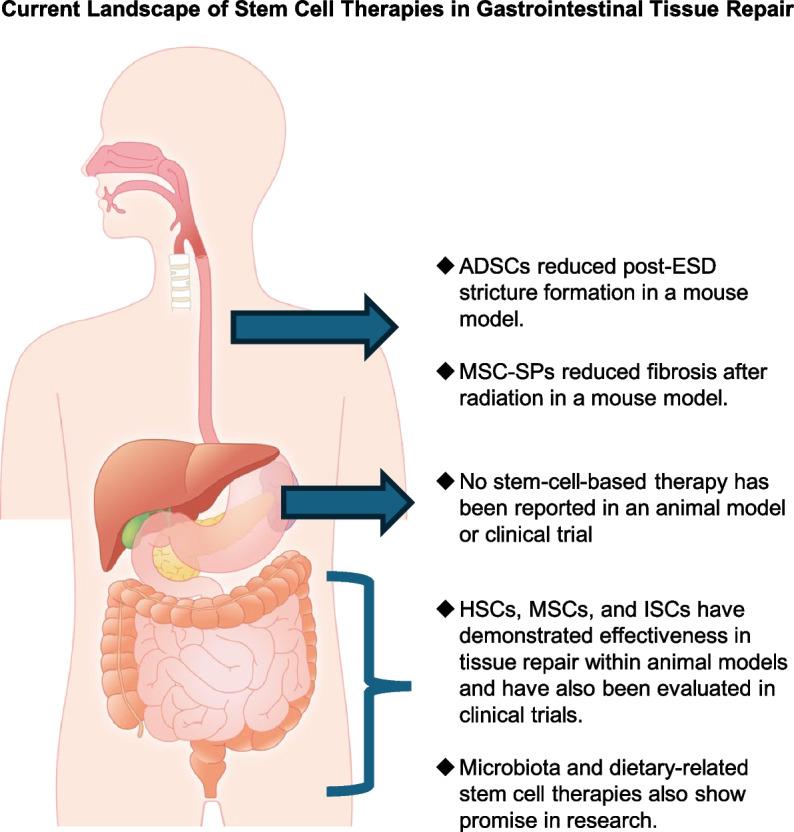
The gastrointestinal (GI) tract constitutes a sophisticated system integral to digestion, nutrient absorption, and overall health, with its functionality predominantly hinging on the distinctive properties of diverse stem cell types. This review systematically investigates the pivotal roles of stem cells across the esophagus, stomach, small intestine, and colon, emphasizing their crucial contributions to tissue homeostasis, repair mechanisms, and regeneration. Each segment of the GI tract is characterized by specialized stem cell populations that exhibit distinct functional attributes, highlighting the necessity for tailored therapeutic approaches in the management of gastrointestinal disorders.Emerging research has shed light on the functional heterogeneity of GI stem cells, with ISCs in the small intestine displaying remarkable turnover rates and regenerative potential, whereas colonic stem cells (CSCs) are essential for the preservation of the colonic epithelial barrier. The intricate interplay between stem cells and their microenvironment-or niche-is fundamentally important for their functionality, with critical signaling pathways such as Wnt and Notch exerting substantial influence over stem cell behavior. The advent of organoid models derived from GI stem cells offers promising avenues for elucidating disease mechanisms and for the preclinical testing of novel therapeutic interventions.Despite notable advancements in foundational research on GI stem cells, the translation of these scientific discoveries into clinical practice remains limited. As of 2025, Japan's clinical GI disease guidelines do not endorse any stem cell-based therapies, underscoring the existing disconnect between research findings and clinical application. This scenario accentuates the urgent need for sustained efforts to bridge this divide and to cultivate innovative strategies that synergize stem cell technology with conventional treatment modalities.Future investigations should be directed toward unraveling the mechanisms that underpin stem cell dysfunction in various gastrointestinal pathologies, as well as exploring combination therapies that harness the regenerative capacities of stem cells in conjunction with immunomodulatory treatments. By fostering collaborative endeavors between basic researchers and clinical practitioners, we can deepen our understanding of GI stem cells and facilitate the translation of this knowledge into effective therapeutic interventions, ultimately enhancing patient outcomes in gastrointestinal diseases.
胃肠道(GI)系统是一个复杂的体系,对消化、营养吸收和整体健康至关重要,其功能主要取决于不同类型干细胞的独特特性。本综述系统地研究了干细胞在食管、胃、小肠和结肠中的关键作用,强调了它们对组织稳态、修复机制和再生的重要贡献。胃肠道的每个部分都有特定的干细胞群体,这些群体具有不同的功能特性,这突出了在胃肠道疾病管理中采用针对性治疗方法的必要性。新兴研究揭示了胃肠道干细胞的功能异质性,小肠中的肠干细胞(ISCs)显示出显著的更新率和再生潜力,而结肠干细胞(CSCs)对于维持结肠上皮屏障至关重要。干细胞与其微环境(即生态位)之间的复杂相互作用对其功能至关重要,诸如Wnt和Notch等关键信号通路对干细胞行为有重大影响。源自胃肠道干细胞的类器官模型的出现为阐明疾病机制和新型治疗干预措施的临床前测试提供了有希望的途径。尽管在胃肠道干细胞的基础研究方面取得了显著进展,但这些科学发现转化为临床实践的程度仍然有限。截至2025年,日本的临床胃肠道疾病指南不认可任何基于干细胞的疗法,这凸显了研究结果与临床应用之间目前存在的脱节。这种情况突出了迫切需要持续努力弥合这一差距,并制定创新策略,将干细胞技术与传统治疗方式相结合。未来的研究应致力于揭示各种胃肠道疾病中干细胞功能障碍的机制,以及探索利用干细胞再生能力与免疫调节治疗相结合的联合疗法。通过促进基础研究人员和临床医生之间的合作努力,我们可以加深对胃肠道干细胞的理解,并促进将这些知识转化为有效的治疗干预措施,最终改善胃肠道疾病患者的治疗效果。
 Zotero 插件