
BTP2不依赖于储存式钙内流来限制图兰病毒和人诺如病毒的复制。
BTP2 restricts Tulane virus and human norovirus replication independent of store-operated calcium entry.
作者信息
Scribano Francesca J, Gebert J Thomas, Engevik Kristen A, Hayes Nicole M, Villanueva Jorge, Pham Son, Kaundal Soni, Dave Janam J, Prasad B V Venkataram, Estes Mary K, Ramani Sasirekha, Hyser Joseph M
机构信息
Department of Molecular Virology and Microbiology, Baylor College of Medicine, Houston, Texas, USA.
Alkek Center for Metagenomics & Microbiome Research, Baylor College of Medicine, Houston, Texas, USA.
出版信息
J Virol. 2025 Jun 17;99(6):e0044425. doi: 10.1128/jvi.00444-25. Epub 2025 May 29.
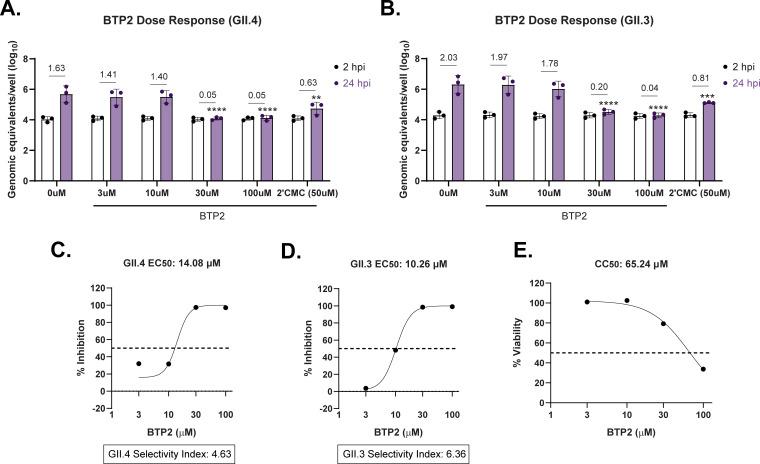
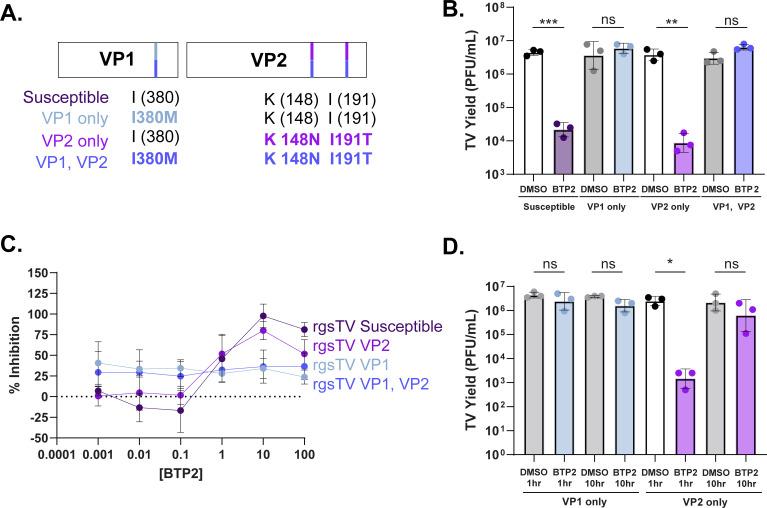
Human norovirus is the leading cause of viral gastroenteritis across all age groups. While there is a need for human norovirus antivirals, therapeutic development has been hindered by a lack of cell culture systems and animal models of infection. Surrogate viruses, such as Tulane virus (TV), have provided tractable systems to screen potential antiviral compounds. Our previous work demonstrated that TV encodes a viral ion channel, which dysregulates cytosolic calcium signaling. We set out to investigate whether host pathways triggered by viral ion channel activity, including store-operated calcium entry (SOCE), play a role in virus replication. Using pharmacologic inhibitors and genetically engineered cell lines, we establish that the SOCE inhibitor, BTP2, reduces TV replication in an SOCE-independent manner. We observed a significant reduction in TV replication, protein expression, and RNA synthesis in cells with both pre- and post-infection BTP2 treatment. By serial passage and plaque isolation, we demonstrate that TV quasi-species have mixed susceptibility and resistance to BTP2. Sequence comparison of the quasi-species revealed that amino acid changes in the structural proteins were associated with drug resistance. We utilized reverse genetics to generate TV with the resistance-associated VP1 and VP2 amino acid changes and found that amino acid changes in both proteins conferred BTP2 resistance. Together, this supports that TV structural proteins are the targets of BTP2. Finally, using human intestinal organoids, we demonstrate that BTP2 significantly reduces human norovirus replication.IMPORTANCEOur work identifies BTP2 as a potential human norovirus antiviral pharmacophore and highlights the utility of targeting calicivirus structural proteins to restrict viral replication. Furthermore, we establish a system whereby Tulane virus (TV) can be used to screen novel antiviral candidates and establish their mechanism of action. Together, this will facilitate rapid preclinical validation of other novel human norovirus therapeutics.
人诺如病毒是所有年龄组病毒性肠胃炎的主要病因。虽然需要人诺如病毒抗病毒药物,但由于缺乏细胞培养系统和感染动物模型,治疗药物的研发受到了阻碍。替代病毒,如杜兰病毒(TV),提供了易于处理的系统来筛选潜在的抗病毒化合物。我们之前的工作表明,TV编码一种病毒离子通道,该通道会失调胞质钙信号。我们着手研究由病毒离子通道活性触发的宿主途径,包括储存式钙内流(SOCE),是否在病毒复制中起作用。使用药理学抑制剂和基因工程细胞系,我们确定SOCE抑制剂BTP2以不依赖SOCE的方式降低TV复制。我们观察到,在感染前和感染后用BTP2处理的细胞中,TV复制、蛋白质表达和RNA合成均显著减少。通过连续传代和平板分离,我们证明TV准种对BTP2具有混合易感性和抗性。准种的序列比较显示,结构蛋白中的氨基酸变化与耐药性相关。我们利用反向遗传学产生具有与耐药性相关的VP1和VP2氨基酸变化的TV,发现这两种蛋白质中的氨基酸变化均赋予了对BTP2的抗性。总之,这支持TV结构蛋白是BTP2的靶点。最后,使用人肠道类器官,我们证明BTP2显著降低人诺如病毒复制。重要性我们的工作确定BTP2为一种潜在的人诺如病毒抗病毒药效基团,并强调了靶向杯状病毒结构蛋白以限制病毒复制的实用性。此外,我们建立了一个系统,利用杜兰病毒(TV)来筛选新型抗病毒候选药物并确定其作用机制。总之,这将有助于其他新型人诺如病毒治疗药物的快速临床前验证。


 Zotero 插件