
数学建模与关联分析揭示肠道微生物群对癌症免疫治疗的影响。
Mathematical Modeling and Association Analysis Decipher the Impact of the Gut Microbiome on Cancer Immunotherapy.
作者信息
Hadjigeorgiou Andreas G, Harkos Constantinos, Mishra Aditya K, Morad Golnaz, Johnson Sarah B, Ajami Nadim J, Wargo Jennifer A, Munn Lance L, Stylianopoulos Triantafyllos, Jain Rakesh K
机构信息
Cancer Biophysics Laboratory, Department of Mechanical and Manufacturing Engineering, University of Cyprus, Nicosia, Cyprus.
Platform for Innovative Microbiome and Translational Research (PRIME-TR), Department of Genomic Medicine, The University of Texas MD Anderson Cancer Center, Houston, Texas.
出版信息
Cancer Res. 2025 Aug 15;85(16):3139-3155. doi: 10.1158/0008-5472.CAN-24-2232.
UNLABELLED
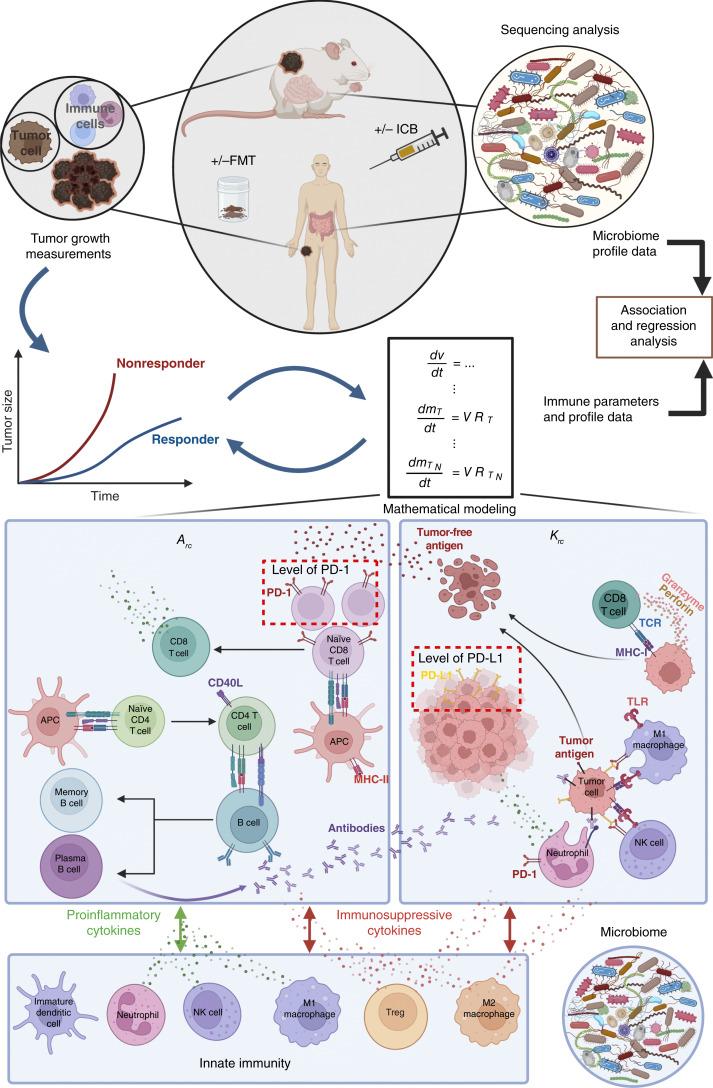
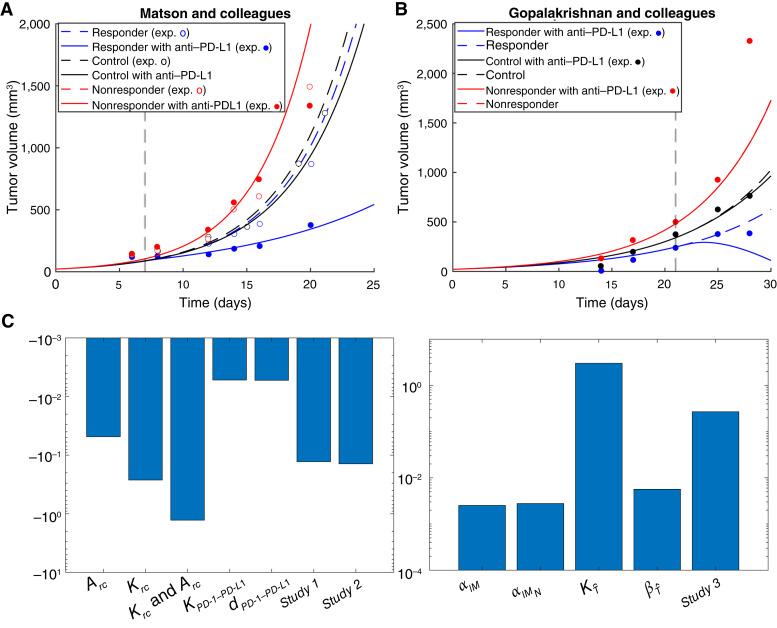
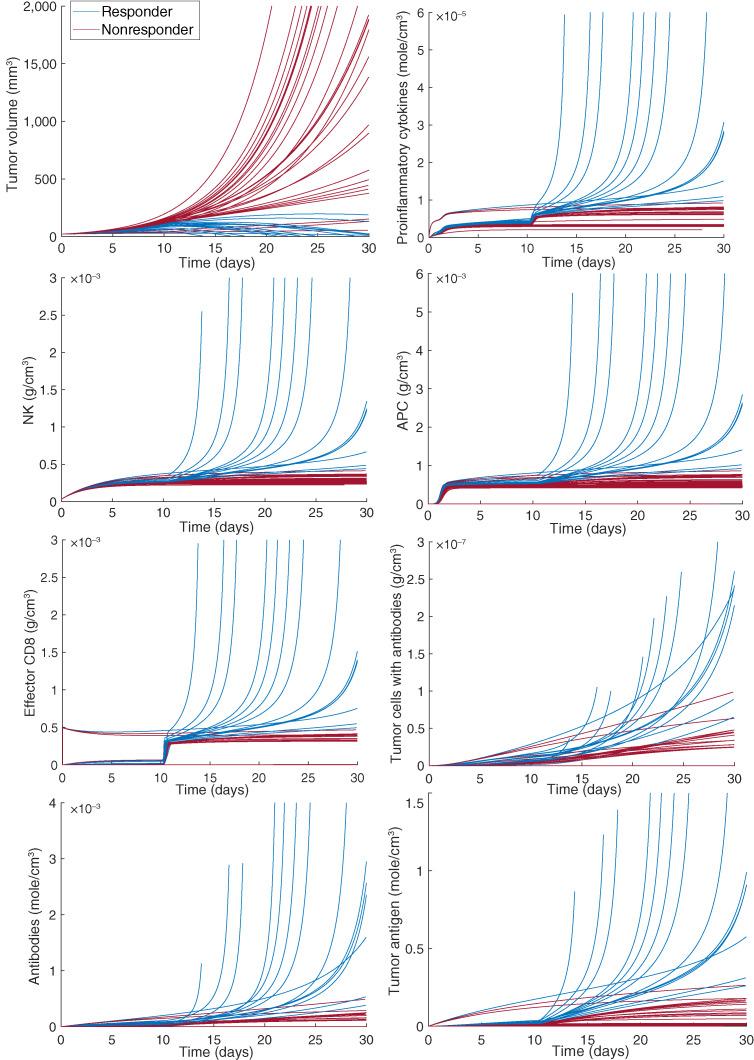
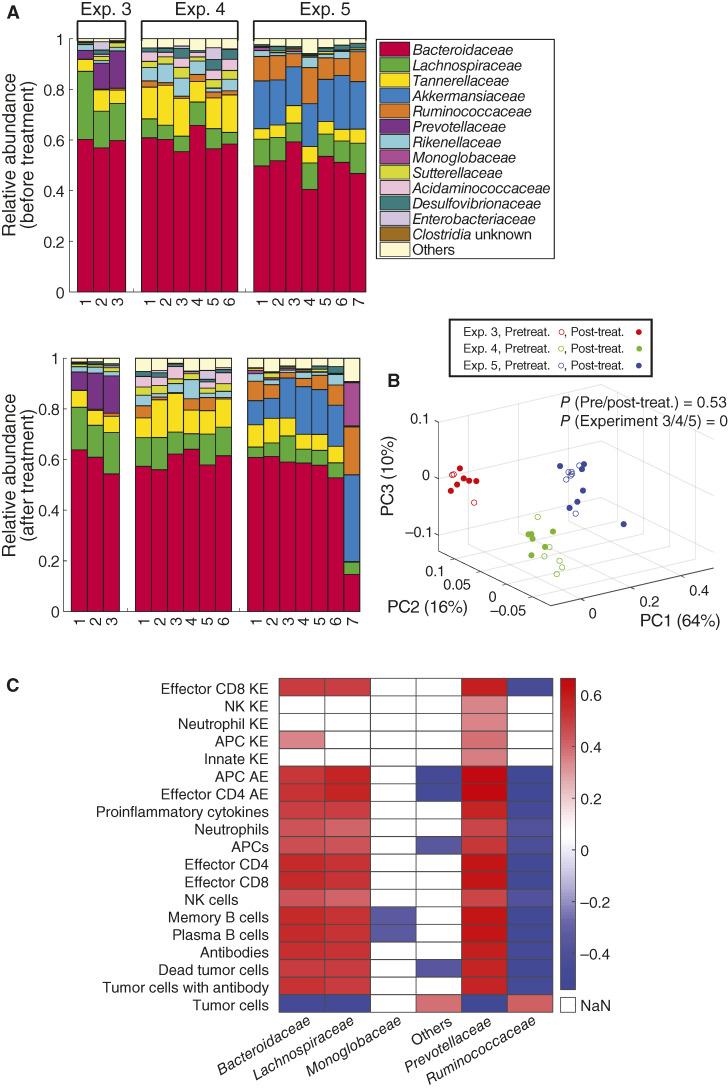
The gut microbiome has emerged as a key regulator of response to cancer immunotherapy. However, a better understanding of the underlying mechanisms by which the microbiome influences immunotherapy is needed to identify strategies to optimize outcomes. To this end, we developed a mathematical model to obtain insights into the effect of the microbiome on the immune system and immunotherapy response. This model was based on (i) gut microbiome data derived from preclinical studies, (ii) mathematical modeling of the antitumor immune response, (iii) association analysis of microbiome profiles with model-predicted immune profiles, and (iv) statistical models that correlate model parameters with the microbiome. The model was used to investigate the complexity of murine and human studies on microbiome modulation. Comparison of model predictions with experimental observations of tumor response in the training and test datasets supported the hypothesis that two model parameters, the activation and killing rate constants of immune cells, are the most influential in tumor progression and are potentially affected by microbiome composition. Evaluation of the associations between the gut microbiome and immune profile indicated that the components and structure of the gut microbiome affect the activation and killing rate of adaptive and innate immune cells. Overall, this study contributes to a deeper understanding of microbiome-cancer interactions and offers a framework for understanding how microbiome interactions influence cancer treatment outcomes.
SIGNIFICANCE
Integration of mathematical modeling and microbiome data reveals how gut microbiome components impact immune response, providing insights to optimize immunotherapy strategies. This article is part of a special series: Driving Cancer Discoveries with Computational Research, Data Science, and Machine Learning/AI.
未标注
肠道微生物群已成为癌症免疫治疗反应的关键调节因子。然而,需要更好地理解微生物群影响免疫治疗的潜在机制,以确定优化治疗结果的策略。为此,我们开发了一个数学模型,以深入了解微生物群对免疫系统和免疫治疗反应的影响。该模型基于:(i)来自临床前研究的肠道微生物群数据;(ii)抗肿瘤免疫反应的数学建模;(iii)微生物群谱与模型预测的免疫谱的关联分析;以及(iv)将模型参数与微生物群相关联的统计模型。该模型用于研究小鼠和人类微生物群调节研究的复杂性。将模型预测与训练和测试数据集中肿瘤反应的实验观察结果进行比较,支持了以下假设:两个模型参数,即免疫细胞的激活和杀伤速率常数,在肿瘤进展中最具影响力,并且可能受微生物群组成的影响。对肠道微生物群与免疫谱之间关联的评估表明,肠道微生物群的组成和结构会影响适应性和先天性免疫细胞的激活和杀伤速率。总体而言,本研究有助于更深入地理解微生物群与癌症的相互作用,并提供了一个框架,以了解微生物群相互作用如何影响癌症治疗结果。
意义
数学建模与微生物群数据的整合揭示了肠道微生物群成分如何影响免疫反应,为优化免疫治疗策略提供了见解。本文是一个特别系列的一部分:通过计算研究、数据科学和机器学习/人工智能推动癌症发现。


 Zotero 插件