
基于临床病理和分子分析,使用10% Ki-67指数临界值对G2胰腺神经内分泌肿瘤进行分层。
Stratification of G2 pancreatic neuroendocrine tumors using a Ten Percent Ki-67 index cut-off based on clinicopathological and molecular analyses.
作者信息
Kageyama Yumiko, Ashida Ryo, Ohike Nobuyuki, Ohshima Keiichi, Norose Tomoko, Ohgi Katsuhisa, Yamada Mihoko, Otsuka Shimpei, Kato Yoshiyasu, Kubo Hidemasa, Uesaka Katsuhiko, Sugiura Teiichi, Sugino Takashi, Notsu Akihumi, Naruoka Akane, Nagashima Takeshi, Urakami Kenichi, Yamaguchi Ken
机构信息
Division of Hepato- Biliary-Pancreatic Surgery, Shizuoka Cancer Center, 1007 Shimonagakubo, Nagaizumi-cho, Sunto-gun, Shizuoka, 411-8777, Japan.
Division of Pathology, Shizuoka Cancer Center, Shizuoka, Japan.
出版信息
Sci Rep. 2025 May 29;15(1):18919. doi: 10.1038/s41598-025-04356-y.
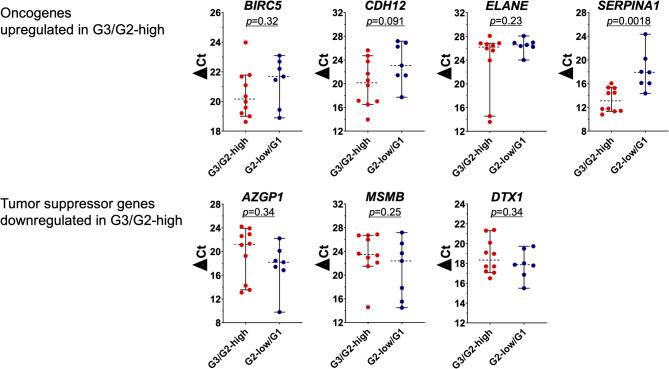
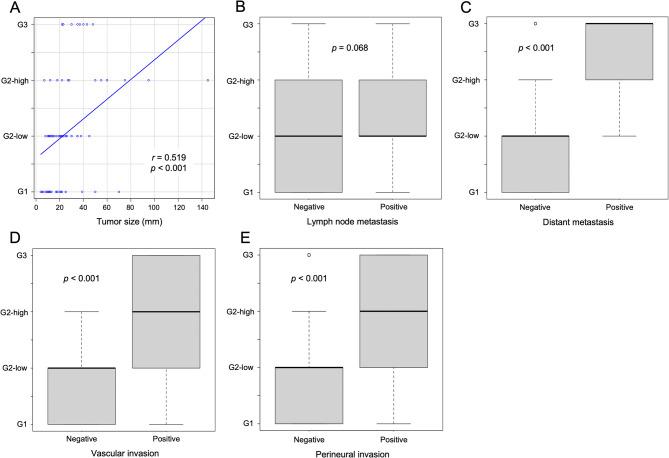
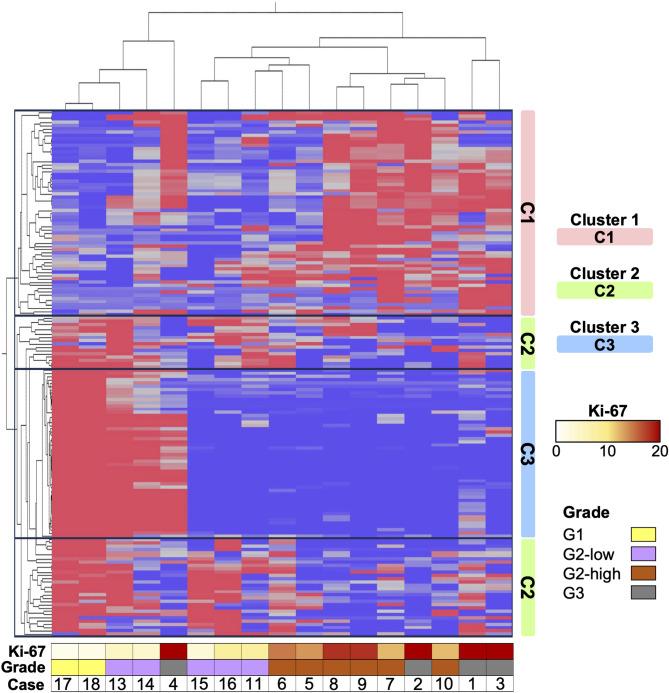
Pancreatic neuroendocrine tumors (PanNETs) often have low malignancy, but some develop distant metastasis or recurrence. This study aimed to investigate the prognostic utility of a Ki-67 index 10% cut-off using clinicopathological and multiomics analyses. Eighty-seven resected PanNETs were classified as G1, G2-low, G2-high, and G3 according to the World Health Organization classification, incorporating a 10% Ki-67 threshold. These groups comprised 29 (33%), 33 (38%), 16 (18%), and 9 (10%) patients, respectively. Comprehensive analyses evaluated tumor characteristics and mutation profiles across the groups. Significant differences in tumor size, recurrence, and overall survival were observed between the G2-low and G2-high groups. Genomic profiling of 19 samples revealed that the G3 (4 patients) and G2-high (6 patients) groups showed greater tumor mutation burdens and more driver gene mutations than the G2-low (6 patients) and G1 (3 patients) groups. Gene expression profiling revealed distinct patterns between the G3/G2-high and G2-low/G1 groups, with the oncogene SERPINA1 significantly upregulated in the G3/G2-high group. The multiomics approach identified key genes, emphasizing the significance of the Ki-67 index 10% cut-off in predicting tumor behavior. The findings support using the Ki-67 index of 10% as a critical threshold for stratifying PanNETs and guiding prognosis and treatment.
胰腺神经内分泌肿瘤(PanNETs)通常恶性程度较低,但有些会发生远处转移或复发。本研究旨在通过临床病理和多组学分析来探讨Ki-67指数10%临界值在预后评估中的作用。根据世界卫生组织分类标准,将87例接受手术切除的PanNETs按照10% Ki-67阈值分为G1、低G2、高G2和G3组。这些组分别包含29例(33%)、33例(38%)、16例(18%)和9例(10%)患者。综合分析评估了各组的肿瘤特征和突变谱。低G2组和高G2组在肿瘤大小、复发和总生存期方面存在显著差异。对19个样本的基因组分析显示,G3组(4例患者)和高G2组(6例患者)比低G2组(6例患者)和G1组(3例患者)表现出更高的肿瘤突变负荷和更多的驱动基因突变。基因表达谱分析显示,G3/高G2组与低G2/G1组之间存在明显差异,癌基因SERPINA1在G3/高G2组中显著上调。多组学方法确定了关键基因,强调了Ki-67指数10%临界值在预测肿瘤行为方面的重要性。这些发现支持将10%的Ki-67指数作为PanNETs分层以及指导预后和治疗的关键阈值。


 Zotero 插件