
驯化番茄中耐盐渐渗基因的生理学研究
Physiology of salt tolerance introgressions from in the domesticated tomato.
作者信息
Bonarota Maria-Sole, Fenstemaker Sean, Vasquez-Gross Hans, Petereit Juli, Santos Patricia, Francis David M, Barrios-Masias Felipe H
机构信息
Department of Agriculture, Veterinary, and Rangeland Sciences. University of Nevada, Reno, NV, United States.
Department of Horticulture and Crop Science. The Ohio State University, Columbus, OH, United States.
出版信息
Front Plant Sci. 2025 May 15;16:1568851. doi: 10.3389/fpls.2025.1568851. eCollection 2025.
INTRODUCTION
Wild trait introgression is a valuable breeding tool for increasing tomato salinity tolerance. However, this process often results in deleterious linkage drag. Understanding the physiological and molecular mechanisms underlying salinity response can aid in developing salt-tolerant cultivars while minimizing undesirable traits. This study investigates the salinity response of the tomato cultivar OH8245, accession LA1141, and two derived introgression lines (ILs SG18_197 and SG18_247) that were previously screened for salt tolerance traits.
METHODS
The physiological and molecular responses of OH8245, LA1141, and the two ILs were analyzed under salinity stress. Key salinity tolerance traits were evaluated, including root characteristics, water status, ion homeostasis, stomatal density, photosynthetic rate, and relative growth rate. Differential gene expression analysis was conducted to identify genes associated with salinity tolerance, comparing the number and uniqueness of differentially expressed genes (DEGs) across genotypes.
RESULTS
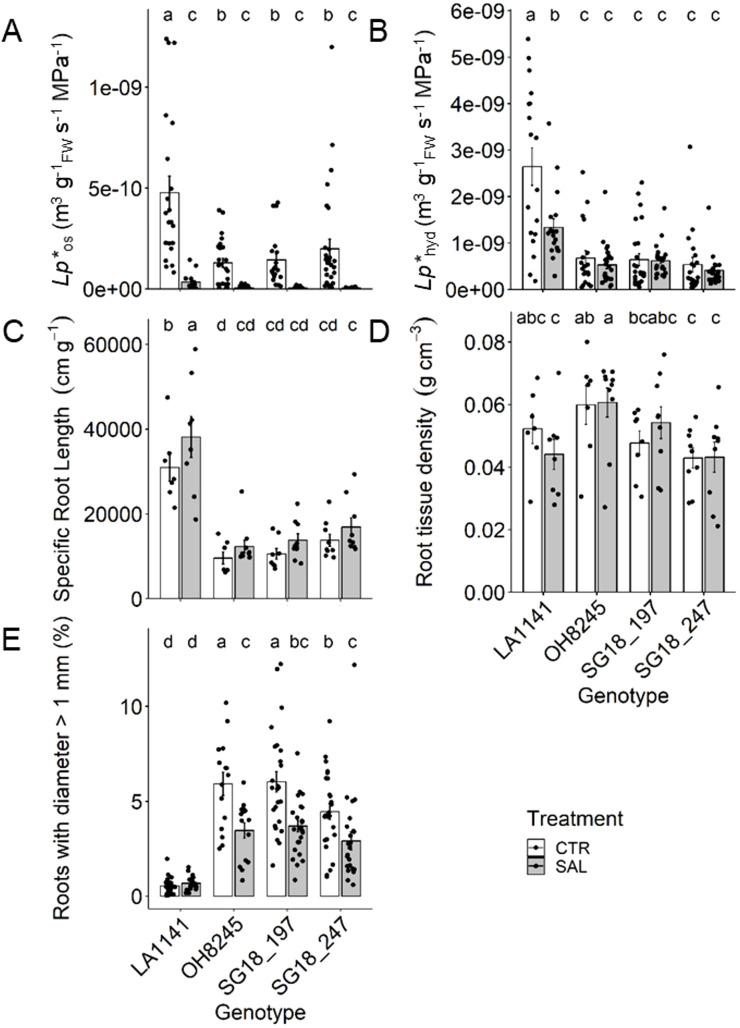
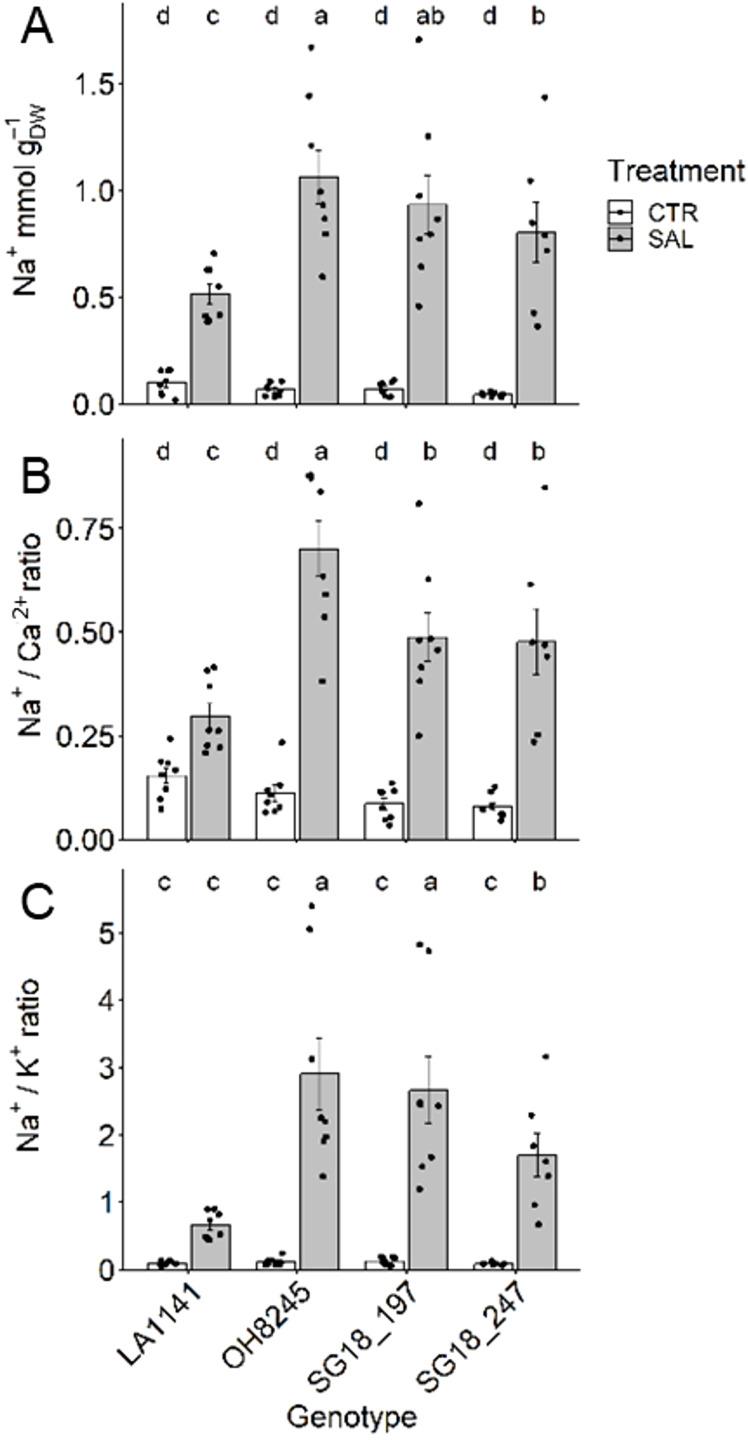
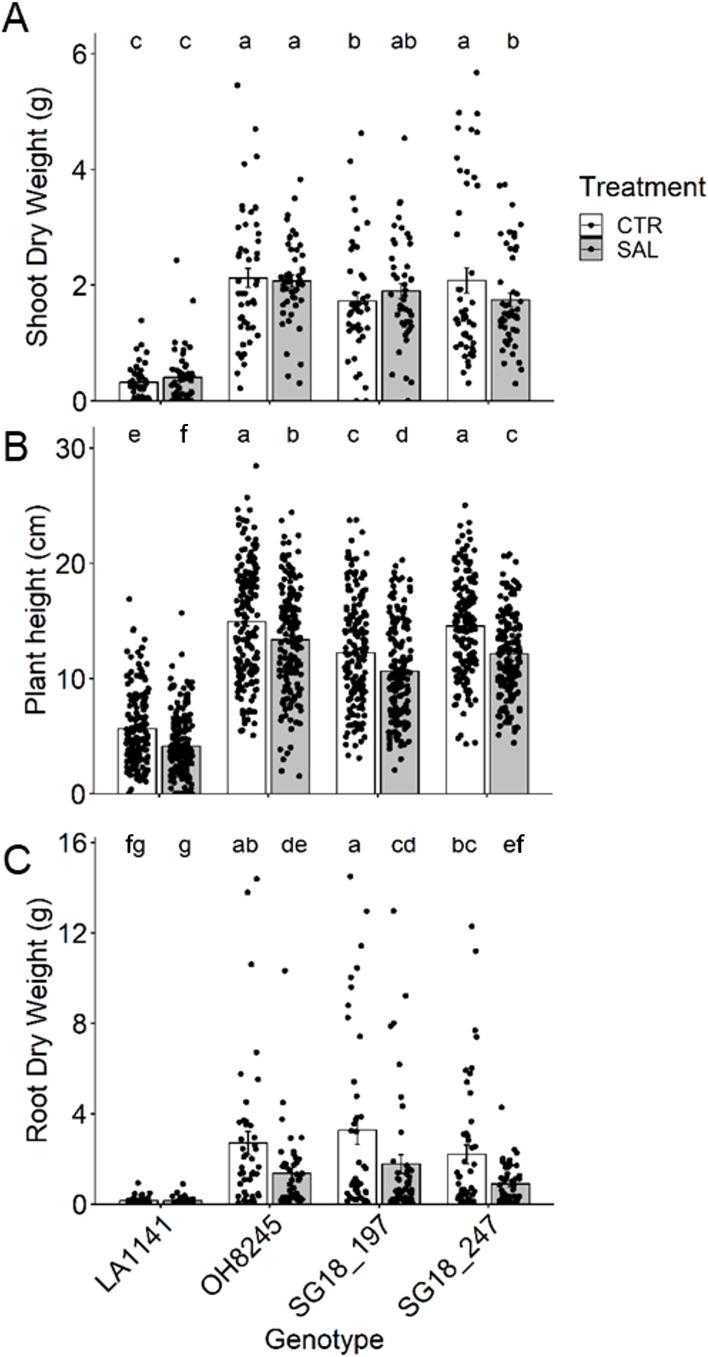
LA1141 exhibited multiple salinity tolerance traits, such as higher specific root length, increased root hydraulic conductivity, and improved plant water status. It also maintained better ion homeostasis and had lower stomatal density compared to OH8245. In contrast, OH8245 demonstrated traits supporting greater biomass accumulation, including a higher photosynthetic rate and relative growth rate. Differential gene expression analysis revealed that LA1141 had the fewest DEGs (706), whereas OH8245 had one of the highest (2524), suggesting a constitutive set of genes contributing to salinity or abiotic stress tolerance. Additionally, 40 DEGs were uniquely found in LA1141 under salinity, with nine and 16 of these transferred to ILs SG18_197 and SG18_247, respectively.
DISCUSSION
Salinity tolerance is a complex trait that imposes an energy cost on the plant. However, key beneficial traits, including improved plant water potential, higher photosynthetic rate, and a lower sodium/potassium ratio, were successfully transferred from LA1141 to at least one of the ILs. These findings provide valuable insights for tomato breeding programs aimed at enhancing salinity tolerance while balancing growth and stress resistance traits.
引言
野生性状渐渗是提高番茄耐盐性的一种有价值的育种工具。然而,这一过程往往会导致有害的连锁累赘。了解盐胁迫响应背后的生理和分子机制有助于培育耐盐品种,同时尽量减少不良性状。本研究调查了番茄品种OH8245、种质LA1141以及两个先前筛选过耐盐性状的渐渗系(ILs SG18_197和SG18_247)对盐胁迫的响应。
方法
分析了OH8245、LA1141和两个渐渗系在盐胁迫下的生理和分子响应。评估了关键的耐盐性状,包括根系特征、水分状况、离子稳态、气孔密度、光合速率和相对生长速率。进行差异基因表达分析以鉴定与耐盐性相关的基因,比较不同基因型中差异表达基因(DEG)的数量和独特性。
结果
LA1141表现出多种耐盐性状,如较高的比根长、增加的根系水力传导率和改善的植株水分状况。与OH8245相比,它还保持了更好的离子稳态,气孔密度较低。相比之下,OH8245表现出支持更大生物量积累的性状,包括较高的光合速率和相对生长速率。差异基因表达分析表明,LA1141的差异表达基因最少(706个),而OH8245是差异表达基因最多的之一(2524个),这表明存在一组构成性基因有助于耐盐性或非生物胁迫耐受性。此外,在盐胁迫下,LA1141中独特发现了40个差异表达基因,其中9个和16个分别转移到了渐渗系SG18_197和SG18_247中。
讨论
耐盐性是一个复杂的性状,会给植物带来能量成本。然而,包括改善植株水势、提高光合速率和降低钠/钾比在内的关键有益性状已成功从LA1141转移到至少一个渐渗系中。这些发现为旨在提高耐盐性同时平衡生长和抗逆性状的番茄育种计划提供了有价值的见解。



 Zotero 插件