
事件标记窗口通信:从神经时间序列推断活动传播
Event-Marked Windowed Communication: Inferring Activity Propagation from Neural Time Series.
作者信息
Madan Mohan Varun, Varley Thomas F, Cash Robin F H, Seguin Caio, Zalesky Andrew
机构信息
Department of Biomedical Engineering, Melbourne School of Engineering, University of Melbourne, Melbourne, Victoria, Australia.
University of Vermont, Burlington, Vermont, USA.
出版信息
Hum Brain Mapp. 2025 Jun 1;46(8):e70223. doi: 10.1002/hbm.70223.
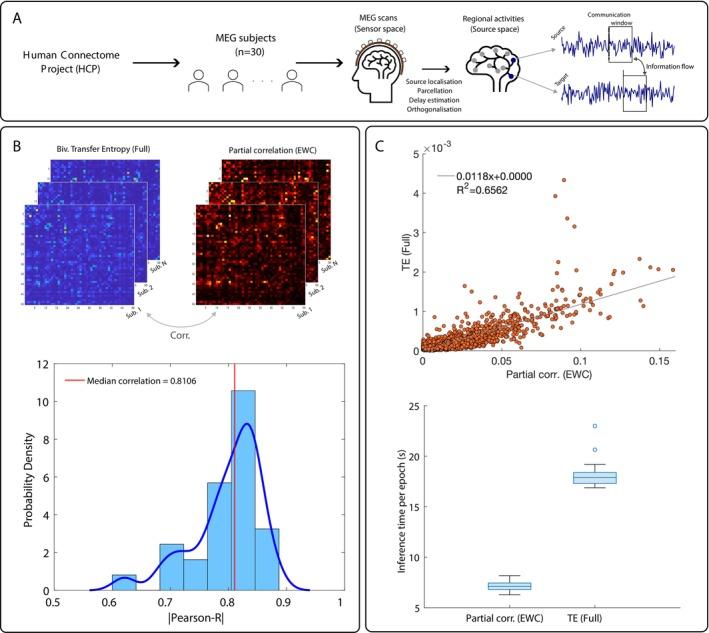
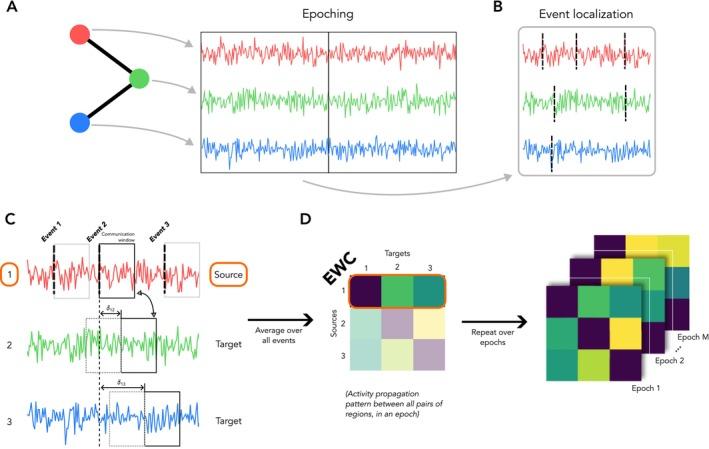
Tracking how activity or signal perturbations propagate in nervous systems is crucial to understanding interareal communication in the brain. Current analytical methodologies are not well suited to systematically infer interareal activity propagation from neural time series recordings. Here, we propose Event-marked Windowed Communication (EWC), a framework to infer activity propagation between neural elements by tracking the statistical consequence of spontaneous, endogenous regional perturbations. EWC tracks the downstream effect of these perturbations by subsampling the neural time series and quantifying statistical dependences using established functional connectivity measures. We test EWC on simulations of neural dynamics and demonstrate the retrieval of ground truth motifs of directional signaling, over a range of model configurations. We also show that EWC can capture activity propagation in a computationally efficient manner by benchmarking it against more advanced FC estimation methods such as transfer entropy. Lastly, we showcase the utility of EWC to infer whole-brain activity propagation maps from magnetoencephalography (MEG) recordings. Networks computed using EWC were compared to those inferred using transfer entropy and were found to be highly correlated (median r = 0.81 across subjects). Importantly, our framework is flexible and can be applied to activity time series captured by diverse functional neuroimaging modalities, opening new avenues for the study of neural communication.
追踪活动或信号扰动在神经系统中的传播方式对于理解大脑中的区域间通信至关重要。当前的分析方法并不适合从神经时间序列记录中系统地推断区域间的活动传播。在此,我们提出了事件标记窗口通信(EWC),这是一个通过追踪自发的、内源性区域扰动的统计结果来推断神经元素之间活动传播的框架。EWC通过对神经时间序列进行子采样并使用既定的功能连接性度量来量化统计依赖性,从而追踪这些扰动的下游效应。我们在神经动力学模拟上测试了EWC,并在一系列模型配置中展示了对定向信号传递的真实主题的检索。我们还表明,通过将EWC与更先进的功能连接性(FC)估计方法(如转移熵)进行基准测试,EWC能够以计算高效的方式捕捉活动传播。最后,我们展示了EWC从脑磁图(MEG)记录中推断全脑活动传播图的效用。将使用EWC计算的网络与使用转移熵推断的网络进行比较,发现它们高度相关(受试者的中位数r = 0.81)。重要的是,我们的框架具有灵活性,可应用于由多种功能神经成像模态捕获的活动时间序列,为神经通信研究开辟了新途径。


 Zotero 插件