
使用深度学习对上颌和下颌第三磨牙拔除难度及拔牙后并发症进行自动诊断。
Automated diagnosis for extraction difficulty of maxillary and mandibular third molars and post-extraction complications using deep learning.
作者信息
Lee Junseok, Park Jumi, Lee Seongju, Moon Seong-Yong, Lee Kyoobin
机构信息
Department of AI Convergence, Gwangju Institute of Science and Technology (GIST), Gwangju, Republic of Korea.
Naval R&D Center, Hanwha systems, Seoul, Gyeonggi-Do, Republic of Korea.
出版信息
Sci Rep. 2025 May 30;15(1):19036. doi: 10.1038/s41598-025-00236-7.
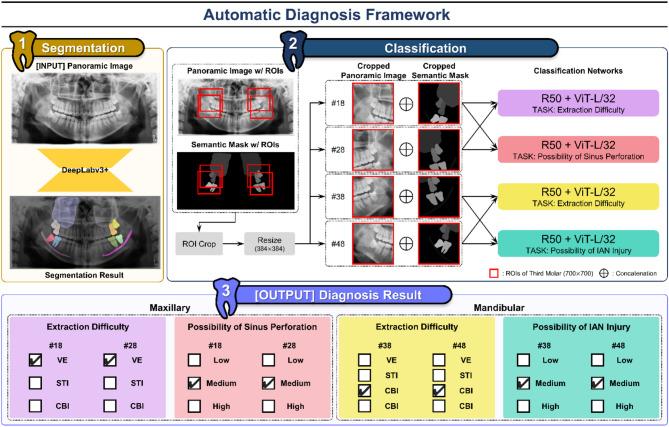
Optimal surgical methods require accurate prediction of extraction difficulty and complications. Although various automated methods related to third molar (M3) extraction have been proposed, none fully predict both extraction difficulty and post-extraction complications. This study proposes an automatic diagnosis method based on state-of-the-art semantic segmentation and classification models to predict the extraction difficulty of maxillary and mandibular M3s and possible complications (sinus perforation and inferior alveolar nerve (IAN) injury). A dataset of 4,903 orthopantomographys (OPGs), annotated by experts, was used. The proposed diagnosis method segments M3s (#18, #28, #38, #48), second molars (#17, #27, #37, #47), maxillary sinuses, and inferior alveolar canal (IAC) in OPGs using a segmentation model and extracts the region of interest (RoI). Using the RoI as input, the classification model predicts extraction difficulty and complication possibilities. The model achieved 87.97% and 88.85% accuracy in predicting maxillary and mandibular M3 extraction difficulty, with area under the receiver operating characteristic curve (AUROC) of 96.25% and 97.3%, respectively. It also predicted the possibility of sinus perforation and IAN injury with 91.45% and 88.47% accuracy, and AUROC of 91.78% and 94.13%, respectively. Our results show that the proposed method effectively predicts the extraction difficulty and complications of maxillary and mandibular M3s using OPG, and could serve as a decision support system for clinicians before surgery.
最佳手术方法需要准确预测拔牙难度和并发症。尽管已经提出了各种与第三磨牙(M3)拔除相关的自动化方法,但没有一种方法能够完全预测拔牙难度和拔牙后并发症。本研究提出了一种基于先进语义分割和分类模型的自动诊断方法,以预测上颌和下颌M3的拔牙难度以及可能的并发症(鼻窦穿孔和下牙槽神经(IAN)损伤)。使用了一个由专家标注的包含4903张口腔全景片(OPG)的数据集。所提出的诊断方法使用分割模型在OPG中分割M3(#18、#28、#38、#48)、第二磨牙(#17、#27、#37、#47)、上颌窦和下牙槽管(IAC),并提取感兴趣区域(RoI)。以RoI作为输入,分类模型预测拔牙难度和并发症可能性。该模型在上颌和下颌M3拔牙难度预测中的准确率分别为87.97%和88.85%,受试者操作特征曲线下面积(AUROC)分别为96.25%和97.3%。它还分别以91.45%和88.47%的准确率预测了鼻窦穿孔和IAN损伤的可能性,AUROC分别为91.78%和94.13%。我们的结果表明,所提出的方法能够有效地利用OPG预测上颌和下颌M3的拔牙难度和并发症,并可为临床医生术前提供决策支持系统。


 Zotero 插件