
不同地理区域、手术类型和国家经济水平的新生儿术后急性肾损伤(AKI)的危险因素及死亡率:一项系统评价和荟萃分析
Risk factors and mortality of postoperative acute kidney injury (AKI) in newborns across geographical regions, surgical type, and national economic levels: a systematic review and meta-analysis.
作者信息
Cui Yu, Luo Yifei, Zhang Diwei, Zhang Qianqian, Huang Qinghua, Gong Tianqing
机构信息
Department of Anesthesiology, School of Medicine, The Affiliated Hospital, UESTC Chengdu Women's and Children's Central Hospital, No.1617, Riyue Avenue, Qingyang District, Chengdu, 610091, China.
出版信息
Eur J Med Res. 2025 May 31;30(1):433. doi: 10.1186/s40001-025-02719-9.
BACKGROUND
It is noted that postoperative acute kidney injury (AKI) in neonates is known to be associated with adverse outcomes, yet its incidence and risk factors remain incompletely elucidated. The current study aims to improve the understanding of postoperative AKI in neonates by systematically evaluating its incidence, diagnostic criteria, risk factors, and clinical outcomes, with particular attention to variations across geographic regions, surgical types, the span of time, and national economic statuses.
METHODS
A comprehensive search of Pubmed, Embase, OVID, Web of Science (WOS), Medline, and Cochrane Controlled Register of Trials (CENTRAL) was conducted from inception to 30 September 2024. Studies meeting all the following inclusion criteria were enrolled: 1) Population: neonates aged ≤ 30 days; 2) Disease: postoperative AKI diagnosed per KDIGO, pRIFLE, AKIN, nKDIGO, or others; 3) Study design: prospective/retrospective cohort studies or case-control studies; 4) Reporting data on postoperative incidence of AKI. The pooled proportion (along with 95% confidence intervals [CI]) of postoperative AKI was calculated. We also calculated pooled odds ratios (95% CI) for all-cause mortality in neonates with postoperative AKI when compared with those without AKI.
RESULTS
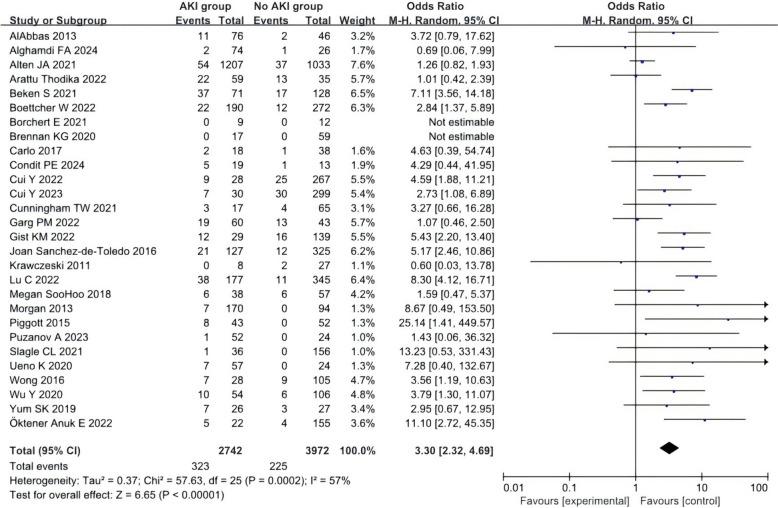
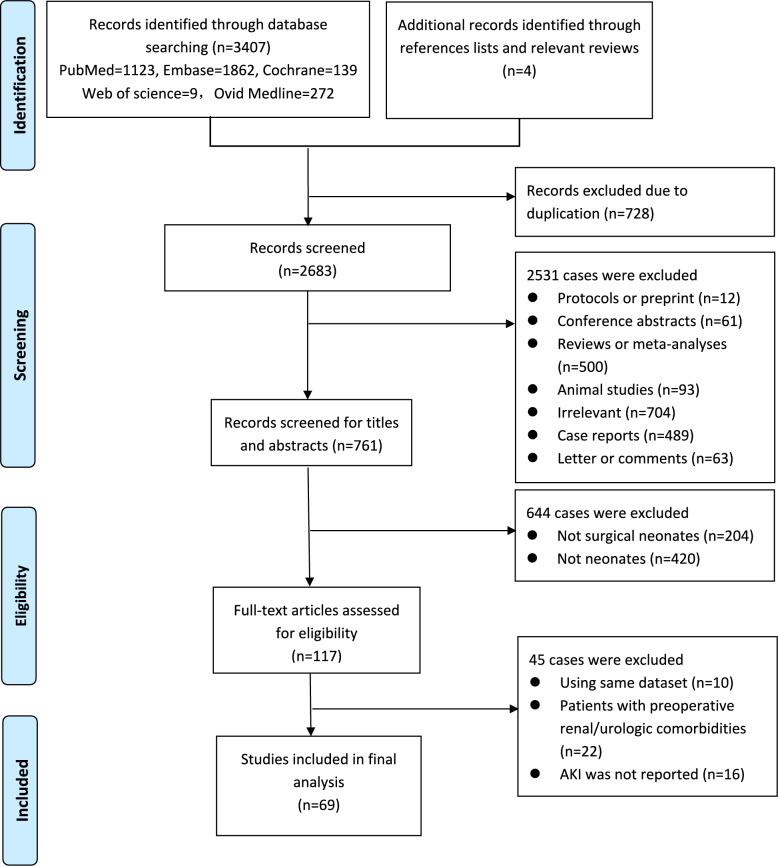
A total of 69 studies (10,519 cases) were included in the meta-analysis. The pooled incidence of postoperative AKI in neonates was 37% (95%CI 32-42, I = 96.4%, P<0.01), with a wide variability ranging from 0.0% to 74.8%. Several risk factors were identified, including lower preoperative or intraoperative urinary output, lower preoperative serum creatinine (SCr)/higher maximum postoperative SCr, elevated vasoactive inotrope score (VIS)/hypotension, younger corrected gestational age, prolonged cardiopulmonary bypass (CPB) duration, hypothermia, sepsis, and preoperative ventilation. Furthermore, 28 studies involving 6714 patients reported data on AKI-associated mortality with an overall incidence of 8.2%. Neonates who developed postoperative AKI had 3.3 times higher odds of mortality as compared to those without this complication.
CONCLUSIONS
Postoperative AKI affects one-third of neonates, and AKI-associated mortality remains high. Future efforts should focus on developing earlier and more sensitive detection methods.
SYSTEMATIC REVIEW REGISTRATION NUMBER
This meta-analysis was registered on https://www.crd.york.ac.uk/prospero/ with the registration number CRD 42024602820 on October 29, 2024.
背景
据指出,新生儿术后急性肾损伤(AKI)与不良预后相关,但其发病率和危险因素仍未完全阐明。本研究旨在通过系统评估其发病率、诊断标准、危险因素和临床结局,提高对新生儿术后AKI的认识,尤其关注地理区域、手术类型、时间跨度和国家经济状况的差异。
方法
对PubMed、Embase、OVID、Web of Science(WOS)、Medline和Cochrane对照试验注册中心(CENTRAL)进行全面检索,检索时间从数据库建立至2024年9月30日。纳入符合以下所有纳入标准的研究:1)研究对象:年龄≤30天的新生儿;2)疾病:根据KDIGO、pRIFLE、AKIN、nKDIGO或其他标准诊断的术后AKI;3)研究设计:前瞻性/回顾性队列研究或病例对照研究;4)报告术后AKI的发病率数据。计算术后AKI的合并比例(以及95%置信区间[CI])。我们还计算了术后发生AKI的新生儿与未发生AKI的新生儿全因死亡率的合并比值比(95%CI)。
结果
荟萃分析共纳入69项研究(10519例病例)。新生儿术后AKI的合并发病率为37%(95%CI 32 - 42,I² = 96.4%,P < 0.01),范围从0.0%到74.8%,差异很大。确定了几个危险因素,包括术前或术中尿量减少、术前血清肌酐(SCr)降低/术后最高SCr升高、血管活性药物评分(VIS)升高/低血压、矫正胎龄较小、体外循环(CPB)时间延长、体温过低、败血症和术前通气。此外,28项涉及6714例患者的研究报告了与AKI相关的死亡率数据,总体发病率为8.2%。发生术后AKI的新生儿死亡率比未发生该并发症的新生儿高3.3倍。
结论
术后AKI影响三分之一的新生儿,且与AKI相关的死亡率仍然很高。未来的努力应集中在开发更早、更敏感的检测方法上。
系统评价注册号
本荟萃分析于2024年10月29日在https://www.crd.york.ac.uk/prospero/上注册,注册号为CRD 42024602820。
 Zotero 插件