
表观遗传年龄加速介导低度全身炎症与心血管疾病之间的关联:来自1999 - 2002年美国国家健康与营养检查调查(NHANES)的见解
Epigenetic age acceleration mediates the association between low-grade systemic inflammation and cardiovascular diseases: insight from the NHANES 1999-2002.
作者信息
Chen Xiaolang, Zhong Jin, Lv Yingnan, Wei Lancheng, Zhou Huijiao, Yang Yongmei, Chi Jinfan, Lee Zhen, Wu Huabei, Zhang Haiying
机构信息
Department of Occupational Health and Environmental Health, School of Public Health, Guangxi Medical University, No. 22, Shuangyong Road, Nanning, 530021, Guangxi, China.
Guangxi Colleges and Universities Key Laboratory of Prevention and Control of Highly Prevalent Diseases, Guangxi Medical University, Nanning, 530021, Guangxi, China.
出版信息
Clin Epigenetics. 2025 May 31;17(1):89. doi: 10.1186/s13148-025-01895-z.
BACKGROUND
Currently, with the global aging of the population, inflammation, recognized as a hallmark in age-related diseases, has been studied and linked to cardiovascular diseases (CVD). However, limited evidence on whether inflammation modifies epigenetic aging and affects CVD risk.
METHODS
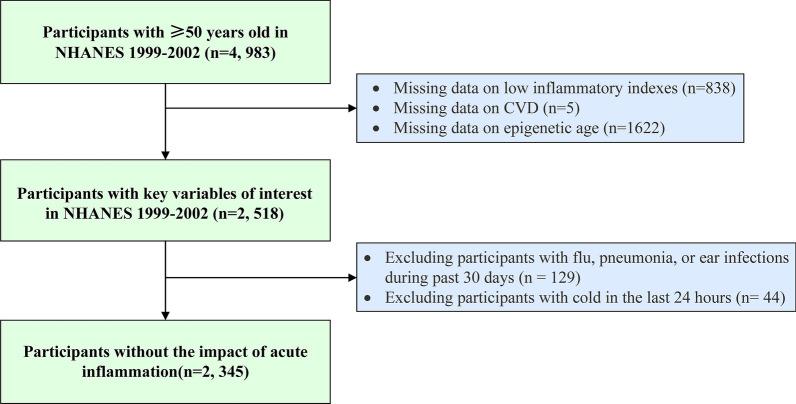
This study included 404 CVD patients and 1941 non-CVD individuals from the 1999-2002 National Health and Nutrition Examination Survey cross-sectional data. Low-grade systemic inflammation was assessed using C-reactive protein (CRP), neutrophil-to-lymphocyte ratio (NLR), and systemic inflammation response index (SIRI). Epigenetic age accelerations (EAAs) were calculated as the residuals between chronological and epigenetic ages: Horvath age acceleration (AgeAccel), AgeAccelHannum, and AgeAccelPheno. Weighted linear and logistic regression analyzed the associations between exposures and outcomes, with mediating effects assessed using the Sobel test.
RESULTS
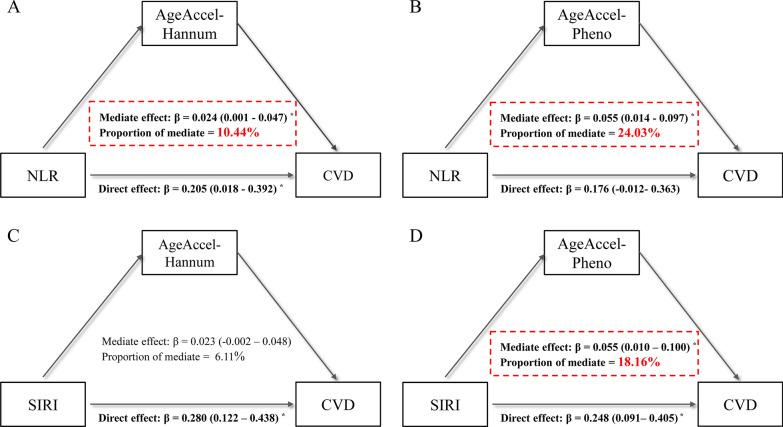
After adjusting confoundings, the log-transformed NLR and SIRI were positively associated with CVD risk, and the odds ratio (OR) ranges from 1.260 to 1.354 (all P < 0.05). Furthermore, the ln-transformed CRP was positively associated with AgeAccelHannum and AgeAccelPheno, and the coefficient (β) ranges from 0.505 to 1.304 (all P < 0.05); the ln-transformed NLR and SIRI were positively associated with all three EAAs, and the β ranges from 0.392 to 2.212 (all P < 0.005). Additionally, 1-unit increase in AgeAccelHannum and AgeAccelPheno was associated with 2.8% (OR: 1.028, 95% CI 1.007-1.049, P = 0.011) and 3.5% (OR: 1.035, 95% CI 1.014-1.056, P = 0.002) increase in CVD risk, respectively. After adjusting confoundings, mediation analysis showed that AgeAccelHannum mediates 10.44% (P = 0.046) of the association between NLR and CVD risk; and AgeAccelPheno mediates 24.03% (P = 0.009) and 18.16% (P = 0.015) of the NLR-CVD and SIRI-CVD risk associations, respectively.
CONCLUSION
Our results demonstrate that EAAs mediate the association between systemic inflammation and CVD risk, highlighting the potential of a multi-target approach to inflammation and epigenetic modifications for personalized management to reduce CVD risk.
背景
目前,随着全球人口老龄化,炎症被认为是与年龄相关疾病的一个标志,已被研究并与心血管疾病(CVD)相关联。然而,关于炎症是否会改变表观遗传衰老并影响CVD风险的证据有限。
方法
本研究纳入了1999 - 2002年国家健康与营养检查调查横断面数据中的404例CVD患者和1941例非CVD个体。使用C反应蛋白(CRP)、中性粒细胞与淋巴细胞比值(NLR)和全身炎症反应指数(SIRI)评估低度全身炎症。表观遗传年龄加速(EAA)计算为实际年龄与表观遗传年龄之间的残差:霍瓦斯年龄加速(AgeAccel)、AgeAccelHannum和AgeAccelPheno。加权线性和逻辑回归分析暴露因素与结局之间的关联,并使用索贝尔检验评估中介效应。
结果
调整混杂因素后,对数转换后的NLR和SIRI与CVD风险呈正相关,优势比(OR)范围为1.260至1.354(所有P < 0.05)。此外,自然对数转换后的CRP与AgeAccelHannum和AgeAccelPheno呈正相关,系数(β)范围为0.505至1.304(所有P < 0.05);自然对数转换后的NLR和SIRI与所有三种EAA均呈正相关,β范围为0.392至2.212(所有P < 0.005)。此外,AgeAccelHannum和AgeAccelPheno每增加1个单位,CVD风险分别增加2.8%(OR:1.028,95% CI 1.007 - 1.049,P = 0.011)和3.5%(OR:1.035,95% CI 1.014 - 1.056,P = 0.002)。调整混杂因素后,中介分析表明AgeAccelHannum介导了NLR与CVD风险之间10.44%(P = 0.046)的关联;AgeAccelPheno分别介导了NLR - CVD和SIRI - CVD风险关联的24.03%(P = 0.009)和18.16%(P = 0.015)。
结论
我们的数据表明EAA介导了全身炎症与CVD风险之间的关联,突出了针对炎症和表观遗传修饰的多靶点方法在个性化管理以降低CVD风险方面的潜力。
 Zotero 插件