
评估代谢组范围内对精神疾病和神经退行性疾病风险的因果效应。
Evaluating metabolome-wide causal effects on risk for psychiatric and neurodegenerative disorders.
作者信息
Gilchrist Lachlan, Mutz Julian, Hysi Pirro, Legido-Quigley Cristina, Kõks Sulev, Lewis Cathryn M, Proitsi Petroula
机构信息
Social, Genetic and Developmental Psychiatry Centre, Institute of Psychiatry, King's College London, Psychology & Neuroscience, London, UK.
Perron Institute for Neurological and Translational Science, Perth, Australia.
出版信息
BMC Med. 2025 Jun 2;23(1):326. doi: 10.1186/s12916-025-04129-4.
BACKGROUND
Evidence indicates phenotypic and biological overlap between psychiatric and neurodegenerative disorders. Further identification of underlying mutual and unique biological mechanisms may yield novel multi-disorder and disorder-specific therapeutic targets. The metabolome represents an important domain for target identification as metabolites play critical roles in modulating a diverse range of biological processes.
METHODS
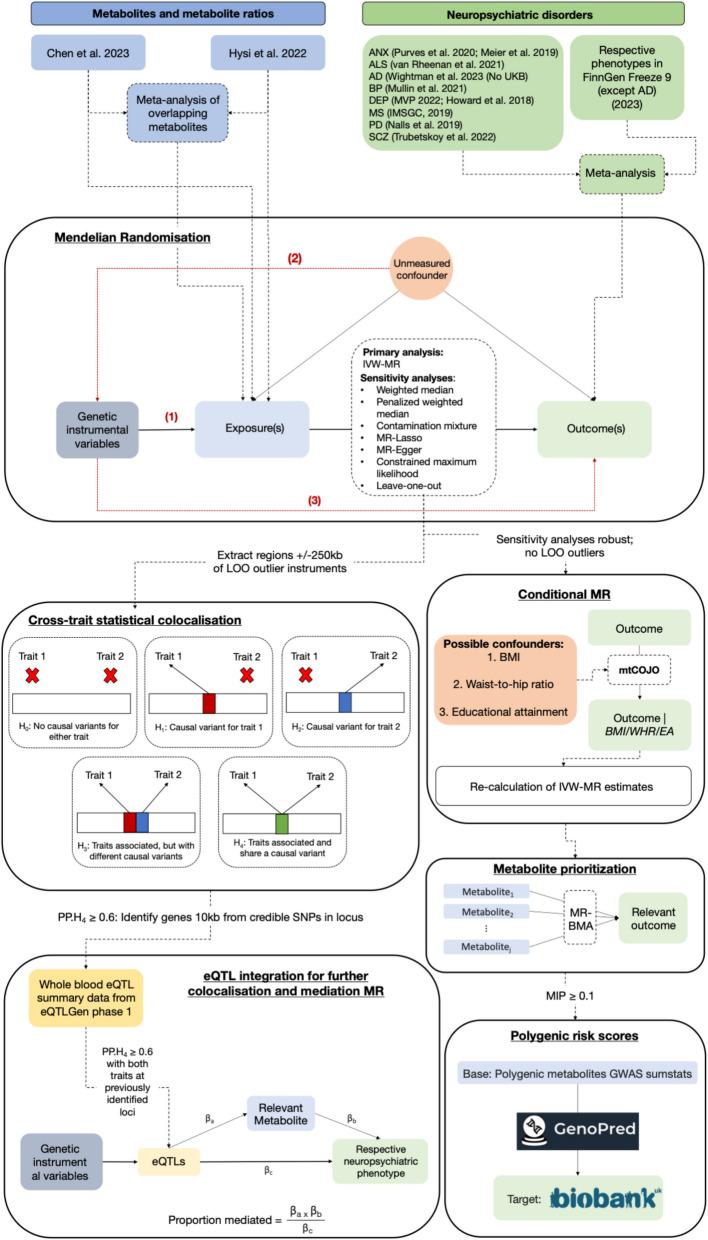
We used Mendelian randomisation (MR) to test the causal effects of ~ 1000 plasma metabolites and ~ 300 metabolite ratios on anxiety, bipolar disorder, depression, schizophrenia, amyotrophic lateral sclerosis, Alzheimer's disease, Parkinson's disease and multiple sclerosis. Follow-up analyses were conducted using statistical colocalisation, multivariable Bayesian model averaging MR (MR-BMA) and polygenic risk score analysis in the UK Biobank.
RESULTS
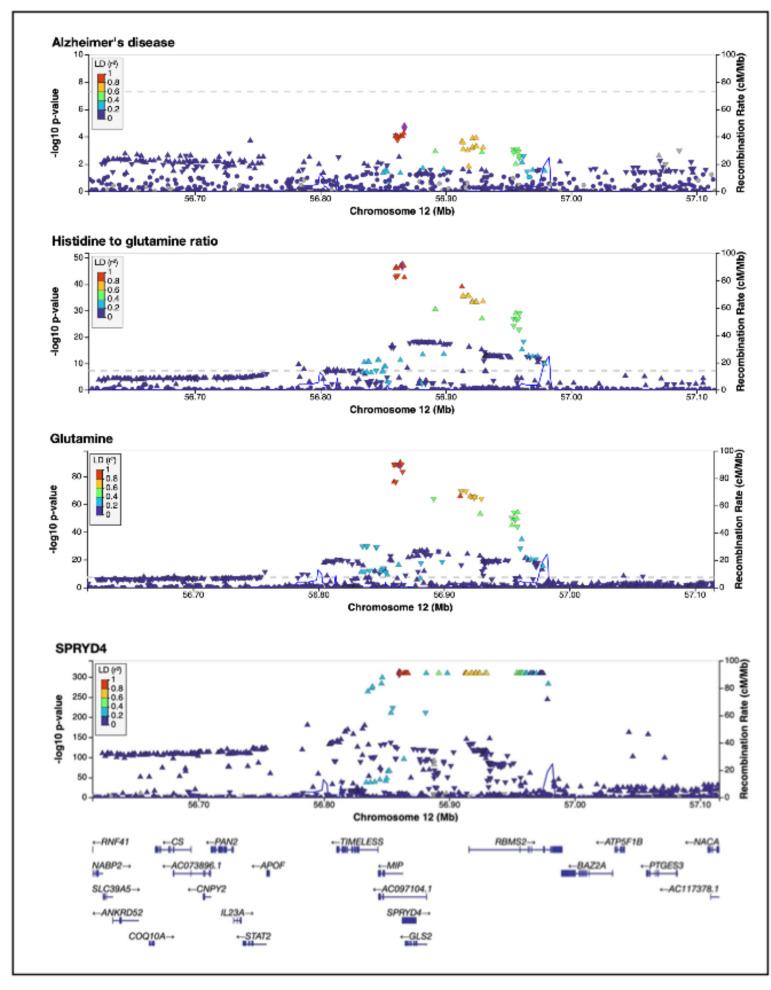
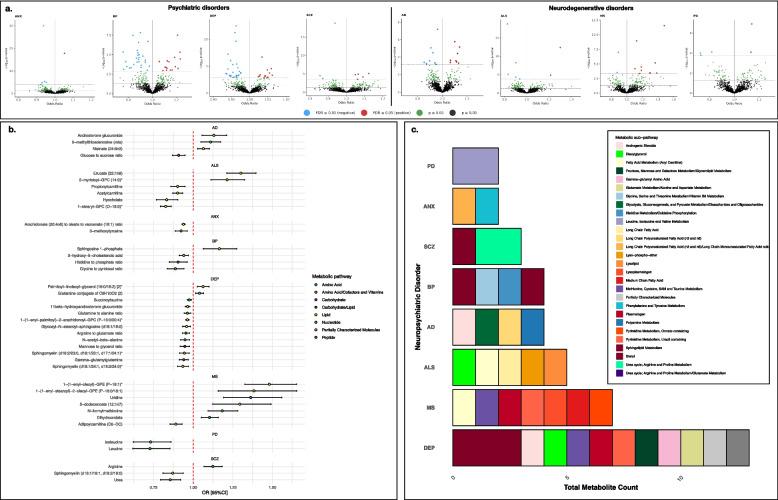
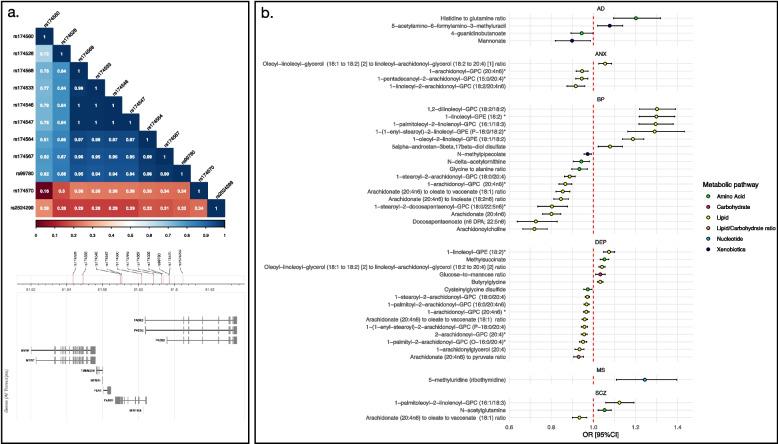
MR analyses identified 85 causal effects involving 77 unique metabolites passing FDR correction and robust sensitivity analyses (IVW-MR OR range 0.73-1.48; p < 0.05). No evidence of reverse causality was identified. Multivariable MR-BMA analyses implicated sphingolipid metabolism in psychiatric disorder risk and carnitine derivatives in risk for amyotrophic lateral sclerosis and multiple sclerosis. Although polygenic risk scores for prioritised metabolites showed limited prediction in the UK Biobank, those nominally significant were directionally consistent with MR estimates. Downstream colocalisation in regions containing influential variants identified greater than suggestive evidence (PP.H ≥ 0.6) for a shared causal variant for 29 metabolite/psychiatric disorder trait-pairs on chromosome 11 at the FADS gene cluster. Most of these metabolites were lipids containing linoleic or arachidonic acid. Additional colocalisation was identified between the ratio of histidine-to-glutamine, glutamine, Alzheimer's disease and SPRYD4 gene expression on chromosome 12.
CONCLUSIONS
Although no single metabolite had a causal effect on both a psychiatric and a neurodegenerative disease, results suggest a broad effect of lipids across brain disorders, with a particular role for lipids containing linoleic or arachidonic acid in psychiatric disorders. The metabolites identified here may help inform future targeted interventions.
背景
有证据表明精神疾病和神经退行性疾病之间存在表型和生物学重叠。进一步确定潜在的共同和独特生物学机制可能会产生新的多疾病和疾病特异性治疗靶点。代谢组是靶点识别的一个重要领域,因为代谢物在调节多种生物学过程中起着关键作用。
方法
我们使用孟德尔随机化(MR)来测试约1000种血浆代谢物和约300种代谢物比率对焦虑症、双相情感障碍、抑郁症、精神分裂症、肌萎缩侧索硬化症、阿尔茨海默病、帕金森病和多发性硬化症的因果效应。在英国生物银行中使用统计共定位、多变量贝叶斯模型平均MR(MR-BMA)和多基因风险评分分析进行后续分析。
结果
MR分析确定了85个因果效应,涉及77种独特的代谢物,经过错误发现率校正和稳健的敏感性分析(IVW-MR比值比范围为0.73 - 1.48;p < 0.05)。未发现反向因果关系的证据。多变量MR-BMA分析表明鞘脂代谢与精神疾病风险有关,肉碱衍生物与肌萎缩侧索硬化症和多发性硬化症风险有关。尽管在英国生物银行中,优先代谢物的多基因风险评分显示出有限的预测能力,但那些名义上显著的评分在方向上与MR估计一致。在包含有影响变体的区域进行的下游共定位确定,在11号染色体上的FADS基因簇处,29种代谢物/精神疾病性状对存在共享因果变体的证据大于提示性证据(PP.H≥0.6)。这些代谢物大多数是含有亚油酸或花生四烯酸的脂质。在12号染色体上,组氨酸与谷氨酰胺的比率、谷氨酰胺、阿尔茨海默病和SPRYD4基因表达之间还发现了额外的共定位。
结论
虽然没有单一的代谢物对精神疾病和神经退行性疾病都有因果效应,但结果表明脂质对多种脑部疾病有广泛影响,特别是含有亚油酸或花生四烯酸的脂质在精神疾病中起特殊作用。此处确定的代谢物可能有助于为未来的靶向干预提供信息。
 Zotero 插件