
在新冠疫情期间(半)急性非手术腰椎手术的增加。
Increase in (semi-) acute non-instrumented lumbar spine surgeries during the COVID-19 pandemic.
作者信息
Gallé C L C, Smeets A Y J M, Krekels-Huijbregts E A, van Santbrink H, Haeren R H L
机构信息
Faculty of Health Medicine and Life Sciences, Maastricht University, Maastricht, the Netherlands.
Department of Neurosurgery, Maastricht University Medical Center+, Maastricht, the Netherlands.
出版信息
Brain Spine. 2025 May 2;5:104270. doi: 10.1016/j.bas.2025.104270. eCollection 2025.
INTRODUCTION
Due to the COVID-19 pandemic healthcare resources were reallocated, thereby reducing elective surgery capacity. An increase in acute surgeries due to postponed elective surgeries was expected. Since elective lumbar spine surgery for degenerative indications was among the cancelled or postponed surgical interventions, we hypothesized that the number of acute and semi-acute surgeries would increase during the pandemic.
RESEARCH QUESTION
What was the effect of the COVID-19 pandemic on the number of (semi-)acute lumbar spinal surgeries?
MATERIAL AND METHODS
This prospective cohort study included patients who underwent non-instrumented degenerative lumbar spine surgery, i.e. interlaminar decompression, laminectomy or lumbar microdiscectomy. We distinguished a pre-COVID cohort (between 01.03.2019 and 29.02.2020) and a COVID-cohort (between 01.03.2020 and 28.02.2021).
RESULTS
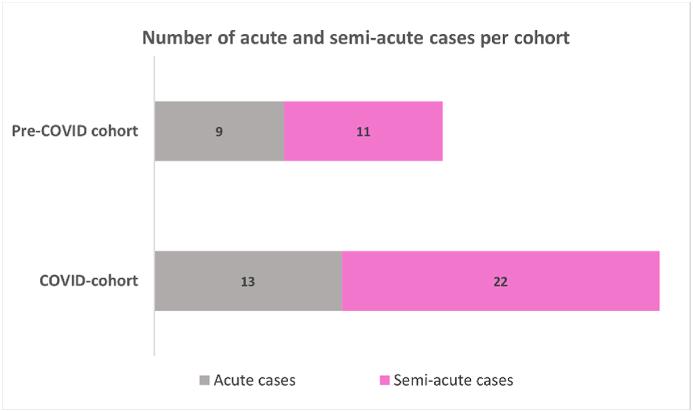
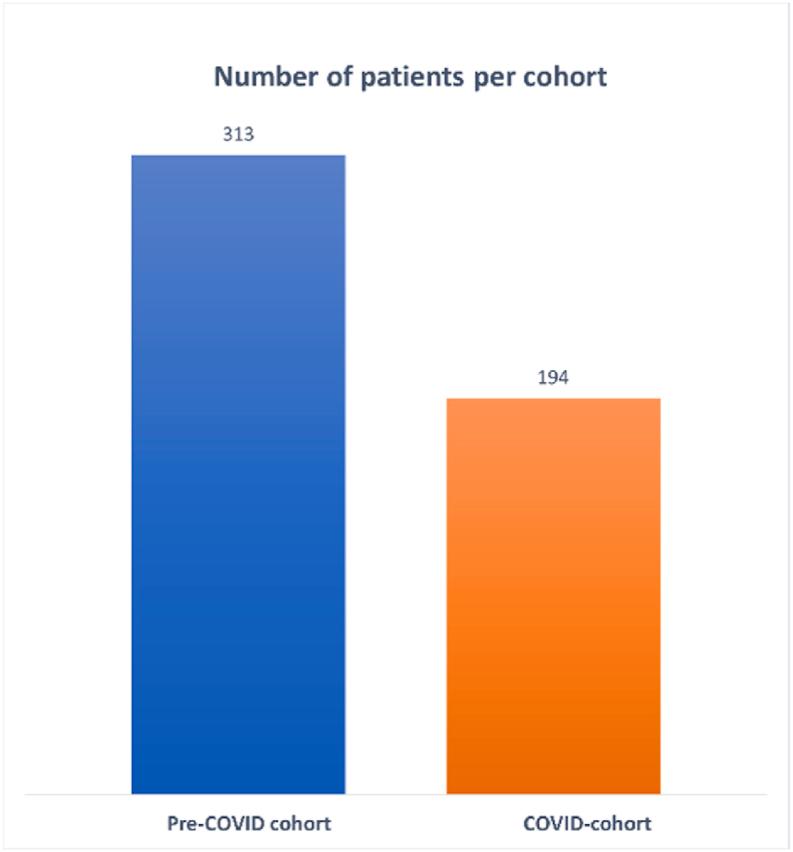
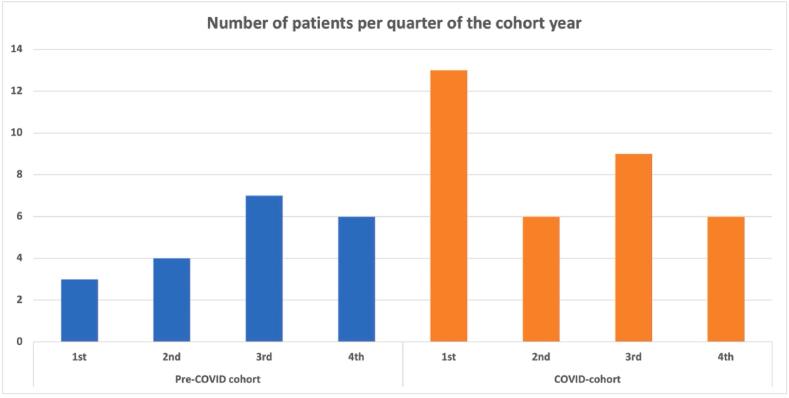
We included 313 patients in the pre-COVID cohort and 194 in the COVID-cohort, reflecting a decline of 38.7 %. The number of (semi-)acute indications increased with 300 % in the COVID-cohort, which was mainly the result of more surgeries for severe and intractable radiculopathy. We also noted an increase in good clinical outcome and a decline in complications in the COVID-cohort.
DISCUSSION AND CONCLUSION
The number of elective degenerative lumbar spine surgeries declined due to the COVID-19 pandemic, while the rate of (semi)-acute lumbar spinal surgeries increased strongly. The latter may be due to altered patients' clinical presentations and surgical decision making in times of severe health care scarcity of elective surgical care.
引言
由于新冠疫情,医疗资源被重新分配,从而降低了择期手术的能力。预计因择期手术推迟导致急性手术数量会增加。由于退行性疾病指征的择期腰椎手术属于被取消或推迟的手术干预措施,我们推测在疫情期间急性和半急性手术的数量会增加。
研究问题
新冠疫情对(半)急性腰椎手术数量有何影响?
材料与方法
这项前瞻性队列研究纳入了接受非器械辅助退行性腰椎手术的患者,即椎板间减压术、椎板切除术或腰椎显微椎间盘切除术。我们区分了新冠疫情前队列(2019年3月1日至2020年2月29日)和新冠疫情队列(2020年3月1日至2021年2月28日)。
结果
我们在新冠疫情前队列中纳入了313例患者,在新冠疫情队列中纳入了194例患者,下降了38.7%。在新冠疫情队列中,(半)急性指征的数量增加了300%,这主要是由于针对严重和顽固性神经根病进行了更多手术。我们还注意到新冠疫情队列中良好临床结局有所增加,并发症有所减少。
讨论与结论
由于新冠疫情,择期退行性腰椎手术的数量下降,而(半)急性腰椎手术的比例大幅上升。后者可能是由于在择期手术医疗资源严重短缺的时期,患者临床表现和手术决策发生了变化。
 Zotero 插件