
丁酰胆碱酯酶和24小时尿铜排泄作为长期治疗威尔逊病的依从性评估指标。
Butyrylcholinesterase and 24 h-urinary copper excretion as compliance assessment in long-term treated Wilson's disease.
作者信息
Hefter Harald, Novak Max, Rosenthal Dietmar, Meuth Sven G, Luedde Tom, Albrecht Philipp, Hartmann Christian J, Samadzadeh Sara
机构信息
Department of Neurology, University of Düsseldorf, Düsseldorf, Germany.
Department of Gastroenterology, University of Düsseldorf, Düsseldorf, Germany.
出版信息
Front Neurol. 2025 May 19;16:1553573. doi: 10.3389/fneur.2025.1553573. eCollection 2025.
BACKGROUND AND AIM OF THE STUDY
Compliance is the most challenging aspect of long-term therapy in Wilson's disease (WD). Evidence is presented that butyrylcholinesterase (CHE) can be used as a sensitive biomarker to detect compliance problems in long-term treated WD-patients.
METHODS
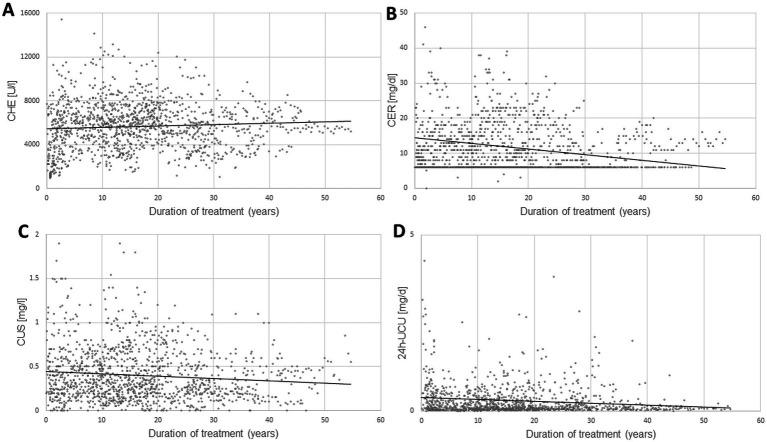
For the present retrospective, monocentric study demographical and treatment related data of 108 WD-patients (who had been treated at the Clinic of Neurology of the university hospital in Düsseldorf (Germany) between 2/2005 and 1/2021) were extracted from the charts. These patients underwent 2003 therapy control visits. The present study focuses on the analysis of three parameters of copper metabolism (serum levels of ceruloplasmin (CER-S), copper (CU-S) and the 24 h-urinary copper excretion (24 h-UCU)) and the serum levels of CHE (CHE-S). A patient was classified to be non-compliant when in his charts at least 8 24 h-UCU-values were found, and all his 24 h-UCU-values were larger than 60 μg/d (N-COM8-group). A patient was classified to be compliant when at least one of at least 8 24 h-UCU-values was lower than or equal to 60 μg/d (COM8-group).
RESULTS
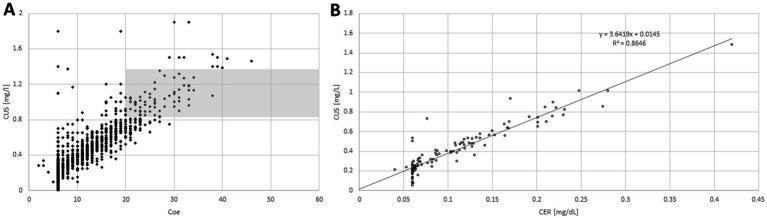
CHE-S was significantly ( < 0.05) different between thus defined compliant or non-compliant patients. Neither CU-S nor CER-S nor calculated free (non-ceruloplasmin-bound) serum copper levels (NCC-S) were significantly different between the NCOM8- and COM8-group. Analysis of the area under the curve and sensitivity and specificity by means of ROC-curves underlined the sensitivity of CHE-S in contrast to the insensitivity of CU-S and CER-S to detect patients who had been classified as compliant/non-compliant on the basis of their 24 h-UCU-values.
CONCLUSION
When compliance of WD-patients is classified on the basis of their 24 h-urinary copper excretion CHE-S is more sensitive to detect problems of non-compliance than serum levels of copper, of non-ceruloplasmin bound free copper or ceruloplasmin. Therefore, CHE-S may be used as an easy to determine further biomarker for compliance assessment in long-term treatment of WD in addition to 24 h-UCU.
研究背景与目的
依从性是肝豆状核变性(WD)长期治疗中最具挑战性的方面。有证据表明,丁酰胆碱酯酶(CHE)可作为一种敏感的生物标志物,用于检测长期接受治疗的WD患者的依从性问题。
方法
在本回顾性单中心研究中,从病历中提取了108例WD患者(2005年2月至2021年1月期间在德国杜塞尔多夫大学医院神经科接受治疗)的人口统计学和治疗相关数据。这些患者共接受了2003次治疗控制访视。本研究重点分析铜代谢的三个参数(血清铜蓝蛋白(CER-S)、铜(CU-S)水平以及24小时尿铜排泄量(24h-UCU))和血清CHE水平(CHE-S)。当在患者病历中发现至少8个24h-UCU值,且所有24h-UCU值均大于60μg/d时,该患者被分类为不依从(N-COM8组)。当至少8个24h-UCU值中的至少一个低于或等于60μg/d时,该患者被分类为依从(COM8组)。
结果
如此定义的依从或不依从患者之间,CHE-S存在显著差异(<0.05)。NCOM8组和COM8组之间,CU-S、CER-S以及计算得出的游离(非铜蓝蛋白结合)血清铜水平(NCC-S)均无显著差异。通过ROC曲线分析曲线下面积、敏感性和特异性,突出了CHE-S的敏感性,与之形成对比的是,CU-S和CER-S对于检测根据24h-UCU值分类为依从/不依从的患者不敏感。
结论
当根据24小时尿铜排泄量对WD患者的依从性进行分类时,CHE-S在检测不依从问题方面比铜、非铜蓝蛋白结合的游离铜或铜蓝蛋白的血清水平更敏感。因此,除了24h-UCU外,CHE-S可作为一种易于测定的额外生物标志物,用于WD长期治疗中的依从性评估。

 Zotero 插件