
围手术期血清转氨酶水平的变化:预测肝细胞癌肝切除术后的早期复发
Changes in perioperative serum transaminase levels: predicting early recurrence after hepatectomy for hepatocellular carcinoma.
作者信息
Wei Yingfei, Qian Guixiang, Meng Tao, Tong Zhong
机构信息
Department of Hepatobiliary and Pancreatic Surgery, The Third Affiliated Hospital, Anhui Medical University, Hefei, China.
出版信息
Front Oncol. 2025 May 19;15:1589884. doi: 10.3389/fonc.2025.1589884. eCollection 2025.
BACKGROUND AND PURPOSE
Hepatocellular carcinoma (HCC) is associated with poor prognosis due to its high propensity for early postoperative recurrence. In this study, we aimed to develop a novel model based on changes in perioperative aspartate aminotransferase (AST) and alanine aminotransferase (ALT) levels to predict early recurrence following hepatectomy for HCC.
METHODS
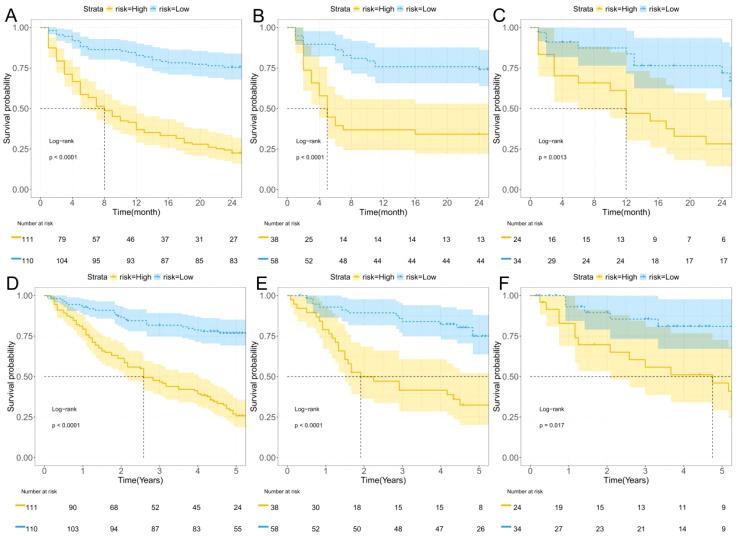
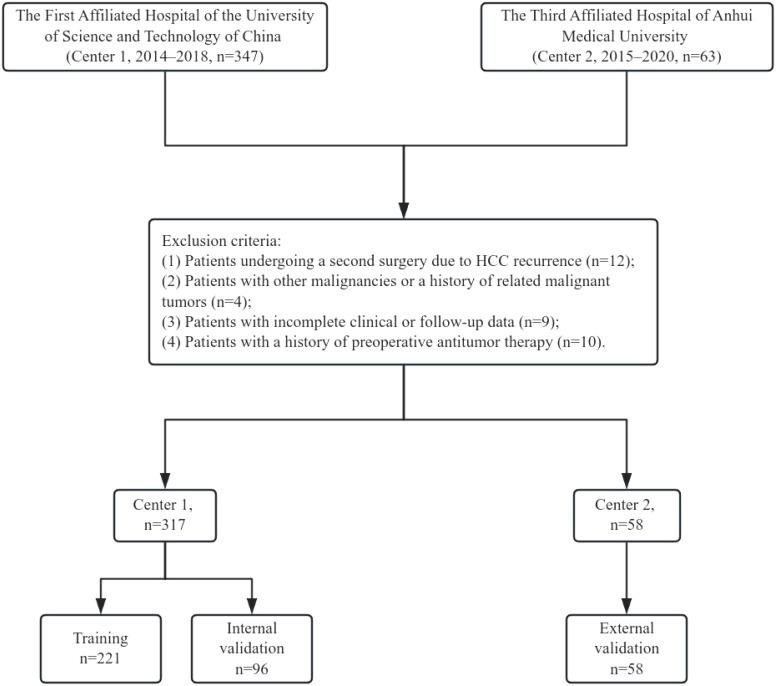
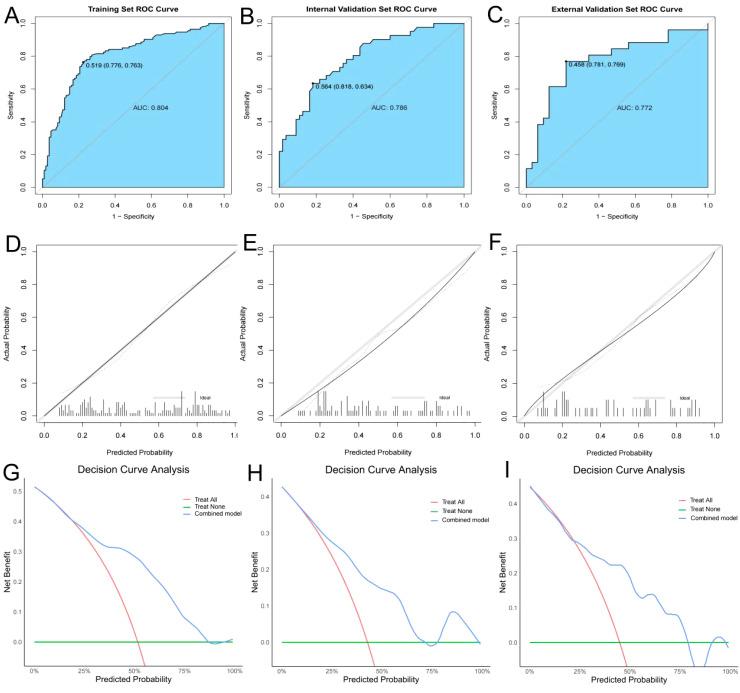
This study is a dual-center retrospective cohort study. Based on strict inclusion and exclusion criteria, 317 hepatocellular carcinoma (HCC) patients from Center 1 and 58 patients from Center 2 were enrolled. Patients from Center 1 were randomly allocated in a 7:3 ratio into a training set (n=221) and an internal validation set (n=96), while Center 2 served as an independent external validation set. In the training set, independent risk factors associated with early recurrence after hepatectomy for HCC were identified through univariate and multivariate analyses, and a predictive model was constructed. The predictive performance was evaluated using the area under the receiver operating characteristic (ROC) curve (AUC). Calibration curves and decision curve analysis (DCA) were employed to assess model calibration and clinical utility, respectively. Additionally, model interpretability was visualized through the SHapley Additive exPlanations (SHAP) framework. Based on the combined model's predictions, this study further stratified patients' two-year progression-free survival (PFS) and five-year overall survival (OS) using Kaplan-Meier curves.
RESULTS
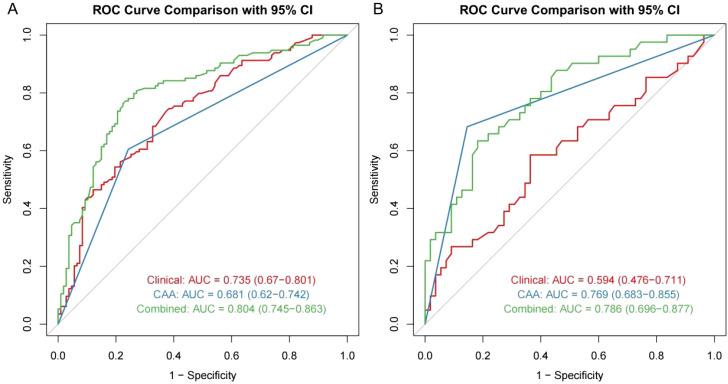
Univariate and multivariate analyses revealed that alpha-fetoprotein (AFP), total bilirubin (TB), postoperative ALT (ALTp), HBV infection history, tumor size, and change in AST and ALT (CAA) were independent risk factors for early recurrence (P<0.05). The predictive model incorporating these factors achieved an AUC of 0.804, demonstrating robust predictive capability. The model exhibited strong consistency between predicted outcomes and actual observations in the training, internal validation, and external validation sets.
CONCLUSION
This retrospective cohort study successfully established a predictive model for early recurrence after hepatectomy in HCC patients, highlighting its potential clinical utility.
背景与目的
肝细胞癌(HCC)术后早期复发倾向高,预后较差。在本研究中,我们旨在基于围手术期天冬氨酸转氨酶(AST)和丙氨酸转氨酶(ALT)水平的变化,开发一种新模型,以预测HCC肝切除术后的早期复发。
方法
本研究为双中心回顾性队列研究。根据严格的纳入和排除标准,纳入了中心1的317例肝细胞癌(HCC)患者和中心2的58例患者。中心1的患者按7:3的比例随机分为训练集(n = 221)和内部验证集(n = 96),而中心2作为独立的外部验证集。在训练集中,通过单因素和多因素分析确定了HCC肝切除术后早期复发的独立危险因素,并构建了预测模型。使用受试者操作特征(ROC)曲线下面积(AUC)评估预测性能。校准曲线和决策曲线分析(DCA)分别用于评估模型校准和临床实用性。此外,通过SHapley加性解释(SHAP)框架直观展示模型可解释性。基于联合模型的预测,本研究进一步使用Kaplan-Meier曲线对患者的两年无进展生存期(PFS)和五年总生存期(OS)进行分层。
结果
单因素和多因素分析显示,甲胎蛋白(AFP)、总胆红素(TB)、术后ALT(ALTp)、乙肝病毒感染史、肿瘤大小以及AST和ALT的变化(CAA)是早期复发的独立危险因素(P<0.05)。纳入这些因素的预测模型的AUC为0.804,显示出强大的预测能力。该模型在训练集、内部验证集和外部验证集中的预测结果与实际观察结果之间表现出很强的一致性。
结论
这项回顾性队列研究成功建立了HCC患者肝切除术后早期复发的预测模型,凸显了其潜在的临床实用性。


 Zotero 插件