
通过比较分析研究蔷薇属(蔷薇科)质体基因组特征及系统发育位置
Plastid genomic features and phylogenetic placement in Rosa (Rosaceae) through comparative analysis.
作者信息
Jiang Hui, He Shuilian, He Jun, Zuo Yunjuan, Guan Wenling, Zhao Yan, Li Xuejiao, Meng Jing
机构信息
College of Landscape and Horticulture, Yunnan Agricultural University, Kunming, 650201, China.
Germplasm Bank of Wild Species, Kunming Institute of Botany, Chinese Academy of Sciences, Kunming, 650201, China.
出版信息
BMC Plant Biol. 2025 Jun 4;25(1):752. doi: 10.1186/s12870-025-06734-0.
BACKGROUND
Species of the genus Rosa are among the commercially important exploited groups of ornamental plants in the world. Despite its wide application, the phylogenetic placement of many subgenera and sections of the genus is still unresolved due to hybridization, polyploidization, incomplete lineage sorting, low differentiation among the genus, and even their complex history of cultivation and breeding. Through more comprehensive taxon sampling, this study analyzed 18 representative Rosa plastid genomes, including 13 new sequences, to elucidate their phylogeny within the genus as well as the variation patterns in the plastid genomes.
RESULTS
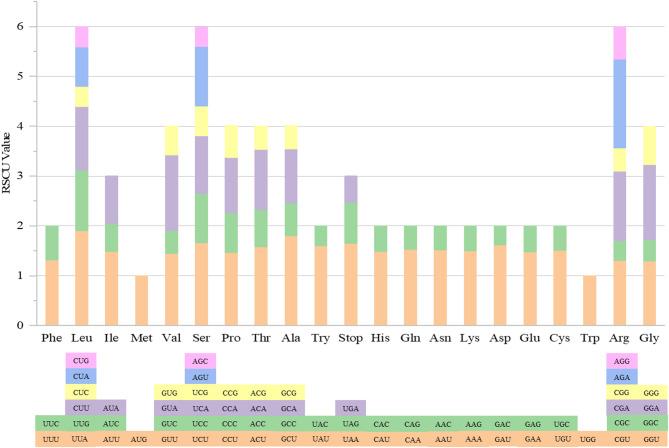
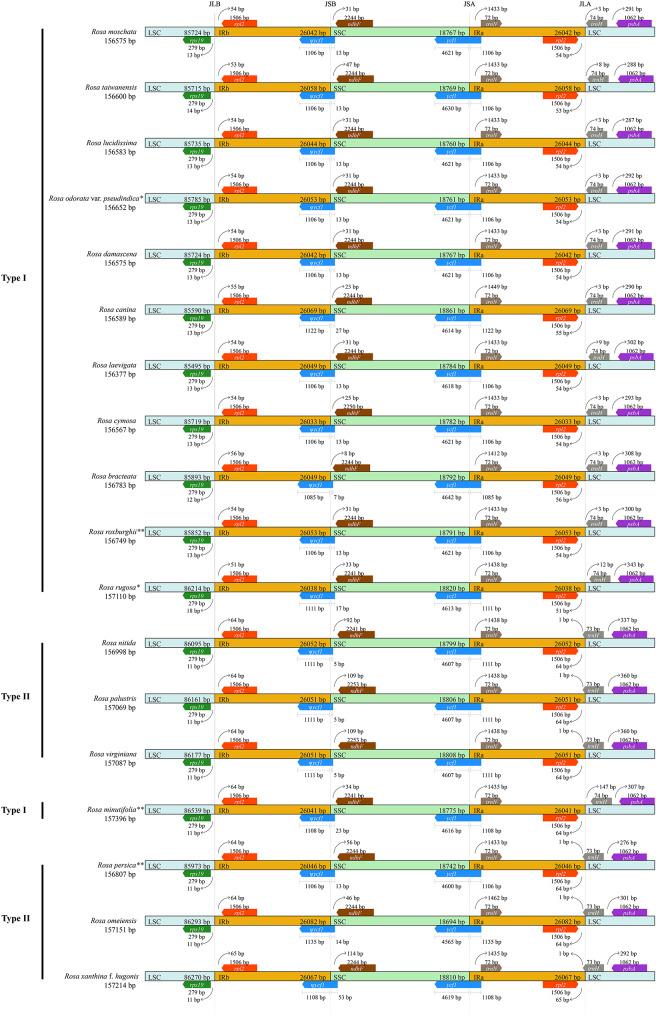
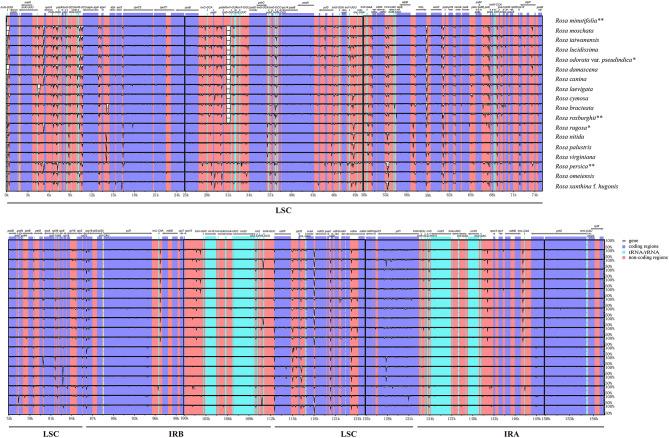
The results revealed that the length of 106 complete Rosa plastomes varied between 156,333 bp and 157,396 bp, with closed circular tetrad structures of the SSC and LSC regions separated by two IR regions. Comparative analysis subsequently revealed high similarity in the total GC content, gene order and PCGs (79) of Rosa plastomes. No significant contraction or expansion of the IR boundary was noted in most Rosa species, except for the trnH-GUG gene, which is found mainly in the LSC region but crosses the IRa/LSC boundary in basal taxa of the Rosa phylogenetic tree. Abundant SSRs (73-87) and long repeat sequences (36-52) were detected in Rosa plastomes, and most of these repeats could be found within the IGS region. Eight IGS regions were identified as highly variable regions, which provides potential information for developing molecular markers. Nineteen genes were discovered to have undergone significant positive selection. Phylogenetic analyses based on PCGs and complete plastome sequences indicated that the genus Rosa was monophyletic well grouped into seven major clades with high bootstrap support. Most previously-defined subgenera and sections were paraphyletic.
CONCLUSIONS
By assembling the largest known dataset of Rosa plastomes, the plastid genomic features across the genus were comprehensively studied before reconstructing a phylogenetic tree with a well-resolved backbone. However, the current study also shows the limitations of using plastomes to infer the phylogeny of some difficult taxa, and combining plastome, morphological and nuclear data together is recommended. This work offers valuable and basic sequence information for phylogenetic studies, species identification, Rosa species breeding and molecular genetics studies.
背景
蔷薇属植物是世界上具有重要商业价值的观赏植物类群之一。尽管其应用广泛,但由于杂交、多倍体化、不完全谱系分选、属内分化程度低,甚至其复杂的栽培和育种历史,该属许多亚属和组的系统发育位置仍未确定。通过更全面的分类群采样,本研究分析了18个代表性蔷薇属植物的质体基因组,包括13个新序列,以阐明它们在属内的系统发育以及质体基因组的变异模式。
结果
结果表明,106个完整蔷薇属植物质体基因组的长度在156,333 bp至157,396 bp之间,具有由两个反向重复(IR)区域分隔的小单拷贝(SSC)和大单拷贝(LSC)区域的闭合环状四分体结构。随后的比较分析显示,蔷薇属植物质体基因组的总GC含量、基因顺序和蛋白质编码基因(PCGs,共79个)具有高度相似性。在大多数蔷薇属物种中,未观察到IR边界有明显的收缩或扩张,除了trnH-GUG基因,该基因主要位于LSC区域,但在蔷薇系统发育树的基部类群中跨越IRa/LSC边界。在蔷薇属植物质体基因组中检测到丰富的简单序列重复(SSRs,73 - 87个)和长重复序列(36 - 52个),其中大多数重复序列可在基因间隔区(IGS)中找到。八个IGS区域被确定为高变区,这为开发分子标记提供了潜在信息。发现有19个基因经历了显著的正选择。基于PCGs和完整质体基因组序列的系统发育分析表明,蔷薇属是单系的,很好地分为七个主要分支,具有较高的自展支持率。大多数先前定义的亚属和组是并系的。
结论
通过组装已知最大的蔷薇属植物质体基因组数据集,在重建具有良好解析主干的系统发育树之前,全面研究了该属的质体基因组特征。然而,当前研究也显示了使用质体基因组推断一些疑难类群系统发育的局限性,建议将质体基因组、形态学和核数据结合起来。这项工作为系统发育研究、物种鉴定、蔷薇属植物育种和分子遗传学研究提供了有价值的基础序列信息。




 Zotero 插件