
与吸烟者、双重使用者和非吸烟者相比,电子烟使用者的局部和全身影响。
Local and systemic effects in e-cigarette users compared to cigarette smokers, dual users, and non-smokers.
作者信息
Sompa Shanzina Iasmin, Ji Jie, Rahman Mizanur, Sjögren Bengt, Upadhyay Swapna, Ganguly Koustav, Olin Anna-Carin, Bergström Anna, Palmberg Lena
机构信息
Integrative Toxicology unit, Institute of Environmental Medicine, Karolinska Institutet, Stockholm, 17177, Sweden.
School of Public Health and Community Medicine, Gothenburg University, Gothenburg, Sweden.
出版信息
Respir Res. 2025 Jun 4;26(1):207. doi: 10.1186/s12931-025-03289-4.
BACKGROUND
The use of electronic (e)-cigarettes in the long term has been associated with an increased risk of respiratory diseases. Dual use of e-cigarettes and traditional cigarettes may increase these risks even more due to the combined exposure effects of these products. The aim of this study was to investigate the local and systemic effects of e-cigarette use for more than one year and compare them with healthy non-smokers, cigarette smokers, and dual users.
METHODS
The clinical study was conducted among 22 healthy non-smokers, 20 e-cigarette users, 20 cigarette smokers, and 20 dual users. Participants were matched with age and BMI, had normal baseline lung function, and had no allergies. Exhaled FeNO and bronchial responsiveness were assessed along with reactive oxygen species (ROS), toll-like receptor (TLR) expression, and inflammatory cytokines in blood and sputum.
RESULTS
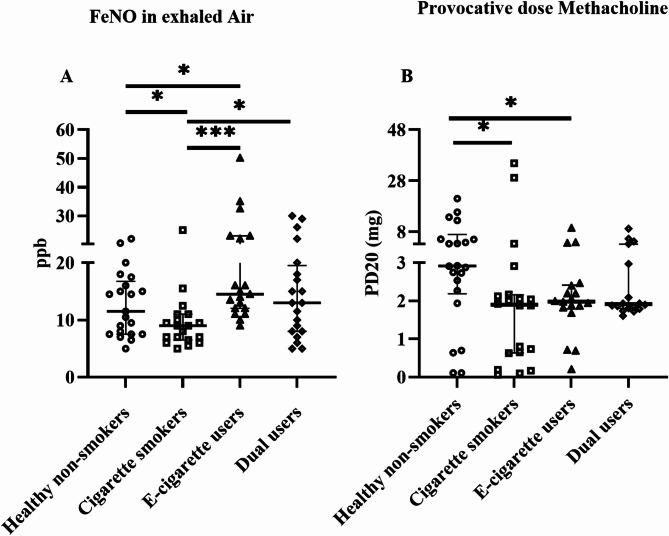
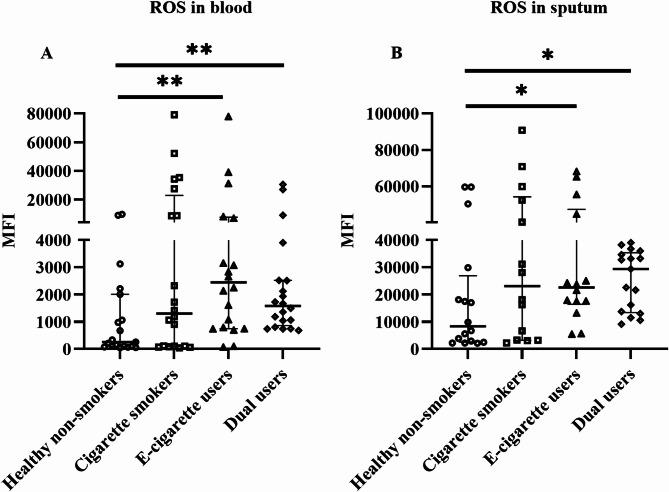
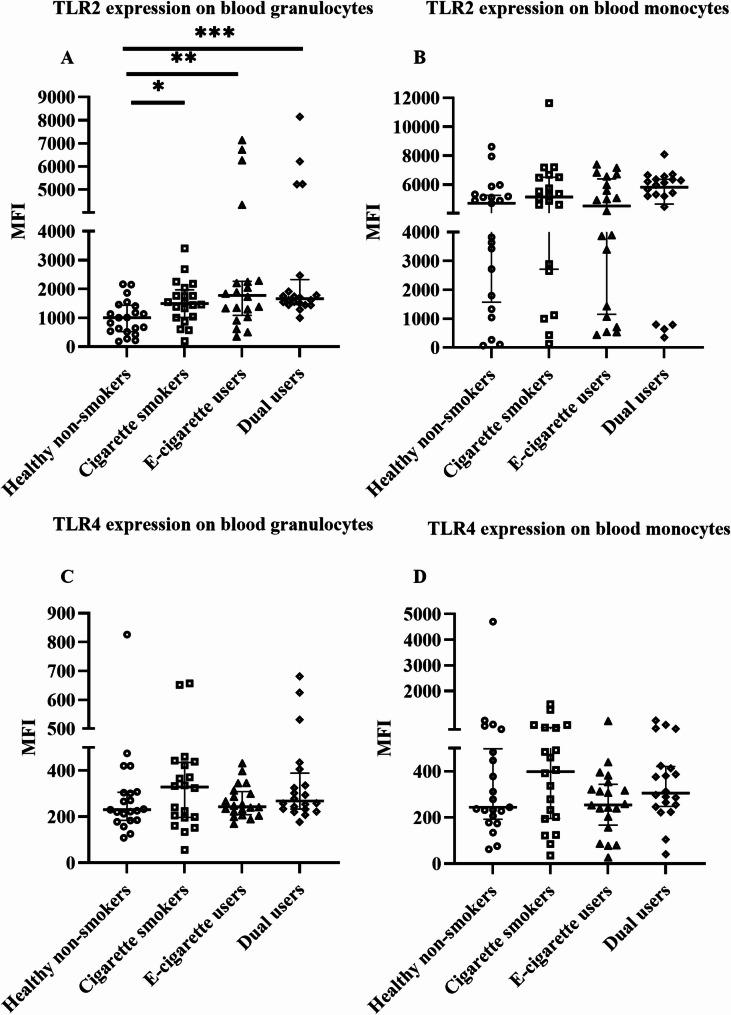
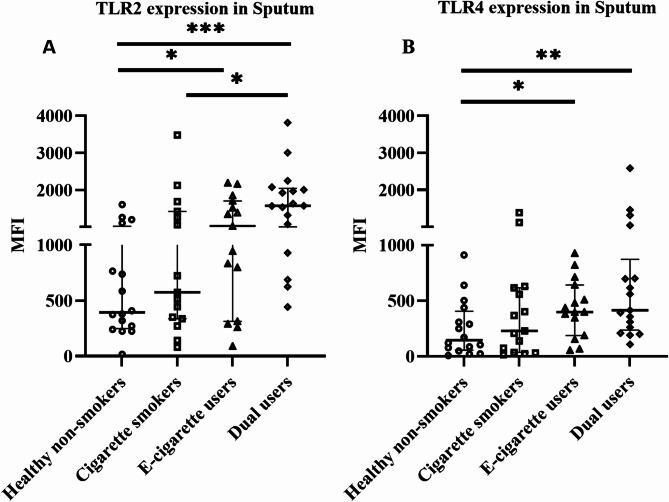
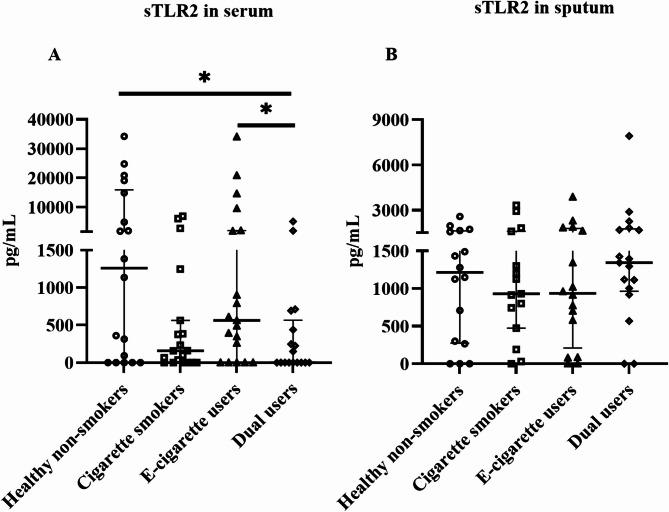
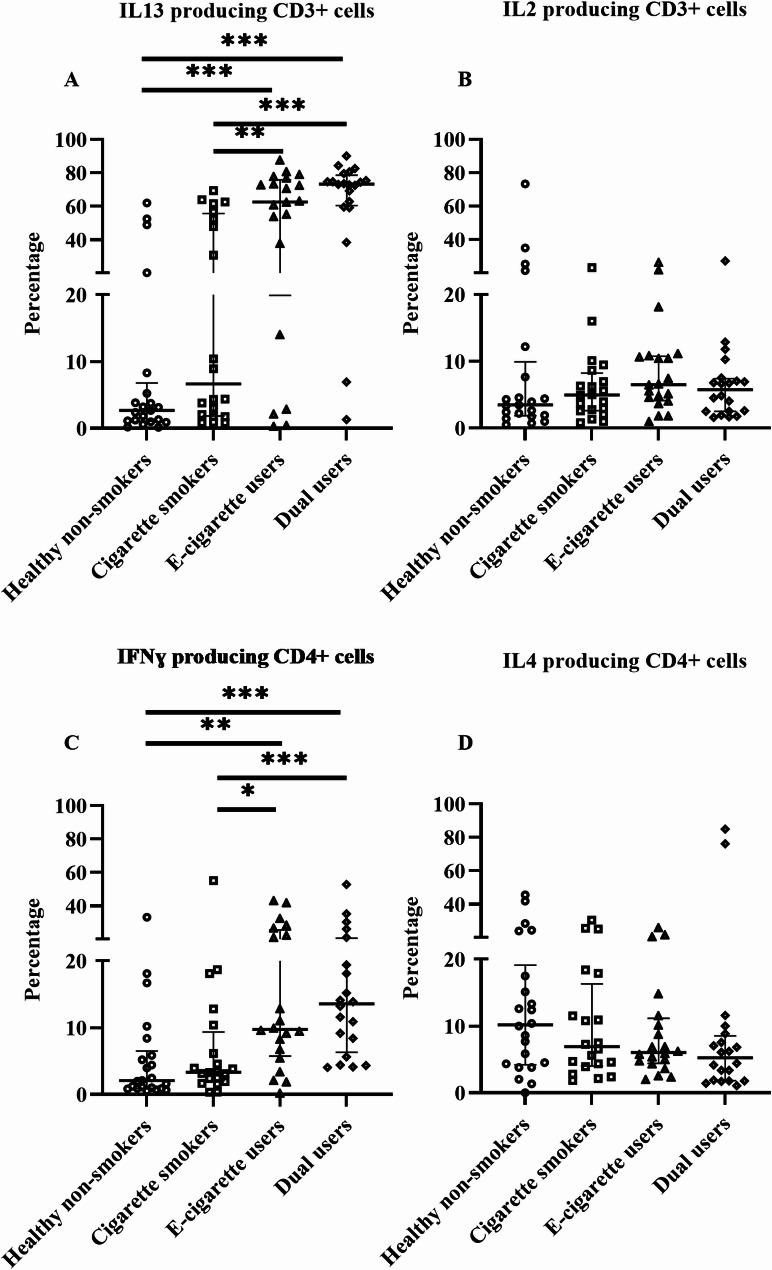
Exhaled FeNO was higher in e-cigarette users (14 ppb, p = 0.04) and lower in cigarette smokers (9 ppb, p = 0.04) compared to healthy non-smokers (11 ppb). Bronchial responsiveness was increased in e-cigarette users (1.9 mg, p = 0.01) and cigarette smokers (1.9 mg, p = 0.01) compared to healthy non-smokers (2.9 mg). ROS in blood and sputum in e-cigarette users (p = 0.005 and p = 0.04) and dual users (p = 0.003 and p = 0.04) were increased. Also, TLR2 expression in blood granulocytes in all exposed groups (p = 0.001), TLR2 and TLR4 expression in sputum in e-cigarette users (p = 0.04 and p = 0.03) and dual users (p < 0.0001 and p = 0.004) were increased. Moreover, the percentage of IL13 and IFNγ cytokine-producing T cells in blood were increased in e-cigarette users (p = 0.0001 and p < 0.0001) and dual users (p = 0.001 and p < 0.0001).
CONCLUSION
Our research indicates that both local and systemic inflammatory responses, along with innate immune receptor activity, were significantly altered in e-cigarette users and dual users. Notably, these alterations were detected in e-cigarette users within a short timeframe of just 1 to 3 years of use.
CLINICAL TRIAL NUMBER
Not applicable.
背景
长期使用电子烟与呼吸系统疾病风险增加有关。电子烟和传统香烟的双重使用可能由于这些产品的联合暴露效应而使这些风险进一步增加。本研究的目的是调查使用电子烟一年以上的局部和全身影响,并将其与健康非吸烟者、吸烟者和双重使用者进行比较。
方法
该临床研究在22名健康非吸烟者、20名电子烟使用者、20名吸烟者和20名双重使用者中进行。参与者在年龄和体重指数方面相匹配,基线肺功能正常,且无过敏史。评估呼出一氧化氮(FeNO)、支气管反应性以及血液和痰液中的活性氧(ROS)、Toll样受体(TLR)表达和炎性细胞因子。
结果
与健康非吸烟者(11 ppb)相比,电子烟使用者呼出的FeNO较高(14 ppb,p = 0.04),吸烟者呼出的FeNO较低(9 ppb,p = 0.04)。与健康非吸烟者(2.9 mg)相比,电子烟使用者(1.9 mg,p = 0.01)和吸烟者(1.9 mg,p = 0.01)的支气管反应性增加。电子烟使用者(p = 0.005和p = 0.04)和双重使用者(p = 0.003和p = 0.04)血液和痰液中的ROS增加。此外,所有暴露组血液中粒细胞的TLR2表达(p = 0.001)、电子烟使用者(p = 0.04和p = 0.03)和双重使用者(p < 0.0001和p = 0.004)痰液中的TLR2和TLR4表达增加。此外,电子烟使用者(p = 0.

 Zotero 插件