
基于个体模型对军事人员集体用餐期间呼吸道传染病传播的理论流行病学调查。
A theoretical epidemiological investigation into the transmission of respiratory infectious diseases during group meals among military personnel based on an individual-based model.
作者信息
Guo Zuiyuan, Liu Kun, Jiang Huawei, Yu Di, Xiao Guangquan, Wang Yayu, Cui Wei, Li Jiangfan, Tian Jing, Yang Yimin, Wang Feng
机构信息
The First Department of Infectious Disease Prevention and Control, Center for Disease Control and Prevention in Northern Theater Command, Shenyang, China.
Department of Epidemiology, School of Public Health, Air Force Medical University, Xi'an, China.
出版信息
Front Public Health. 2025 May 21;13:1545938. doi: 10.3389/fpubh.2025.1545938. eCollection 2025.
INTRODUCTION
Within military settings, soldiers are arranged to eat together in a self-service manner for every meal. The process of food selection and consumption often leads to close contact amongst individuals, heightening the risk of respiratory infectious disease transmission. To comprehend the transmission dynamics during communal dining, we have conducted an in-depth epidemiological investigation.
METHODS
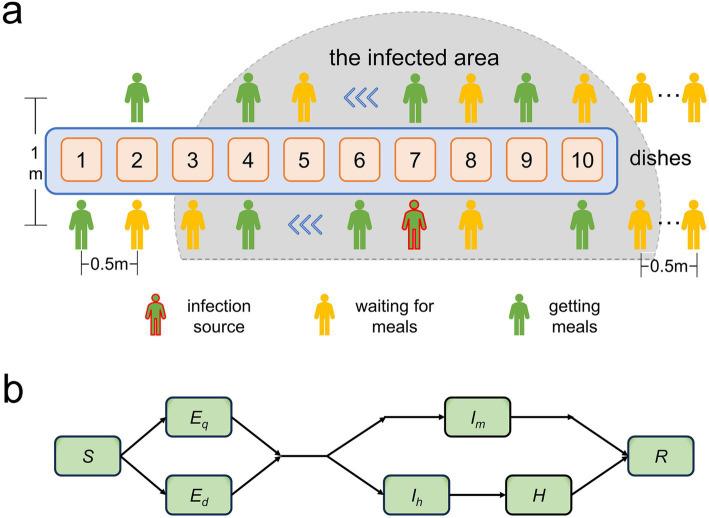
The dining process was divided into two phases: lining up for food and dining at designated seats. Soldiers were randomly split into two queues and entered the food selection area from the same side. The movements of the soldiers dynamically altered both the queues and the contact duration and distance between susceptible individuals and infection sources. We utilized a random computer model using MATLAB software, with the individual as the unit of study, for simulating the food selection process. This model quantitatively analyzed the dynamic process of disease transmission within the queues due to the dispersion of small pathogen-carrying particles.
RESULTS
Our findings indicate that close interactions between individuals during picking up food can result in the persistent transmission of airborne infectious diseases. Implementing measures such as discontinuing buffet-style meals, implementing staggered dining schedules, and mandating mask-wearing during food collection could help control disease transmission during an epidemic.
DISCUSSION
This study demonstrates that the individual-based model can simulate the dynamic process of disease transmission through complex behavioral activities and is more suitable for conducting research on the dynamics of infectious diseases in small-scale populations. Since this is a simulation conducted in a virtual scenario, the results of the model still need to be verified through field investigations. Nevertheless, once robust outbreak investigation studies have yielded reliable model parameters, these parameters can be adapted to this and other similar situations to demonstrate the potential for transmission.
引言
在军事环境中,士兵每餐都以自助方式一起用餐。食物选择和食用过程常常导致个体之间密切接触,增加了呼吸道传染病传播的风险。为了理解集体用餐期间的传播动态,我们进行了深入的流行病学调查。
方法
用餐过程分为两个阶段:排队取餐和在指定座位用餐。士兵被随机分成两队,从同一侧进入食物选择区。士兵的行动动态改变了队列以及易感个体与传染源之间的接触持续时间和距离。我们使用MATLAB软件的随机计算机模型,以个体为研究单位,模拟食物选择过程。该模型定量分析了由于携带病原体的小颗粒扩散导致队列内疾病传播的动态过程。
结果
我们的研究结果表明,取餐时个体之间的密切互动可能导致空气传播传染病的持续传播。采取诸如停止自助餐形式、实施错峰用餐时间表以及在取餐时强制佩戴口罩等措施,有助于在疫情期间控制疾病传播。
讨论
本研究表明,基于个体的模型可以模拟通过复杂行为活动的疾病传播动态过程,更适合于对小规模人群中传染病动态进行研究。由于这是在虚拟场景中进行的模拟,模型结果仍需通过现场调查进行验证。然而,一旦强有力的疫情调查研究得出可靠的模型参数,这些参数可适用于此及其他类似情况,以证明传播的可能性。


 Zotero 插件