
革兰氏阴性菌的高通量临床抗菌药敏试验及耐药亚群检测
High-throughput clinical antimicrobial susceptibility testing and drug-resistant subpopulation detection in Gram-negative bacteria.
作者信息
Hu QingFeng, Zhou Yuhan, Zhu Yongze, Ma Zixuan, Li Tongtong, Yao Shuhang, Pan Ju, Shi Mengyan, Su Fang, Shen Beiqiong, Li Xi, Ruan Benfang Helen, Wang Jiaxue
机构信息
School of Laboratory Medicine and Bioengineering, Hangzhou Medical College, Hangzhou, Zhejiang, China.
Zhejiang Provincial People's Hospital (Affiliated People's Hospital), Hangzhou Medical College, Hangzhou, Zhejiang, China.
出版信息
Microbiol Spectr. 2025 Jul;13(7):e0001125. doi: 10.1128/spectrum.00011-25. Epub 2025 Jun 5.
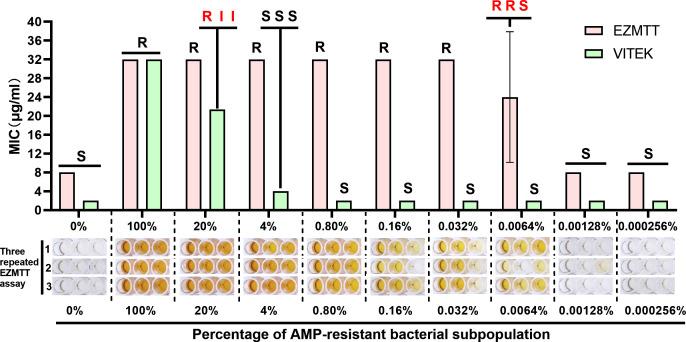
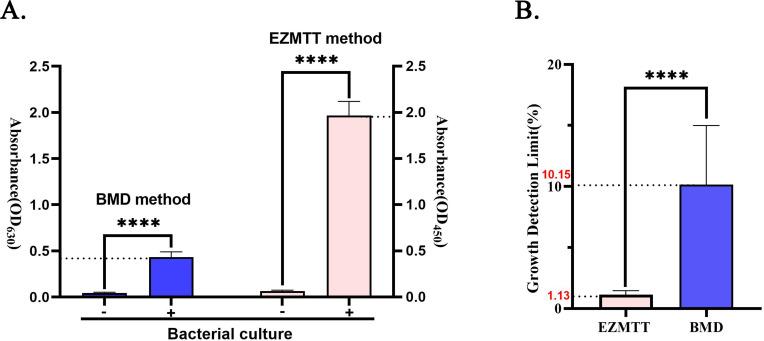
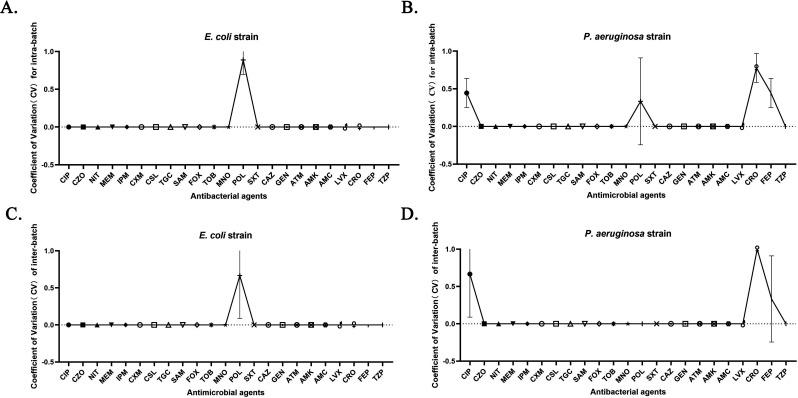
The optimized Easy and Zooming MTT (EZMTT)-based antimicrobial susceptibility testing (AST) method for Gram-negative bacteria demonstrated 5- to 20-fold enhanced sensitivity and improved the detection limit to approximately 1.13% ± 0.30% growth. This advancement enables the detection of drug-resistant subpopulations that were previously undetectable by the gold standard broth microdilution (BMD) method, which has a growth limitation of approximately 10.15% ± 4.70%. Consistent results were achieved through AST of 205 clinical bacterial samples using both the EZMTT and BMD methods. At 450 nm, the overall positive and negative compliance rates were 98.94% and 99.58%, respectively, with a kappa value of 0.981 and a 95% CI of 0.974-0.988. For each of the 23 antibiotics tested, compliance rates exceeded 90.00%, with kappa values above 0.794 ~ 1.000 for 21 of them. Notably, the AST screening identified a clinical strain (KP007) containing drug-resistant subpopulations. Further analysis using the K-B method identified 13 drug-resistant subpopulations in KP007, with detection rates of 100% by the EZMTT method, 77% by the BMD method, and less than 44% by the VITEK method. A series of heteroresistant strains was generated by mixing the parent-sensitive strain (DH10B) with fivefold dilutions of its resistant strain transformed with an ampicillin resistance gene (DH10B-Amp). Results indicated that the EZMTT method is more than 3,000 times more effective at detecting the resistant subpopulation (DH10B-Amp) compared to VITEK. In conclusion, this study demonstrates that the EZMTT method exhibits good consistency and stability and is a highly sensitive AST method for detecting drug-resistant subpopulations in Gram-negative bacteria.IMPORTANCEBacterial drug resistance represents a significant global health concern. Currently, the minimum inhibitory concentration (MIC) is widely accepted as a primary criterion for determining bacterial sensitivity or resistance. However, pathogenic bacteria classified as sensitive based on MIC criteria may still exhibit resistance. One crucial factor contributing to this phenomenon is the heterogeneity of bacterial resistance. Due to the small number of drug-resistant bacteria in these subpopulations, their corresponding drug resistance is often challenging to detect in MIC data. AST remains a critical method for guiding the use of antibacterial agents. In this study, we employed the EZMTT method to accurately detect drug-resistant bacterial subpopulations. This method significantly improved assay consistency, stability, and sensitivity in clinical bacterial strains when compared with other methods. Consequently, the application of EZMTT-modified BMD assay in clinical settings may potentially prevent the development of multidrug-resistant bacteria and enhance the treatment of infectious diseases in the future.
基于优化的简易变焦MTT(EZMTT)的革兰氏阴性菌抗菌药敏试验(AST)方法,灵敏度提高了5至20倍,检测限提高到约1.13%±0.30%的生长率。这一进展使得能够检测出以前金标准肉汤微量稀释(BMD)方法无法检测到的耐药亚群,BMD方法的生长限制约为10.15%±4.70%。使用EZMTT和BMD方法对205份临床细菌样本进行AST检测,结果一致。在450nm处,总体阳性和阴性符合率分别为98.94%和99.58%,kappa值为0.981,95%置信区间为0.974 - 0.988。对于所测试的23种抗生素中的每一种,符合率均超过90.00%,其中21种的kappa值高于0.794至1.000。值得注意的是,AST筛查鉴定出一株含有耐药亚群的临床菌株(KP007)。使用K - B方法进一步分析发现,KP007中有13个耐药亚群,EZMTT方法的检测率为100%,BMD方法为77%,VITEK方法低于44%。通过将亲本敏感菌株(DH10B)与其用氨苄青霉素抗性基因转化的抗性菌株(DH10B - Amp)进行五倍稀释混合,产生了一系列异质性耐药菌株。结果表明,与VITEK相比,EZMTT方法检测耐药亚群(DH10B - Amp)的效率高出3000多倍。总之,本研究表明EZMTT方法具有良好的一致性和稳定性,是检测革兰氏阴性菌耐药亚群的高灵敏度AST方法。
重要性
细菌耐药性是全球重大的健康问题。目前,最低抑菌浓度(MIC)被广泛接受为确定细菌敏感性或耐药性的主要标准。然而,根据MIC标准分类为敏感的病原菌仍可能表现出耐药性。导致这种现象的一个关键因素是细菌耐药性的异质性。由于这些亚群中耐药细菌数量较少,其相应的耐药性在MIC数据中往往难以检测到。AST仍然是指导抗菌药物使用的关键方法。在本研究中,我们采用EZMTT方法准确检测耐药细菌亚群。与其他方法相比,该方法显著提高了临床细菌菌株检测的一致性、稳定性和灵敏度。因此,在临床环境中应用EZMTT改良的BMD检测方法可能有助于预防多重耐药细菌的产生,并在未来加强传染病的治疗。


 Zotero 插件