
催产素促进大鼠的人类触摸诱导游戏行为。
Oxytocin facilitates human touch-induced play behavior in rats.
作者信息
Hayashi Himeka, Tateishi Sayaka, Inutsuka Ayumu, Maejima Sho, Hagiwara Daisuke, Sakuma Yasuo, Onaka Tatsushi, Grinevich Valery, Sakamoto Hirotaka
机构信息
Department of Biology, Faculty of Environmental, Life, Natural Science and Technology, Okayama University, 3-1-1 Tsushimanaka, Kita-ku, Okayama 700-8530, Japan; Ushimado Marine Institute (UMI), Faculty of Environmental, Life, Natural Science and Technology, Okayama University, Ushimado, Setouchi, Okayama 701-4303, Japan.
Ushimado Marine Institute (UMI), Faculty of Environmental, Life, Natural Science and Technology, Okayama University, Ushimado, Setouchi, Okayama 701-4303, Japan.
出版信息
Curr Biol. 2025 Jun 23;35(12):2916-2926.e3. doi: 10.1016/j.cub.2025.05.034. Epub 2025 Jun 4.
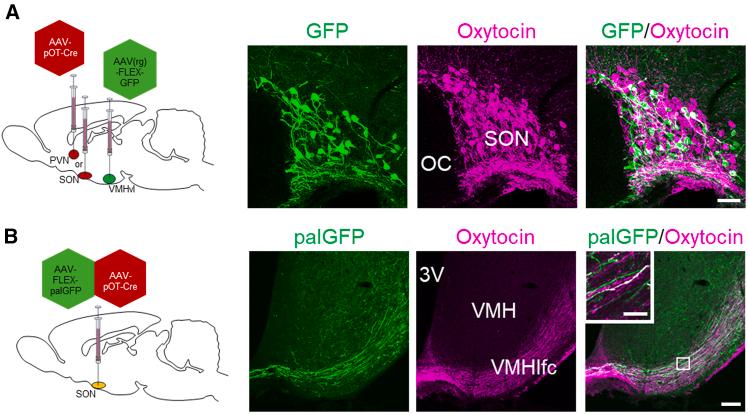
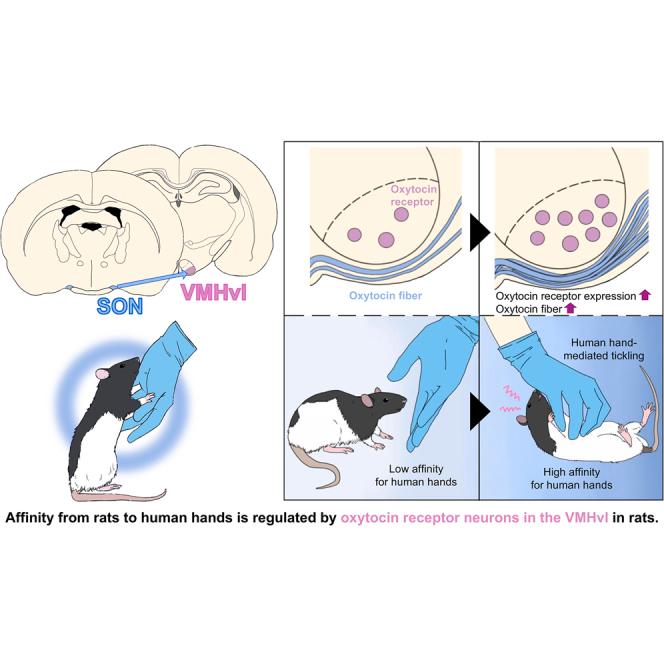
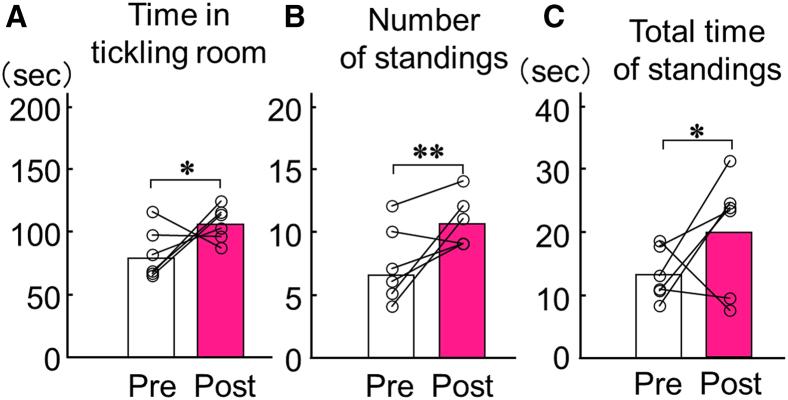
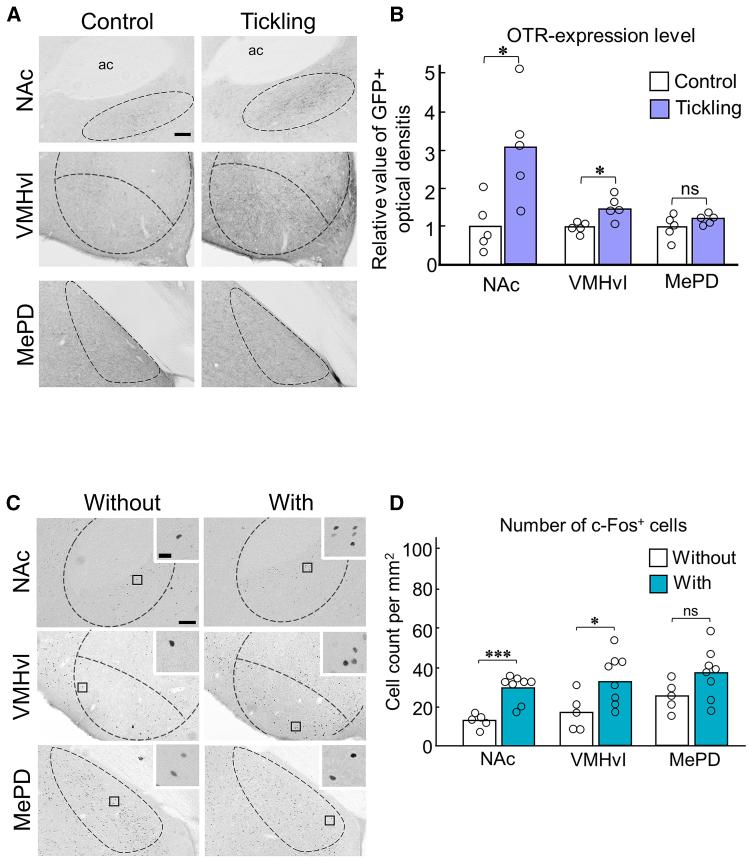
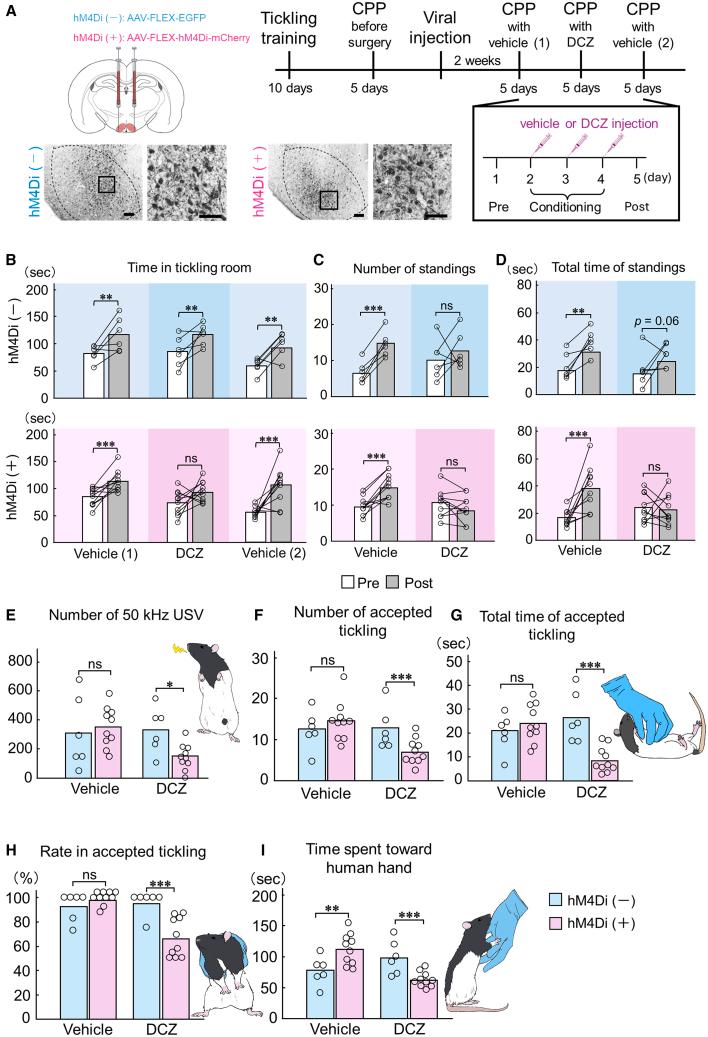
Pleasant touch sensations play a fundamental role in social bonding, yet the neural mechanisms underlying affinity-like behaviors remain poorly understood. Here, we demonstrate that juvenile-adolescent rats, which naturally engage in social play with peers characterized by rough-and-tumble interactions and 50 kHz ultrasonic vocalizations indicating pleasant sensations, develop a strong affinity for human hands through similar playful contact achieved by repeated tickling with human hands. Using this rat with tickling-induced high affinity for human hands, we discovered that repeated tickling mimicking rough-and-tumble play led to increased oxytocin receptor (OTR) expression in the ventrolateral part of the ventromedial hypothalamus (VMHvl). Inhibition of oxytocin signaling in the VMHvl reduced affinity-like behaviors from rats to human hands. These findings suggest that OTR neurons in VMHvl play an important role in the increase in affinity for human hands induced by pleasant touch sensation with human touch-induced play behavior. Based on retrograde and anterograde tracing studies examining the supraoptic nucleus (SON) and the paraventricular nucleus (PVN) as primary sources of oxytocin, we demonstrate that a subset of oxytocin fibers in the VMHvl originate from the SON, suggesting that affinity-like behavior from rats to human hands may be controlled by oxytocin signaling from magnocellular neurons. Together, this work advances our understanding of how oxytocin shapes social behavior and may inform the development of therapeutic strategies to promote positive social interactions.
愉悦的触觉在社会联结中起着基础性作用,然而,类似亲密行为背后的神经机制仍知之甚少。在这里,我们证明了幼年到青少年期的大鼠,它们自然地与同伴进行社交玩耍,其特点是有激烈的扭打互动和表明愉悦感觉的50千赫兹超声波发声,通过与人类手部反复挠痒痒所实现的类似玩耍接触,它们对人类的手产生了强烈的亲近感。利用这种对人类的手有挠痒痒诱导的高亲近感的大鼠,我们发现,模仿激烈扭打玩耍的反复挠痒痒会导致腹内侧下丘脑腹外侧部分(VMHvl)的催产素受体(OTR)表达增加。抑制VMHvl中的催产素信号会降低大鼠对人类的手的类似亲密行为。这些发现表明,VMHvl中的OTR神经元在由人类触摸诱导的玩耍行为所产生的愉悦触觉引起的对人类的手的亲近感增加中起重要作用。基于对作为催产素主要来源的视上核(SON)和室旁核(PVN)进行的逆行和顺行追踪研究,我们证明VMHvl中一部分催产素纤维起源于SON,这表明大鼠对人类的手的类似亲密行为可能受大细胞神经元的催产素信号控制。总之,这项工作推进了我们对催产素如何塑造社会行为的理解,并可能为促进积极社会互动的治疗策略的开发提供信息。


 Zotero 插件