
亚洲碳青霉烯类耐药的流行情况及分子流行病学:一项系统评价和荟萃分析
Prevalence and molecular epidemiology of carbapenem resistance in Asia: a systematic review and meta-analysis.
作者信息
Jayathilaka Nishadi, Shehana Sashini, Nakkawita Dilini, Senaratne Thamarasi
机构信息
Faculty of Graduate Studies, General Sir John Kotelawala Defence University, Ratmalana, Colombo, 10390, Sri Lanka.
School of Life Sciences, Edinburgh Napier University, Scotland, UK.
出版信息
Syst Rev. 2025 Jun 5;14(1):123. doi: 10.1186/s13643-025-02776-5.
BACKGROUND
Carbapenems are a group of last-resort antibiotics used to treat serious life-threatening infections. The emergence of resistance to carbapenems is a major public health threat. However, comprehensive information on the prevalence and molecular epidemiology of carbapenem resistance (CR) among Asian countries is lacking. Therefore, we aimed to determine the prevalence of CR and associated molecular determinants quantitatively among Asian countries.
METHODS
In this systematic review and meta-analysis, we searched published reports in electronic databases such as PubMed, ScienceDirect, the Cochrane Library, and Web of Science from 1 of January 2014 to 31 of January 2024 that fulfilled these criteria; original studies conducted in Asian countries including clinical isolates, and published in English. Data extraction and risk-of-bias assessment were performed by two independent reviewers. The pooled prevalence of CR with 95% confidence interval (CI) was computed with a random effects model. Heterogeneity across studies was determined by I. The geographical location, income level, publication year, and sample size were analyzed as subgroups.
RESULTS
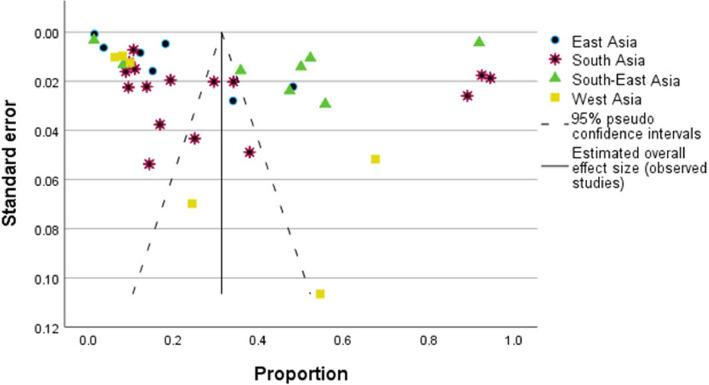
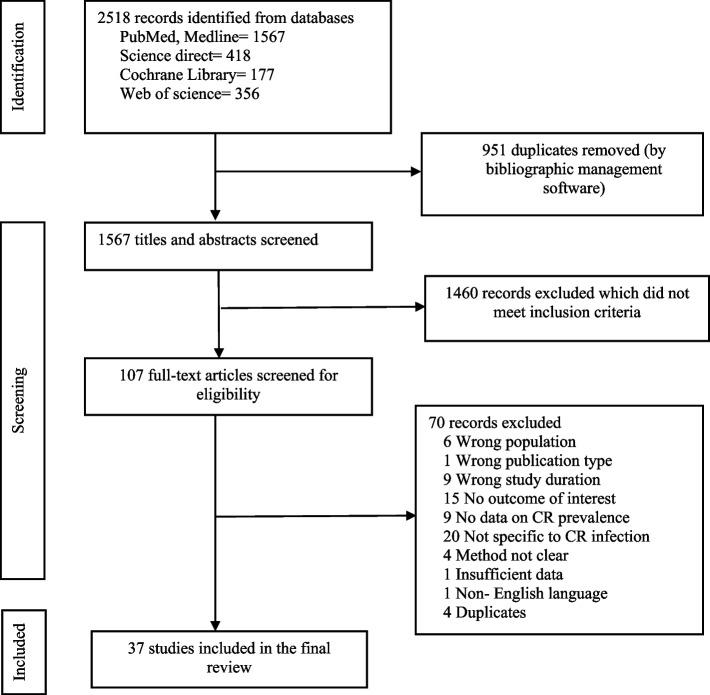
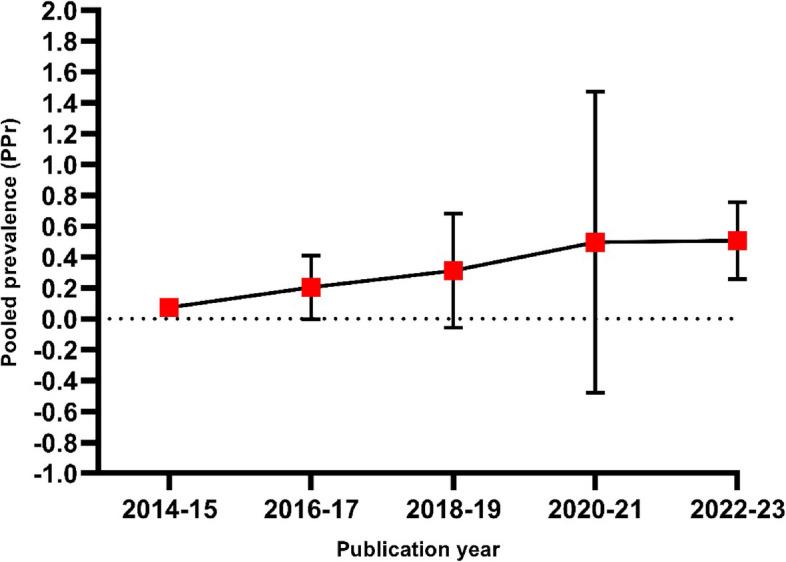
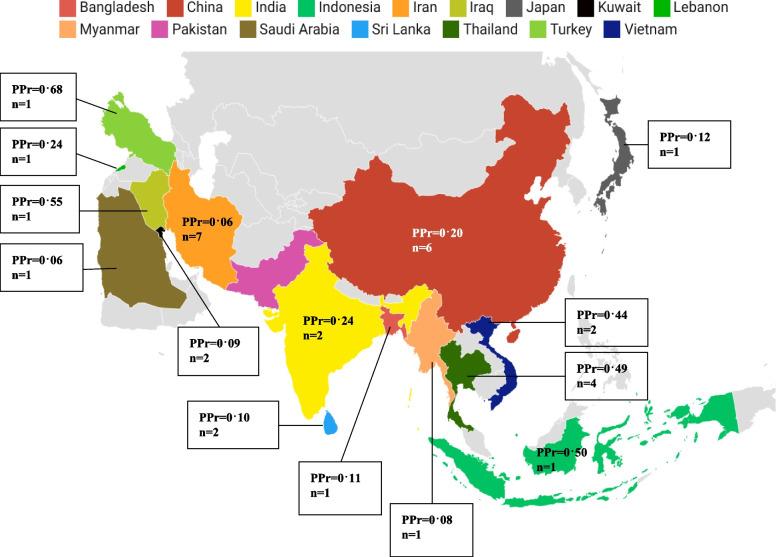
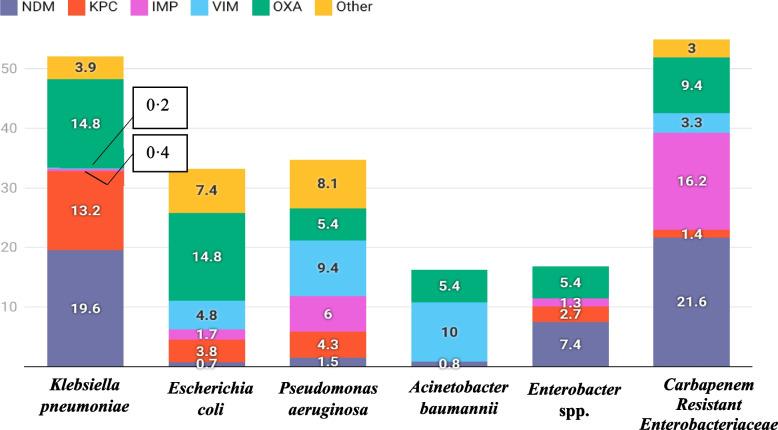
We identified 2518 eligible studies, of which 37 assessed the CR prevalence data of 10,433 patients. The pooled prevalence (PPr) of CR was 31.3% (95% CI: 0.22 to 0.40; I = 99.9%; P = 0.00). A trend of CR incidence was observed from 2004 to 2023, with PPr values ranging from 7.4% to 50.6%. A variation in the distribution of CR genes was observed, with bla being the most common gene, followed by bla and bla. Univariate meta-regression analysis indicated that geographical location, income level, publication year, and sample size did not significantly affect heterogeneity (P < 0.05).
CONCLUSION
The results suggest that surveillance of CR among Asian countries is essential to reduce the burden of antibiotic resistance. Mitigating the impact of CR infections will safeguard the efficacy of carbapenems for future generations and reduce further dissemination of CR genes.
SYSTEMATIC REVIEW REGISTRATION
PROSPERO CRD42024515806.
背景
碳青霉烯类是用于治疗严重危及生命感染的一类最后手段的抗生素。对碳青霉烯类耐药性的出现是一个重大的公共卫生威胁。然而,亚洲国家中关于碳青霉烯类耐药性(CR)的流行情况和分子流行病学的全面信息尚缺乏。因此,我们旨在定量确定亚洲国家中CR的流行情况及相关分子决定因素。
方法
在这项系统评价和荟萃分析中,我们检索了电子数据库(如PubMed、ScienceDirect、Cochrane图书馆和Web of Science)中从2014年1月1日至2024年1月31日发表的符合这些标准的报告;在亚洲国家进行的包括临床分离株的原始研究,且以英文发表。由两名独立评审员进行数据提取和偏倚风险评估。采用随机效应模型计算CR的合并患病率及95%置信区间(CI)。通过I²确定研究间的异质性。将地理位置、收入水平、发表年份和样本量作为亚组进行分析。
结果
我们确定了2518项符合条件的研究,其中37项评估了10433例患者的CR患病率数据。CR的合并患病率(PPr)为31.3%(95%CI:0.22至0.40;I² = 99.9%;P = 0.00)。观察到2004年至2023年CR发病率的趋势,PPr值范围为7.4%至50.6%。观察到CR基因分布存在差异,bla是最常见的基因,其次是bla和bla。单变量meta回归分析表明,地理位置、收入水平、发表年份和样本量对异质性没有显著影响(P < 0.05)。
结论
结果表明亚洲国家中对CR的监测对于减轻抗生素耐药负担至关重要。减轻CR感染的影响将保障碳青霉烯类对后代的疗效,并减少CR基因的进一步传播。
系统评价注册
PROSPERO CRD42024515806。

 Zotero 插件