
信迪利单抗诱导的史蒂文斯-约翰逊综合征:一例报告及文献复习
Stevens-Johnson syndrome induced by Sintilimab: a case report and literature review.
作者信息
Kuang Huan, Huang DongBei, Hu ChuXiang, Gong LiPing, Yu ZiYu, Zhu XunJin, Lan HongRong, Huang Gang
机构信息
Department of Postgraduate, Jiangxi University of Chinese Medicine, Nanchang, Jiangxi, China.
Dermatology Department, Affiliated Hospital of Jiangxi University of Chinese Medicine, Nanchang, Jiangxi, China.
出版信息
Front Oncol. 2025 May 22;15:1568316. doi: 10.3389/fonc.2025.1568316. eCollection 2025.
BACKGROUND
Skin diseases induced by Sintilimab, a programmed cell death protein-1 (PD-1) inhibitor, are rare, with only 28 cases reported. We provide a literature review on skin diseases associated with Sintilimab and summarize the patient's primary disease, duration of Sintilimab use, treatment, and disease progression. This study aims to improve understanding of Stevens-Johnson syndrome (SJS) induced by this monoclonal antibody and its treatment strategies.
CASE DESCRIPTION
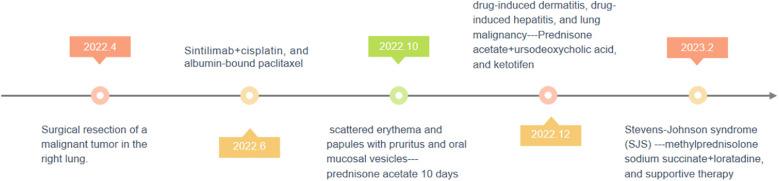
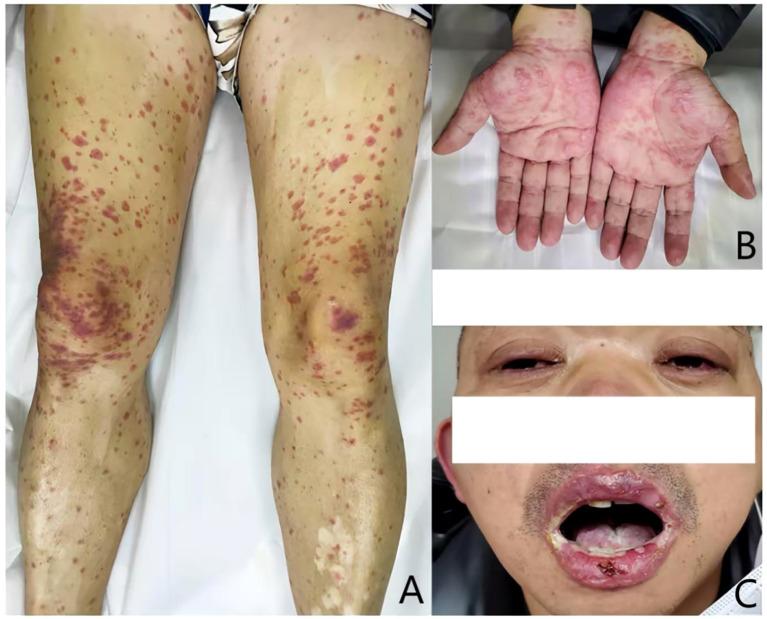
We report a case of SJS induced by Sintilimab in a patient treated at our hospital. The patient exhibited widespread erythema, papules, and vesicles, accompanied by mucosal erosion and exudation in the oral cavity, eyes, urethral orifice, and perianal region. The patient was immediately treated with intravenous methylprednisolone sodium succinate (40 mg/day), antihistamines, and supportive care, including fluid replacement and wound care. His symptoms gradually improved, and he was discharged after 20 days. At the 6-month follow-up, he remained stable, with no recurrence of symptoms.
CONCLUSIONS
Although severe drug rash, including SJS, caused by PD-1 inhibitors is relatively uncommon, its underlying molecular pathogenesis remains unclear. Physicians should remain vigilant regarding potential adverse reactions when prescribing Sintilimab. If severe reactions occur, discontinuation of chemotherapy and immediate administration of adequate corticosteroids with symptomatic support can help reduce morbidity and mortality.
背景
程序性细胞死亡蛋白1(PD-1)抑制剂信迪利单抗引起的皮肤疾病较为罕见,仅报告了28例。我们对与信迪利单抗相关的皮肤疾病进行文献综述,并总结患者的原发疾病、信迪利单抗使用时长、治疗方法及疾病进展情况。本研究旨在提高对这种单克隆抗体诱发的史蒂文斯-约翰逊综合征(SJS)及其治疗策略的认识。
病例描述
我们报告了1例在我院接受治疗的患者由信迪利单抗诱发SJS的病例。患者出现广泛的红斑、丘疹和水疱,伴有口腔、眼睛、尿道口及肛周区域的黏膜糜烂和渗出。患者立即接受了静脉注射琥珀酸甲泼尼龙(40毫克/天)、抗组胺药治疗及包括补液和伤口护理在内的支持治疗。其症状逐渐改善,20天后出院。在6个月的随访中,他病情稳定,症状未复发。
结论
尽管由PD-1抑制剂引起的严重药疹(包括SJS)相对少见,但其潜在的分子发病机制仍不清楚。医生在开具信迪利单抗处方时应警惕潜在的不良反应。如果发生严重反应,停用化疗并立即给予足量糖皮质激素及对症支持治疗有助于降低发病率和死亡率。

 Zotero 插件