
墨西哥全国范围内实施基于单片第二代整合酶抑制剂治疗的经验。
Experience of a Nationwide implementation of single-tablet second-generation integrase inhibitors-based treatment in Mexico.
作者信息
Piñeirúa-Menéndez Alicia, Caro-Vega Yanink, Mosqueda-Gómez Juan Luis, Ríos Santiago Ávila, Badial-Hernández Florentino, la Torre-Rosas Alethse De, Sierra-Madero Juan
机构信息
CISIDAT, Health Research Consortium, Dwight W. Morrow 8-Interior 7, Cuernavaca Centro, Centro, 62000 Cuernavaca, Morelos, México.
Departamento de Inmunoinfectología, Instituto Nacional de Ciencias Médicas y Nutrición, Salvador Zubirán. Vasco de Quiroga 15, Belisario Domínguez Secc 16, Tlalpan, 14080 Ciudad de México, México.
出版信息
IJID Reg. 2025 Apr 7;15:100645. doi: 10.1016/j.ijregi.2025.100645. eCollection 2025 Jun.
OBJECTIVES
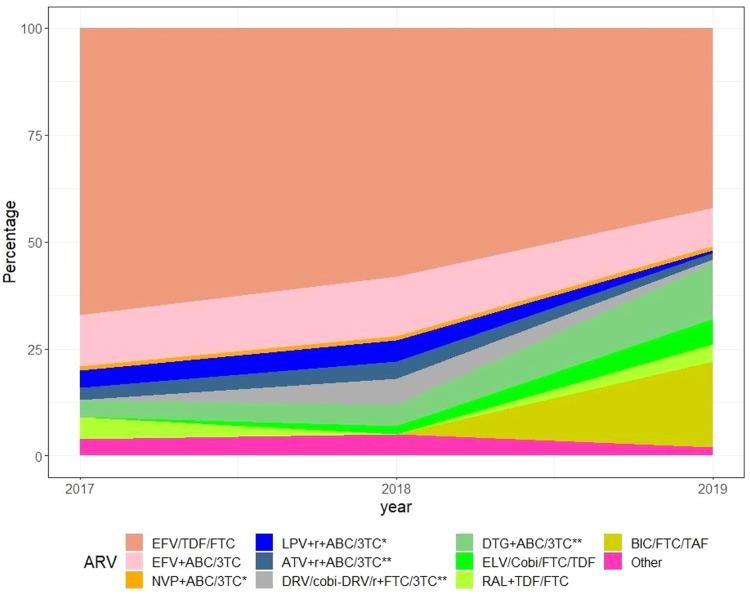
In Mexico, until 2018, antiretroviral therapy (ART) primarily relied on efavirenz-containing regimens or other options suitable for optimization, with ART costs among the highest in the region. This study evaluated the impact of a national strategy using single-tablet, second-generation integrase inhibitors (STSGII)-either bictegravir, emtricitabine, and tenofovir alafenamide or abacavir/lamivudine/dolutegravir-for ART initiation or switch.
METHODS
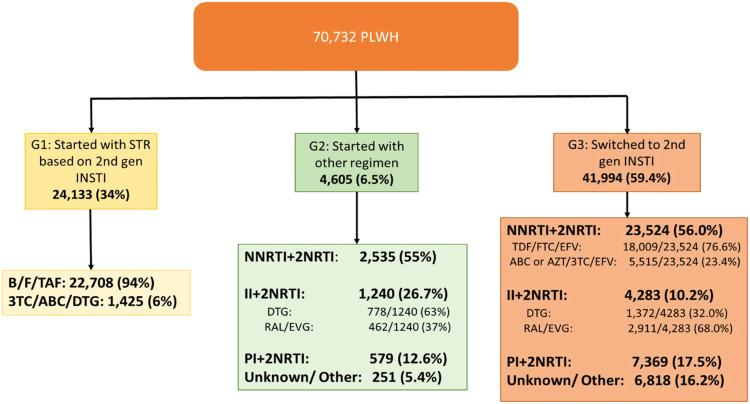
Adults initiating or switching to STSGII between June 1, 2019, and June 30, 2021, at clinics for individuals without social security, were categorized into three groups: G1 (initiated with STSGII), G2 (initiated with non-STSGII), and G3 (switched to STSGII). The switch was defined as individuals changing ART in the presence of virological suppression. Viral suppression (VS) at 6 months post-initiation or switch was reported. A Cox model evaluated VS and regimen durability, defined as maintaining VS without ART change, loss to follow-up, or death.
RESULTS
A total of 70,732 individuals were included; 24,133 (34.1%) on G1, 4605 (6.5%) on G2, and 41,994 (59.4%) on G3. VS was achieved in 85.7%, 52.7%, and 82.7% of individuals in G1, G2, and G3, respectively. Durability was met in 85.1%, 41.3%, and 90.8% of individuals in G1, G2, and G3.
CONCLUSIONS
Second-generation INSTIs are effective and durable in this 2-year follow-up analysis, both for ART initiation and optimization in Mexico's population, offering a valuable strategy for improving ART outcomes.
目的
在墨西哥,直到2018年,抗逆转录病毒疗法(ART)主要依赖含依非韦伦的治疗方案或其他适合优化的方案,该地区ART成本位居最高之列。本研究评估了使用单片第二代整合酶抑制剂(STSGII)——比克替拉韦、恩曲他滨和替诺福韦艾拉酚胺或阿巴卡韦/拉米夫定/多替拉韦——用于ART起始或转换的国家策略的影响。
方法
2019年6月1日至2021年6月30日期间,在无社会保障人员诊所开始或转换为STSGII的成年人被分为三组:G1组(开始使用STSGII)、G2组(开始使用非STSGII)和G3组(转换为STSGII)。转换定义为在病毒学抑制状态下改变ART的个体。报告起始或转换后6个月时的病毒抑制(VS)情况。采用Cox模型评估VS和治疗方案的持久性,持久性定义为在不改变ART、失访或死亡的情况下维持VS。
结果
共纳入70732例个体;G1组24133例(34.1%),G2组4605例(6.5%),G3组41994例(59.4%)。G1组、G2组和G3组分别有85.7%、52.7%和82.7%的个体实现了VS。G1组、G2组和G3组分别有85.1%、41.3%和90.8%的个体达到了持久性。
结论
在这项为期2年的随访分析中,第二代整合酶链转移抑制剂(INSTIs)在墨西哥人群中用于ART起始和优化方面均有效且持久,为改善ART结局提供了一项有价值的策略。

 Zotero 插件