
播种前用生物银纳米颗粒处理谷物可刺激玉米生长并影响其氧化还原稳态。
Pre-sowing grain treatment with bio-AgNPs stimulates plant growth and affects redox homeostasis in maize.
作者信息
Trzcińska-Wencel Joanna, Mucha Natalia, Rai Mahendra, Tyburski Jarosław, Golińska Patrycja
机构信息
Department of Microbiology, Faculty of Biological and Veterinary Sciences, Nicolaus Copernicus University in Toruń, Toruń, Poland.
Department of Plant Physiology and Biotechnology, Faculty of Biological and Veterinary Sciences, Nicolaus Copernicus University in Toruń, Toruń, Poland.
出版信息
Front Plant Sci. 2025 May 22;16:1494741. doi: 10.3389/fpls.2025.1494741. eCollection 2025.
INTRODUCTION
In the pursuit of sustainable development, nanotechnology provides effective solutions for enhancing agricultural productivity. Nanomaterials (NMs) can be effective in increasing plant abiotic and biotic stress tolerance. Understanding the nanoparticles (NPs)-plant interaction is essential to identify the potential of NPs for growth stimulation and phytotoxicity risks. Therefore, this study aimed to evaluate the effects of biologically synthesized silver nanoparticles (AgNPs) from IOR 825 on the growth of . Furthermore, the effect of AgNPs on oxidative stress and the antioxidant response was assessed.
METHODS
AgNPs were efficiently synthesized from IOR 825 and characterized for physicochemical properties using transmission electron microscopy (TEM), nanoparticle tracking analysis (NTA), dynamic light scattering (DLS), X-ray diffraction (XRD), and Fourier transform infrared (FTIR) spectroscopy and measurement of Zeta potential. AgNPs at concentrations of 32, 128, and 512 µg mL were used for the pre-sowing treatment of maize grains to inhibit microbial pathogens present on their surface. Sterilized maize grains were cultivated for 14 days for plantlet development. Subsequently, germination percentage (%G), mean germination time (MGT), germination rate index (GRI), fresh and dry weight (FW and DW), and the Ag content in plant organs and total chlorophyll content were analyzed. Hydrogen peroxide (HO) and malondialdehyde (MDA) were determined in leaves, roots, stems, and caryopses to assess the oxidative stress. The antioxidative system response to the AgNPs treatment was studied by determining total glutathione (GSH+GSSG) and ascorbate (ASC) contents as well as catalase (CAT), superoxide dismutase (SOD), peroxidase (POX), and ascorbate peroxidase (APX) activities.
RESULTS
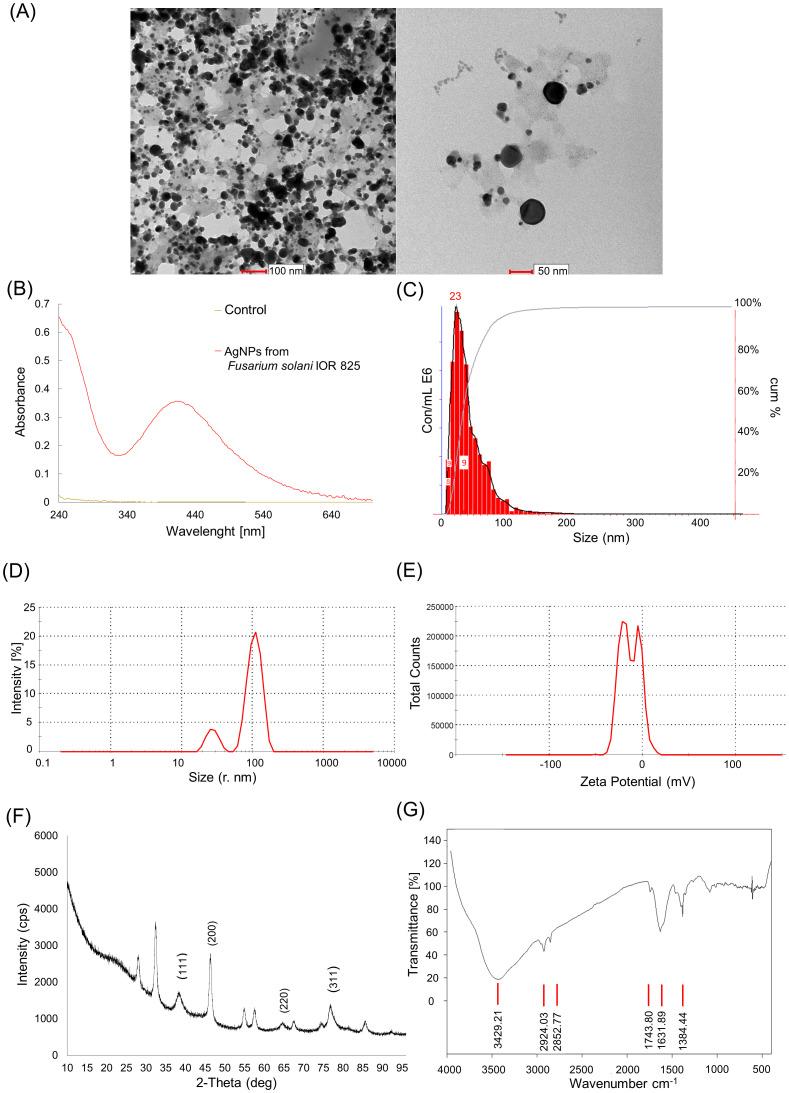
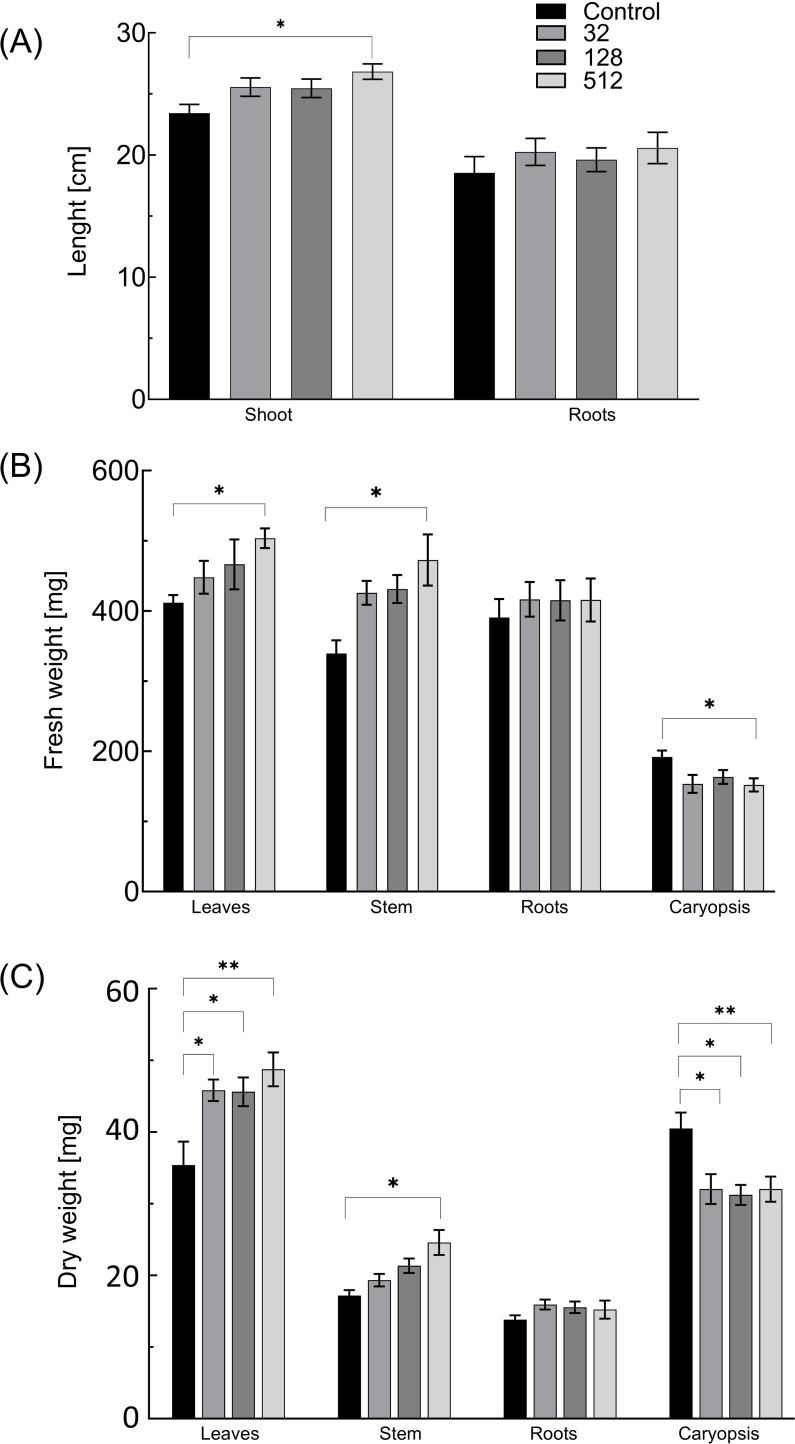
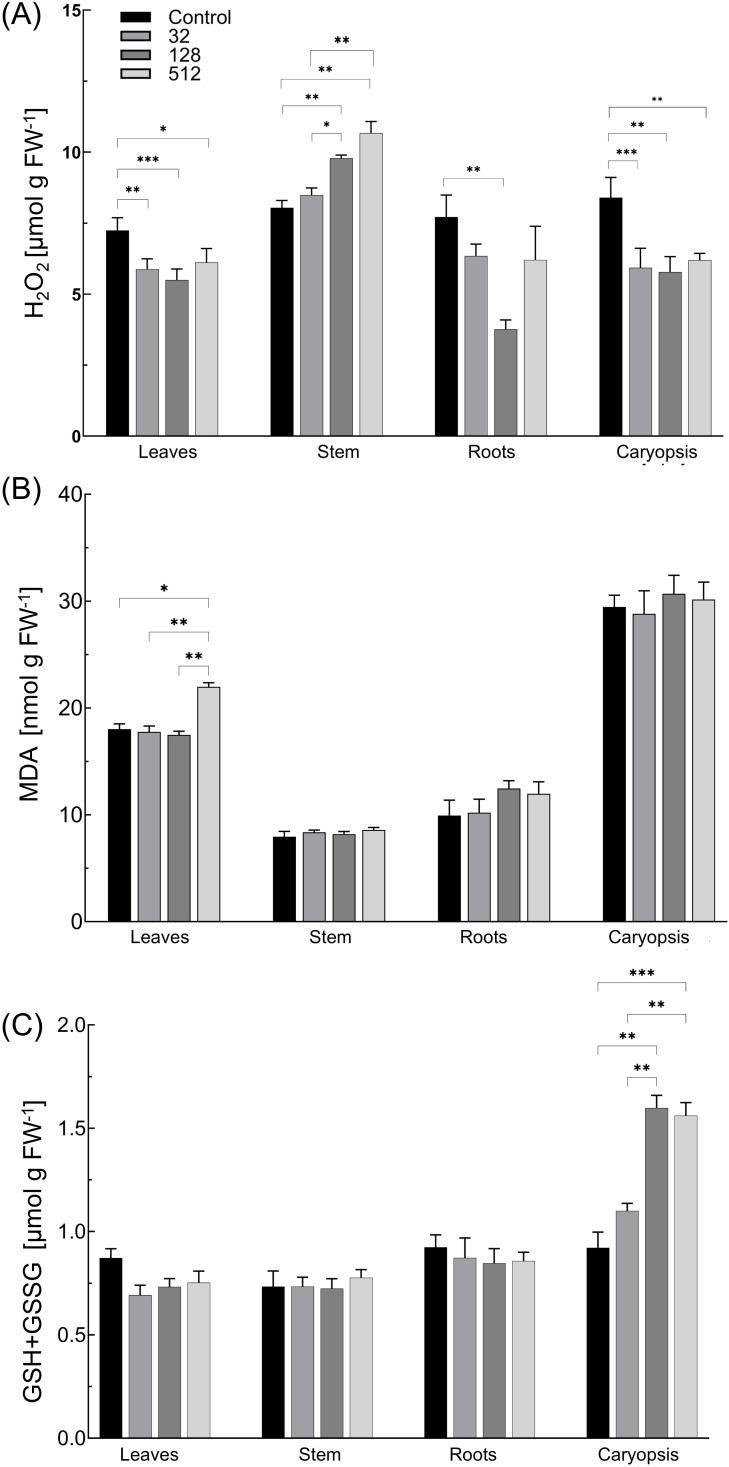
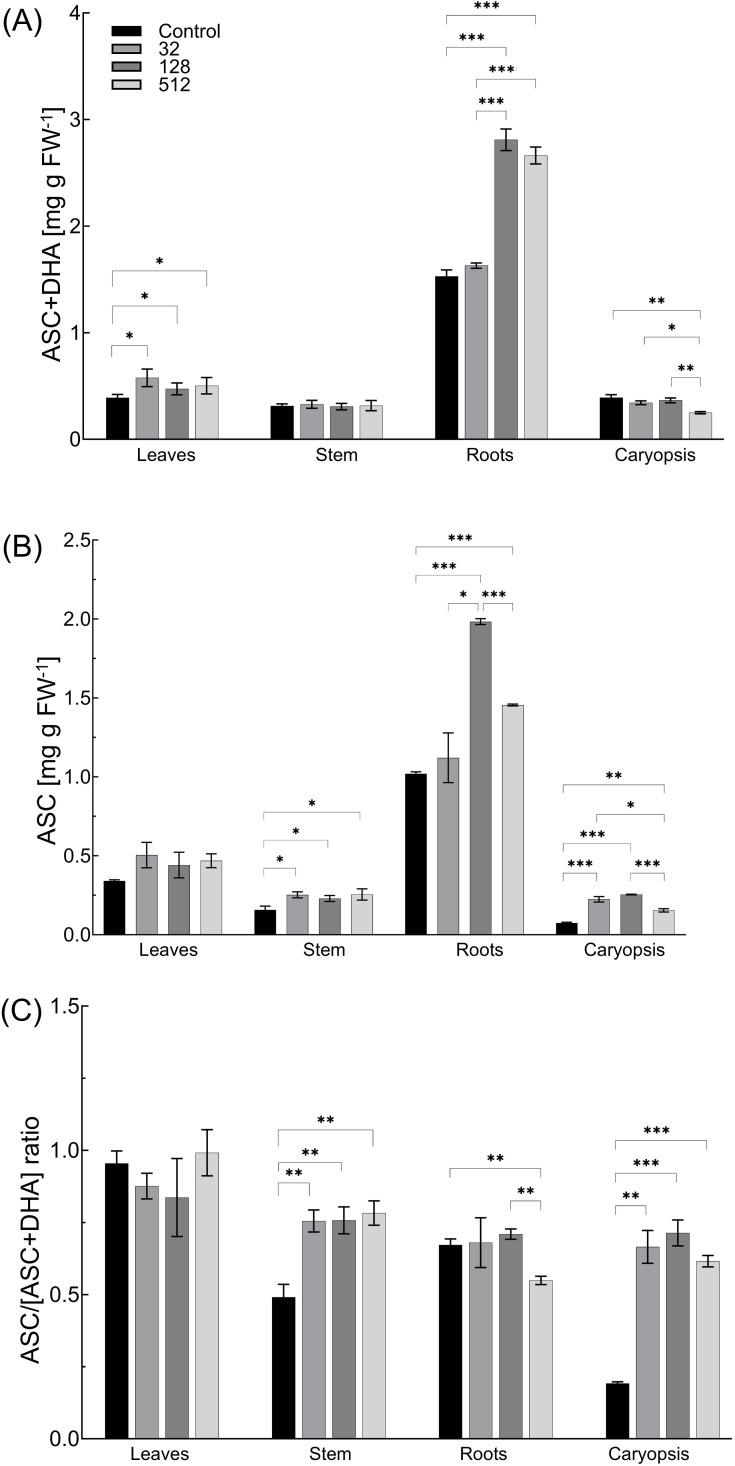
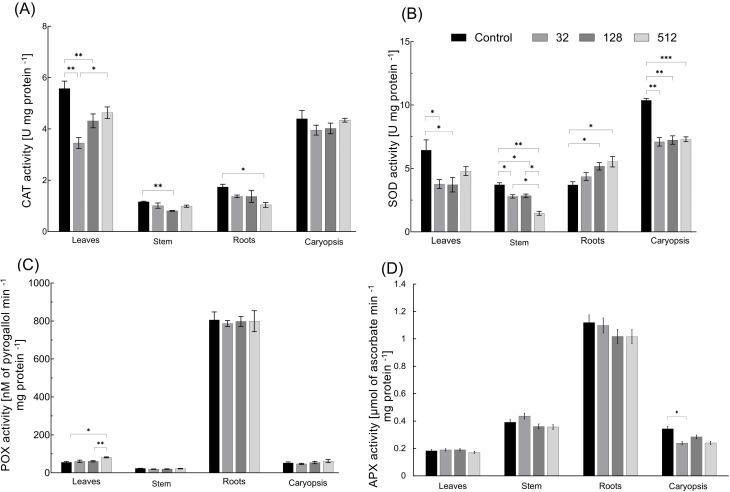
AgNPs were spherical and small [TEM average diameter of 22.97 ± 9.4 nm, NTA average size of 43 ± 36 nm, and DLS average hydrodynamic diameters of 27.44 nm (14%) and 108.4 nm (86%)]. Zeta potential revealed that NPs were negatively charged [-19.5 mV (61.3%) and -2.93 mV (38.6%)]. The diffractogram of AgNPs confirmed the presence of a face-centered cubic structure of crystalline AgNPs, while FTIR spectra showed the presence of biomolecules on their surface. The results showed a dose-dependent effect on maize growth. The increase in length and fresh weight of plants treated with a AgNPs concentration of 512 µg mL was noted. The treatment with all tested concentrations of AgNPs (32, 128, and 512 µg mL) resulted in increased dry weight of leaves. Reduced chlorophyll content was observed in plants treated with the highest tested concentration of AgNPs (512 µg mL). The treatment of grains with AgNPs decreased HO levels in all organs, except the stem where the oxidant's level increased. MDA levels were unaffected except for the highest tested concentration of AgNPs, which raised its content in leaves. ASC and total glutathione levels were increased in roots and caryopses, respectively. The highest impact of AgNPs treatment was determined for SOD activity, which decreased in leaves, stems, and caryopses and increased in roots. CAT activity was decreased in leaves, stems, and roots. There was a minor effect on POX and APX activities.
CONCLUSION
The lowest tested concentration of AgNPs (32 µg mL) on maize efficiently inhibits maize-borne pathogens, without any negative effect on plant growth and chlorophyll content. Moreover, it does not provoke oxidative stress. However, AgNPs may affect cellular redox systems when their higher concentrations (128 and 512 µg mL) are used. The results indicate the potential use of biogenically synthesized AgNPs in agriculture through a crop-safe approach to eliminate pathogens and increase maize production efficiency.
引言
在追求可持续发展的过程中,纳米技术为提高农业生产力提供了有效的解决方案。纳米材料(NMs)可有效提高植物对非生物和生物胁迫的耐受性。了解纳米颗粒(NPs)与植物的相互作用对于确定NPs促进生长的潜力和植物毒性风险至关重要。因此,本研究旨在评估从IOR 825生物合成的银纳米颗粒(AgNPs)对[植物名称未给出]生长的影响。此外,还评估了AgNPs对氧化应激和抗氧化反应的影响。
方法
从IOR 825高效合成AgNPs,并使用透射电子显微镜(TEM)、纳米颗粒跟踪分析(NTA)、动态光散射(DLS)、X射线衍射(XRD)、傅里叶变换红外(FTIR)光谱以及Zeta电位测量对其理化性质进行表征。将浓度为32、128和512 μg/mL的AgNPs用于玉米种子的播种前处理,以抑制其表面存在的微生物病原体。对灭菌后的玉米种子进行14天的培养以促进幼苗发育。随后,分析发芽率(%G)、平均发芽时间(MGT)、发芽速率指数(GRI)、鲜重和干重(FW和DW),以及植物器官中的银含量和总叶绿素含量。测定叶片、根、茎和颖果中的过氧化氢(H₂O₂)和丙二醛(MDA)含量,以评估氧化应激。通过测定总谷胱甘肽(GSH+GSSG)和抗坏血酸(ASC)含量以及过氧化氢酶(CAT)、超氧化物歧化酶(SOD)、过氧化物酶(POX)和抗坏血酸过氧化物酶(APX)活性,研究抗氧化系统对AgNPs处理的反应。
结果
AgNPs呈球形且尺寸较小[TEM平均直径为22.97±9.4 nm,NTA平均尺寸为43±36 nm,DLS平均流体动力学直径为27.44 nm(14%)和108.4 nm(86%)]。Zeta电位显示NPs带负电荷[-19.5 mV(61.3%)和-2.93 mV(38.6%)]。AgNPs的衍射图谱证实了结晶AgNPs存在面心立方结构,而FTIR光谱显示其表面存在生物分子。结果表明对玉米生长有剂量依赖性影响。注意到用512 μg/mL的AgNPs浓度处理的植物的长度和鲜重增加。用所有测试浓度的AgNPs(32、128和512 μg/mL)处理均导致叶片干重增加。在用最高测试浓度的AgNPs(512 μg/mL)处理的植物中观察到叶绿素含量降低。用AgNPs处理谷物降低了所有器官中的H₂O₂水平,但茎中氧化剂水平增加除外。除了最高测试浓度的AgNPs使叶片中MDA含量升高外,MDA水平未受影响。根和颖果中的ASC和总谷胱甘肽水平分别升高。确定AgNPs处理对SOD活性影响最大,其在叶片、茎和颖果中降低,在根中升高。CAT活性在叶片、茎和根中降低。对POX和APX活性影响较小。
结论
对玉米测试的最低浓度的AgNPs(32 μg/mL)可有效抑制玉米携带的病原体,对植物生长和叶绿素含量无任何负面影响。此外,它不会引发氧化应激。然而,当使用较高浓度(128和512 μg/mL)的AgNPs时,可能会影响细胞氧化还原系统。结果表明通过作物安全方法生物合成的AgNPs在农业中具有潜在用途,可消除病原体并提高玉米生产效率。


 Zotero 插件