
急诊科脓毒性休克患者颈动脉与左心室流出道无创心输出量测量的一致性:一项前瞻性观察研究。
Agreement between carotid and LVOT non-invasive cardiac output measurements in ED septic shock patients: a prospective observational study.
作者信息
Chanthawatthanarak Sivit, Boonasa Kiattida, Apiratwarakul Korakot, Cheung Lap Woon, Tiamkao Somsak, Ienghong Kamonwon
机构信息
Department of Emergency Medicine, Faculty of Medicine, Khon Kaen University, Khon Kaen, 40002, Thailand.
Department of Emergency Medicine, Li Ka Shing Faculty of Medicine, The University of Hong Kong, Pokfulam, Hong Kong.
出版信息
Sci Rep. 2025 Jun 6;15(1):19911. doi: 10.1038/s41598-025-05077-y.
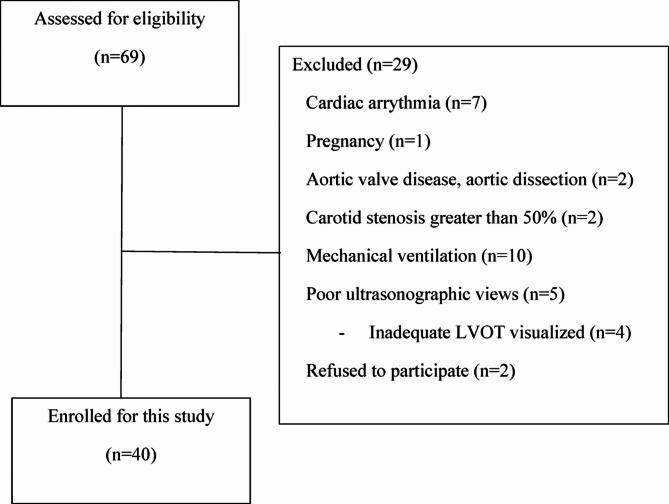
Sepsis significantly impacts the circulatory system and is associated with high mortality rates, particularly in patients with septic shock who require urgent treatment. Non-invasive cardiac output monitoring is a critical bedside tool for assessing fluid responsiveness. This study aimed to evaluate the agreement between cardiac output measurements obtained from the carotid artery and the left ventricular outflow tract (LVOT) in patients with septic shock in the emergency department (ED). A prospective observational study was conducted on adult patients diagnosed with septic shock and admitted to the ED between October 2023 and October 2024. Cardiac output was calculated using the standard formula (CO = VTI × cross-sectional area × heart rate) for both LVOT and carotid measurements. Agreement between LVOT-derived and carotid-derived cardiac output was assessed using Lin's concordance correlation coefficient, intraclass correlation coefficient, Bland-Altman analysis, and percentage error. Forty patients with septic shock were included in the study. The mean carotid blood flow was 0.855 L/min, while the mean cardiac output measured by LVOT echocardiography was 5.329 L/min. Cardiac output measurements derived from carotid artery VTI and LVOT VTI showed a moderate agreement, as demonstrated by Lin's Concordance Correlation Coefficient of 0.527 (p < 0.001) and an Intraclass Correlation Coefficient (absolute agreement) of 0.695 (p < 0.001). Bland-Altman analysis revealed a bias of - 0.47 (95% CI: -2.11 to 1.17), with a concordance interval ranging from - 10.51 (95% CI: -13.35 to - 7.67) to 9.58 (95% CI: 6.74 to 12.42). Non-invasive cardiac output measurements from the carotid artery exhibited only moderate agreement with those derived from the LVOT, accompanied by wide limits of agreement. This indicates that the two methods should not be utilized interchangeably for clinical decision-making in individual patients. Carotid artery measurements should not be regarded as a direct replacement for LVOT examinations.
脓毒症对循环系统有显著影响,且与高死亡率相关,尤其是在需要紧急治疗的感染性休克患者中。无创心输出量监测是评估液体反应性的关键床边工具。本研究旨在评估急诊科(ED)感染性休克患者经颈动脉和左心室流出道(LVOT)获得的心输出量测量值之间的一致性。对2023年10月至2024年10月期间确诊为感染性休克并入住ED的成年患者进行了一项前瞻性观察研究。LVOT和颈动脉测量均使用标准公式(心输出量=速度时间积分×横截面积×心率)计算心输出量。使用林氏一致性相关系数、组内相关系数、布兰德-奥特曼分析和百分比误差评估LVOT衍生的心输出量与颈动脉衍生的心输出量之间的一致性。40例感染性休克患者纳入研究。颈动脉平均血流为0.855升/分钟,而LVOT超声心动图测量的平均心输出量为5.329升/分钟。经颈动脉速度时间积分和LVOT速度时间积分得出的心输出量测量值显示出中等一致性,林氏一致性相关系数为0.527(p<0.001),组内相关系数(绝对一致性)为0.695(p<0.001)。布兰德-奥特曼分析显示偏差为-0.47(95%CI:-2.11至1.17),一致性区间为-10.51(95%CI:-13.35至-7.67)至9.58(95%CI:6.74至12.42)。来自颈动脉的无创心输出量测量值与来自LVOT的测量值仅显示出中等一致性,且一致性界限较宽。这表明这两种方法在个体患者的临床决策中不应互换使用。颈动脉测量不应被视为LVOT检查的直接替代方法。

 Zotero 插件