
肝细胞癌微小RNA诊断准确性研究中对STARD指南的遵循情况:一项系统评价
Adherence to STARD guidelines in miRNA diagnostic accuracy studies for hepatocellular carcinoma: a systematic review.
作者信息
Wang Shuaiyang, Wu Mei, Xie Bei, Ma Xingyuan, Li Jing, Ma Bin, Li Linjing
机构信息
Department of Clinical Laboratory Center, The Second Hospital of Lanzhou University, Lanzhou, 730000, Gansu, China.
Evidence-Based Medicine Centre, School of Basic Medical Sciences, Lanzhou University, Lanzhou, 730000, Gansu, China.
出版信息
BMC Med Res Methodol. 2025 Jun 6;25(1):155. doi: 10.1186/s12874-025-02610-5.
BACKGROUND
Accumulating evidence demonstrates that miRNAs exhibit enhanced diagnostic sensitivity and specificity compared to the conventional hepatocellular carcinoma (HCC) biomarker alpha-fetoprotein (AFP), particularly showing promising clinical utility in early-stage HCC detection. However, insufficient transparency in methodology reporting compromises the validity assessment of these findings and hinders their translational applications. In this study, we investigated the adherence to the STARD criteria in studies investigating the diagnostic accuracy of miRNA for liver cancer. In addition, the quality of reporting was examined to identify factors influencing the quality of reporting.
METHOD
A comprehensive search strategy was performed on the PubMed, EMBASE, Cochrane Library, and Web of Science, as of March 30, 2023. Clinical trials investigating the diagnostic value of miRNA for HCC diagnosis were included in the analysis. The eligible studies were checked against adherence to the STARD criteria. Factors determining quality of studies were evaluated through subgroup analyses. All statistical analyses were performed using SPSS (varsion25.0).
RESULTS
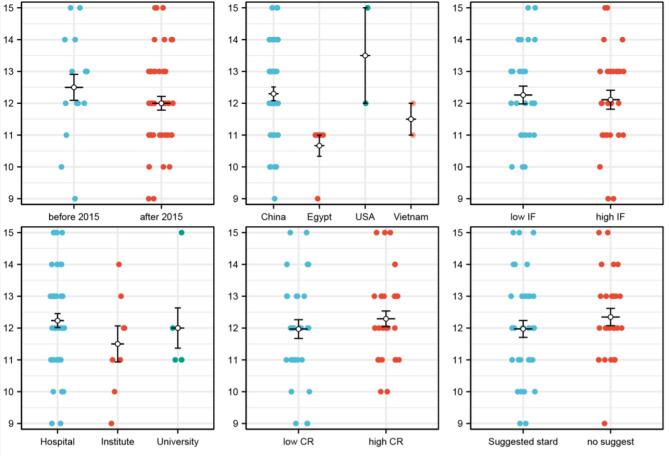
Sixty-two eligible studies, all published between 2010 and 2022, were eventually included in the final analysis. The results revealed a moderate overall adherence to STARD 2015, with an average of 12.1 (52.6%) of the 23 items reported. Subgroup analysis revealed that adherence to the STARD 2015 varied among countries (USA 58.7%;Egypt 46.5%)(p<0.05).
CONCLUSION
The quality of studies reporting the diagnostic accuracy of miRNAs in HCC was average and did not increase after the publication of STARD 2015. Our findings rise awareness regarding the need to improve STARD standards, implying that more journals need to include STARD standards for relevant manuscripts. In addition, editorial and peer approval procedures should adopt measures that will aim to improve reporting quality.
背景
越来越多的证据表明,与传统的肝细胞癌(HCC)生物标志物甲胎蛋白(AFP)相比,微小RNA(miRNA)具有更高的诊断敏感性和特异性,尤其在早期HCC检测中显示出良好的临床应用前景。然而,方法学报告的透明度不足影响了这些研究结果的有效性评估,并阻碍了其转化应用。在本研究中,我们调查了在研究miRNA对肝癌诊断准确性的研究中对STARD标准的遵守情况。此外,还对报告质量进行了检查,以确定影响报告质量的因素。
方法
截至2023年3月30日,在PubMed、EMBASE、Cochrane图书馆和科学网进行了全面的检索策略。分析纳入了调查miRNA对HCC诊断价值的临床试验。对照STARD标准检查符合条件的研究。通过亚组分析评估决定研究质量的因素。所有统计分析均使用SPSS(版本25.0)进行。
结果
最终纳入最终分析的有62项符合条件的研究,均发表于2010年至2022年之间。结果显示对2015年STARD标准的总体遵守程度中等,23项条目中平均报告了12.1项(52.6%)。亚组分析显示,不同国家对2015年STARD标准的遵守情况有所不同(美国58.7%;埃及46.5%)(p<0.05)。
结论
报告miRNA在HCC中诊断准确性的研究质量一般,在2015年STARD标准发布后并未提高。我们的研究结果提高了人们对改进STARD标准必要性的认识,这意味着更多期刊需要将STARD标准纳入相关稿件。此外,编辑和同行评审程序应采取旨在提高报告质量的措施。


 Zotero 插件