
无阻塞性冠状动脉疾病的心绞痛女性患者中的前C型利钠肽
Pro-C-Type Natriuretic Peptide in Women With Angina Pectoris and No Obstructive Coronary Artery Disease.
作者信息
Mark Peter D, Schroder Jakob, Jensen Andreas K, Prickett Timothy C R, Prescott Eva, Goetze Jens P
机构信息
Department of Clinical Biochemistry, Rigshospitalet, University of Copenhagen, Copenhagen, Denmark.
Department of Cardiology, Bispebjerg-Frederiksberg Hospital, University of Copenhagen, Copenhagen, Denmark.
出版信息
JACC Adv. 2025 Jun 6;4(7):101859. doi: 10.1016/j.jacadv.2025.101859.
BACKGROUND
Circulating C-type natriuretic peptides (CNPs) predict adverse outcome in women presenting with ST-elevation myocardial infarction.
OBJECTIVES
The purpose of this study was to determine the prognostic impact of a high proCNP concentration in women with angina pectoris but no obstructive coronary artery disease (ANOCA).
METHODS
In a prospective cohort of women with ANOCA, we assessed the baseline associations between proCNP concentrations in plasma and clinical data. Moreover, we performed exploratory partial least squares regression (PLS) analyses for correlation patterns of proCNP with 185 cardiovascular plasma markers. We included 1,508 women in baseline/follow-up analyses and 1,598 women in PLS analyses. Follow-up analyses included all-cause death and a composite endpoint of cardiovascular events, where we calculated HR estimates from crude and adjusted (age, creatinine) Cox proportional hazards models.
RESULTS
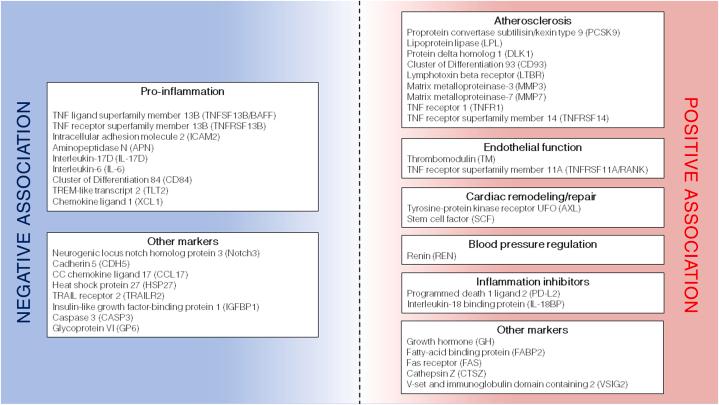
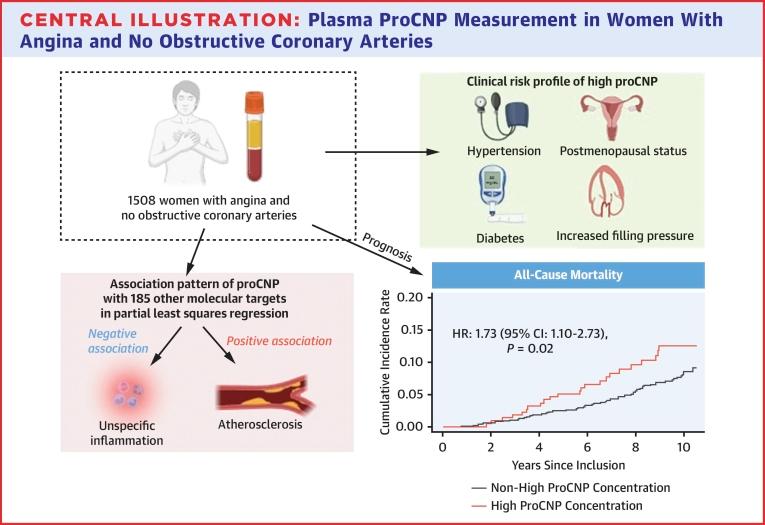
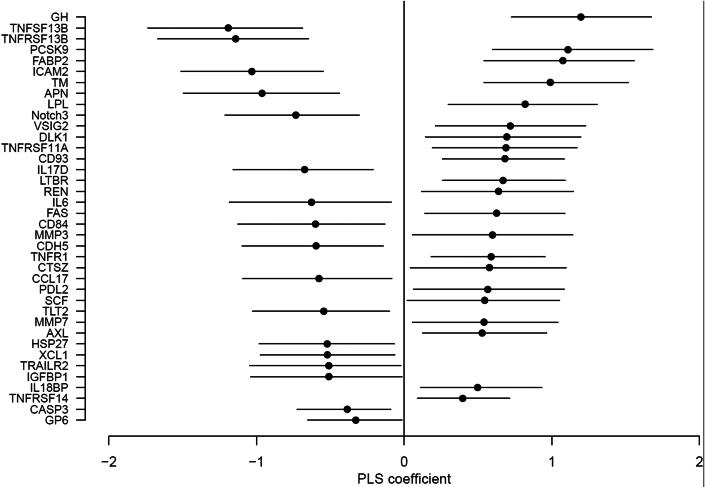
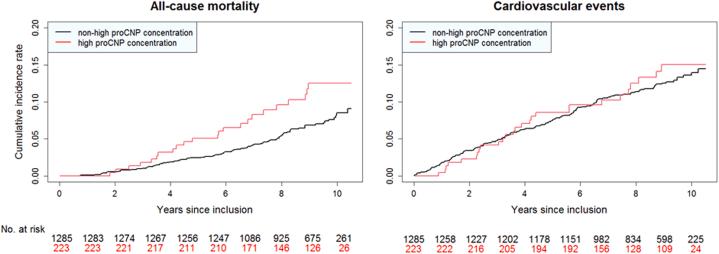
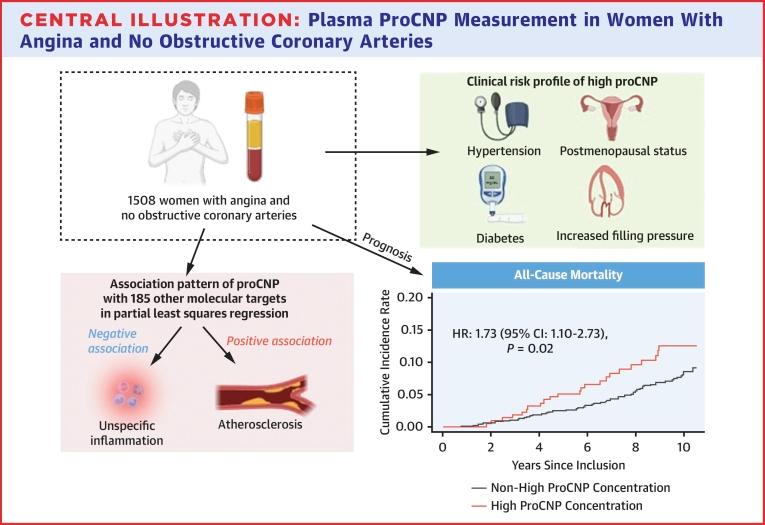
A high proCNP concentration (223 women) was associated with hypertension (P = 0.001), diabetes mellitus (P < 0.001), and postmenopausal status (P < 0.001) but not age (P = 0.13). PLS analyses showed that proCNP concentrations were positively associated with atherosclerotic markers and negatively associated with pro-inflammatory markers. For high proCNP, we found an increased risk of all-cause mortality (HR: 1.73 [95% CI: 1.10-2.73]; P = 0.02 and HR: 1.57 [95% CI: 0.99-2.49]; P = 0.06), whereas hazard rates of cardiovascular events were comparable (HR: 1.08 [95% CI: 0.72-1.62]; P = 0.71 and HR: 1.03 [95% CI: 0.68-1.56]; P = 0.90).
CONCLUSIONS
In women with ANOCA, a high circulating proCNP concentration is associated with a distinct cardiovascular risk profile beyond pro-inflammatory biomarkers and an increased risk of all-cause mortality.
背景
循环C型利钠肽(CNP)可预测ST段抬高型心肌梗死女性患者的不良预后。
目的
本研究旨在确定高浓度前体CNP(proCNP)对无阻塞性冠状动脉疾病(ANOCA)的心绞痛女性患者的预后影响。
方法
在一个ANOCA女性患者的前瞻性队列中,我们评估了血浆中proCNP浓度与临床数据之间的基线关联。此外,我们对proCNP与185种心血管血浆标志物的相关模式进行了探索性偏最小二乘回归(PLS)分析。基线/随访分析纳入了1508名女性,PLS分析纳入了1598名女性。随访分析包括全因死亡和心血管事件复合终点,我们从粗数据和校正(年龄、肌酐)的Cox比例风险模型计算风险比(HR)估计值。
结果
高proCNP浓度(223名女性)与高血压(P = 0.001)、糖尿病(P < 0.001)和绝经后状态(P < 0.001)相关,但与年龄无关(P = 0.13)。PLS分析表明,proCNP浓度与动脉粥样硬化标志物呈正相关,与促炎标志物呈负相关。对于高proCNP,我们发现全因死亡率增加(HR:1.73 [95% CI:1.10 - 2.73];P = 0.02和HR:1.57 [95% CI:0.99 - 2.49];P = 0.06),而心血管事件的风险率相当(HR:1.08 [95% CI:0.72 - 1.62];P = 0.71和HR:1.03 [95% CI:0.68 - 1.56];P = 0.90)。
结论
在ANOCA女性患者中,高循环proCNP浓度与促炎生物标志物之外的独特心血管风险特征以及全因死亡率增加相关。
 Zotero 插件