
机器人辅助手术治疗肾结石的手术效果:来自香港大学和欧洲泌尿外科学会腔内泌尿外科分会的系统评价和荟萃分析
Surgical outcomes of robotic surgery for kidney stones: a systematic review and meta-analysis from section of YAU and EAU endourology.
作者信息
Ergül Rifat Burak, Özervarli M Fırat, Panthier Frederic, Nedbal Carlotta, Tsaturyan Arman, Pietropaolo Amelia, Cacciamani Giovanni, Kronenberg Peter, De Backer Pieter, Ghnatios Chady, Khene Zine-Eddine, Cho Sung Yong, Turney Ben, Somani Bhaskar, Traxer Olivier, Tefik Tzevat
机构信息
Department of Urology, Istanbul Faculty of Medicine, Istanbul University, Istanbul, Turkey.
Department of Urology, Tenon Hospital, AP-HP, Paris, France.
出版信息
World J Urol. 2025 Jun 8;43(1):364. doi: 10.1007/s00345-025-05734-x.
BACKGROUND
Urinary tract stone disease is quite common in the population, and treatment modalities are constantly evolving. Technological advancements in endourology have led to a shift towards more minimally invasive treatments. Nowadays, robotic flexible ureteroscopy is becoming increasingly popular, showing promising results. This systematic review and meta-analysis aimed to evaluate the outcomes of robotic flexible ureteroscopy.
MATERIALS AND METHODS
We conducted a systematic review in the PubMed, Scopus and Web of Science databases based on the 2020 Preferred Reporting Items for Systematic Review and Meta-Analyses guideline. Study protocol was registered at PROSPERO (CRD420251017383). All robotic flexible studies published until April 2025, which defined and provided the stone-free rate, were included. To assess surgical efficacy and reliability, stone size, operation time, and complications were also evaluated. Stone size was measured in a one-dimensional manner, based on the maximum length.
RESULTS
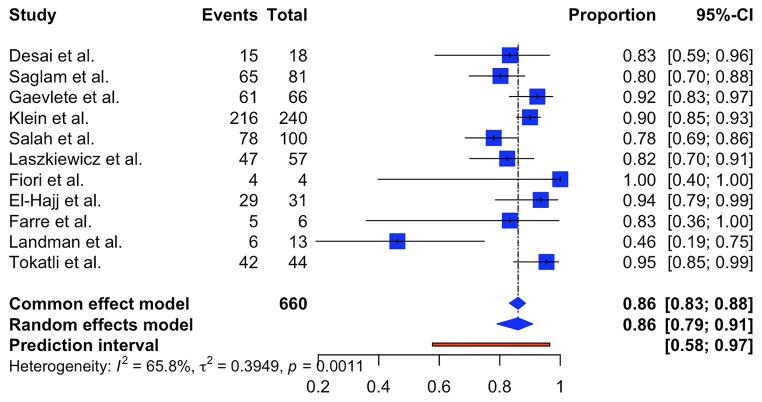
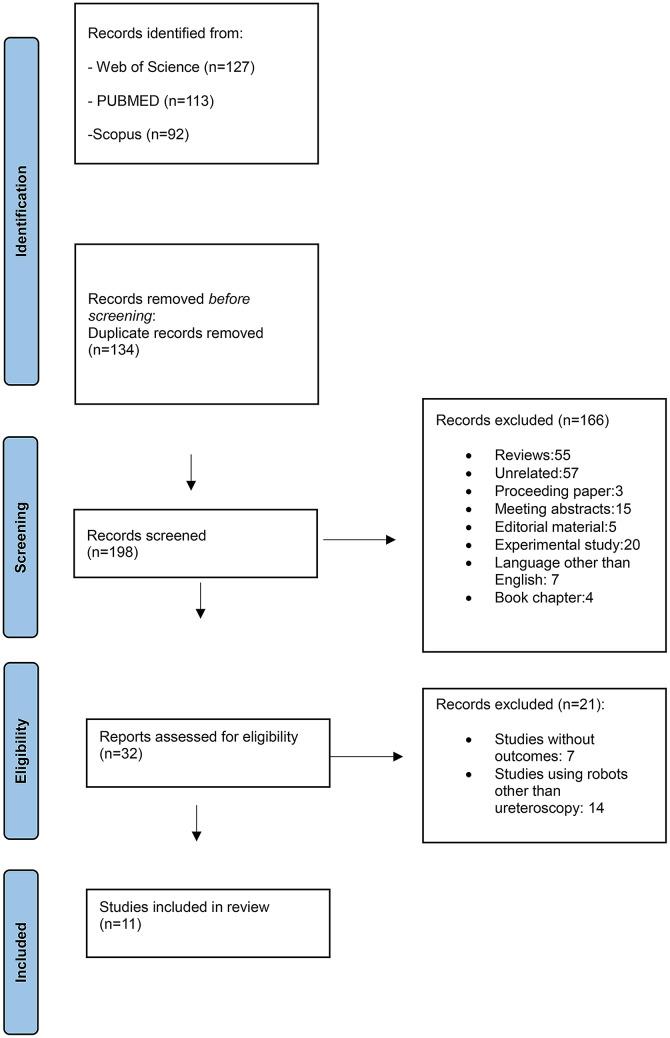
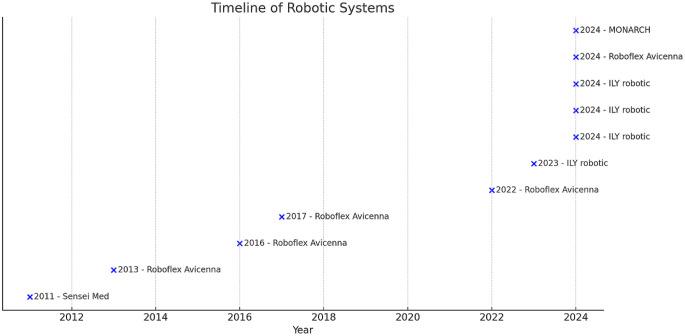
A total of 320 studies were initially identified, with 11 full-text articles meeting the inclusion criteria, involving 656 patients and 660 renal units. The analysis included data from various robotic systems, including the Roboflex Avicenna, ILY, Senhance, and MONARCH platforms. The mean pooled stone-free rate was 86.0%, with a range from 57.7 to 96.5%, indicating variability across studies. The use of a random-effects model was justified by the presence of moderate-to-substantial heterogeneity across studies (I² = 63.5%, τ² = 0.627), and a statistically significant Q-test (p = 0.0022). The studies defined stone-free status as either complete stone clearance or residual fragments smaller than 2 mm.
CONCLUSION
The analysis suggests that robotic URS is an effective and feasible treatment option for selected patients with urinary stones. Future research should focus on standardized reporting, comparative effectiveness studies, and cost-benefit analyses, while also addressing surgeon-centered outcomes such as ergonomic strain and musculoskeletal pain, to better define the role of robotic technology in endourological practice.
背景
尿路结石病在人群中相当常见,治疗方式也在不断发展。腔内泌尿外科技术的进步已导致治疗方式向更微创的方向转变。如今,机器人柔性输尿管镜检查越来越受欢迎,显示出有前景的结果。本系统评价和荟萃分析旨在评估机器人柔性输尿管镜检查的结果。
材料与方法
我们根据2020年系统评价和荟萃分析的首选报告项目指南,在PubMed、Scopus和Web of Science数据库中进行了系统评价。研究方案已在PROSPERO(CRD420251017383)注册。纳入所有截至2025年4月发表的定义并提供无石率的机器人柔性输尿管镜检查研究。为评估手术疗效和可靠性,还评估了结石大小、手术时间和并发症。结石大小基于最大长度以一维方式测量。
结果
最初共识别出320项研究,11篇全文文章符合纳入标准,涉及656例患者和660个肾单位。分析纳入了来自各种机器人系统的数据,包括Roboflex Avicenna、ILY、Senhance和MONARCH平台。合并后的平均无石率为86.0%,范围为57.7%至96.5%,表明各研究之间存在差异。由于各研究之间存在中度至高度异质性(I² = 63.5%,τ² = 0.627)以及具有统计学意义的Q检验(p = 0.0022),因此采用随机效应模型是合理的。这些研究将无石状态定义为结石完全清除或残留碎片小于2毫米。
结论
分析表明,机器人输尿管镜检查对于选定的尿路结石患者是一种有效且可行的治疗选择。未来的研究应侧重于标准化报告、比较有效性研究和成本效益分析,同时还应解决以医生为中心的结果,如人体工程学压力和肌肉骨骼疼痛,以更好地界定机器人技术在腔内泌尿外科实践中的作用。
 Zotero 插件