
肌酸激酶作为新冠病毒感染儿童疾病严重程度的预测指标
Creatine Kinase as a Predictor of Disease Severity in Children with COVID-19.
作者信息
Nateghian Alireza, Nojomi Marzieh, Roohravan Benis Mahshid, Heidarpour Tayebeh
机构信息
Department of Pediatric Infectious Disease, Aliasghar Children's Hospital, School of Medicine, Iran University of Medical Sciences, Tehran, Iran.
Preventive Medicine and Public Health Research Center, Psychosocial Health Research Institute, Department of Community and Family Medicine, School of Medicine, Iran University of Medical Sciences, Tehran, Iran.
出版信息
Med J Islam Repub Iran. 2025 Feb 4;39:20. doi: 10.47176/mjiri.39.20. eCollection 2025.
BACKGROUND
The majority of children with COVID-19 infection experience asymptomatic or mild disease, but some of them are at risk of developing severe illness. Determination of predictors of severe disease can help to prevent this form of disease in children. The aim of the current study was to determine the predictors of disease severity of COVID-19 infection based on laboratory markers and underlying conditions in children.
METHODS
This cross-sectional study was conducted in Iran from May 2021 to March 2022. Thirty hundred and seventeen children under 18 years old with positive tests or pulmonary manifestations of COVID-19 referred to a teaching hospital in Tehran were included in the study. Demographic, laboratory, and clinical parameters of included children were measured. The participants were classified into three severity groups based on a severity-scoring protocol. Data was analyzed using SPSS software with chi-square, analysis of variance (ANOVA) tests, and linear generalized model. Statistical significance was considered at 0.05.
RESULTS
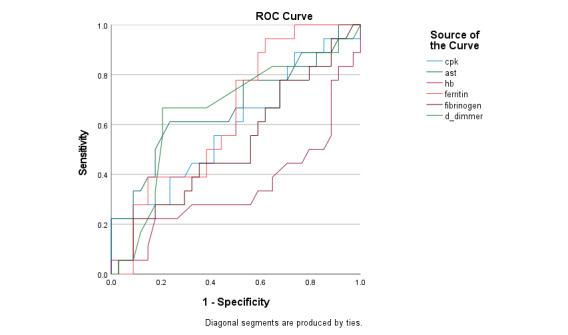
Among 317 children, 186 patients (58.7%) were male. The mean age of the participants was 4.75 ± 4.47 years old. Examination of clinical factors showed cough (64%), Malaise (57.7%), and Tachypnea (35.3%) were the most frequent findings among the subjects. Employing the severity scoring protocol, most patients (69.1%) were classified into the mild group. There was a significant relationship between the severity of COVID-19 and the level of Hemoglobin, Aspartate Transaminase (AST), Alanine Transaminase (ALT), C-reactive protein (CRP), Lactate Dehydrogenase (LDH), Creatine Kinase (CK), D-dimer, Ferritin, and Fibrinogen (<0.001). Creatine Kinase was found to be a predictor of COVID-19 severity in adjusted model. All underlying conditions, except asthma, were significantly associated with disease severity.
CONCLUSION
In our study, it was determined that CK could be considered a predictor of the severity of COVID-19 in children. These results suggest that integrating CK assessment into routine clinical protocols may aid healthcare providers in timely risk stratification and personalized patient care approaches.
背景
大多数感染新冠病毒的儿童无症状或症状轻微,但其中一些有发展为重症的风险。确定重症疾病的预测因素有助于预防儿童出现这种疾病形式。本研究的目的是根据实验室指标和基础疾病确定儿童新冠病毒感染疾病严重程度的预测因素。
方法
本横断面研究于2021年5月至2022年3月在伊朗进行。纳入了317名18岁以下新冠病毒检测呈阳性或有肺部表现并转诊至德黑兰一家教学医院的儿童。测量了纳入儿童的人口统计学、实验室和临床参数。根据严重程度评分方案将参与者分为三个严重程度组。使用SPSS软件进行卡方检验、方差分析(ANOVA)和线性广义模型分析数据。统计学显著性设定为0.05。
结果
在317名儿童中,186例患者(58.7%)为男性。参与者的平均年龄为4.75±4.47岁。临床因素检查显示,咳嗽(64%)、乏力(57.7%)和呼吸急促(35.3%)是受试者中最常见的表现。采用严重程度评分方案,大多数患者(69.1%)被归类为轻症组。新冠病毒感染的严重程度与血红蛋白、天冬氨酸转氨酶(AST)、丙氨酸转氨酶(ALT)、C反应蛋白(CRP)、乳酸脱氢酶(LDH)、肌酸激酶(CK)、D-二聚体、铁蛋白和纤维蛋白原水平之间存在显著关系(<0.001)。在调整模型中,肌酸激酶被发现是新冠病毒感染严重程度的一个预测因素。除哮喘外,所有基础疾病均与疾病严重程度显著相关。
结论
在我们的研究中,确定肌酸激酶可被视为儿童新冠病毒感染严重程度的一个预测因素。这些结果表明,将肌酸激酶评估纳入常规临床方案可能有助于医疗保健提供者及时进行风险分层和采取个性化的患者护理方法。
 Zotero 插件