
德国全国范围内脊柱狭窄症患者队列在新冠疫情期间的衰弱变化
Shifts in Frailty in A Nationwide Cohort of Spinal Stenosis Patients in Germany During the COVID-19 Pandemic.
作者信息
von Riegen Hanna, Abduljawwad Nehad, Gheewala Hussain, Kuhlen Ralf, Dengler Julius, Hohenstein Sven, Bollmann Andreas, Dengler Nora
机构信息
Faculty of Health Sciences Brandenburg, Brandenburg Medical School Theodor Fontane, Campus Bad Saarow, Bad Saarow, Germany.
Department of Neurosurgery, HELIOS Hospital Bad Saarow, Bad Saarow, Germany.
出版信息
J Frailty Sarcopenia Falls. 2025 Jun 1;10(2):78-86. doi: 10.22540/JFSF-10-078. eCollection 2025 Jun.
OBJECTIVES
To examine shifts in frailty among spinal stenosis patients during the COVID-19 pandemic and associations with interventions and outcomes.
METHODS
This retrospective analysis compared types of management and rates of in-hospital mortality between pre-pandemic (January 1, through December 31, 2019) and pandemic phases (March 5, 2020 through May 17, 2022) among spinal stenosis patients across a network of 76 hospitals in Germany, utilizing logistic generalized linear mixed models. Frailty was quantified using the Hospital Frailty Risk Score (HFRS) and categorized as low (<5 points), intermediate (5-15 points), and high (>15 points).
RESULTS
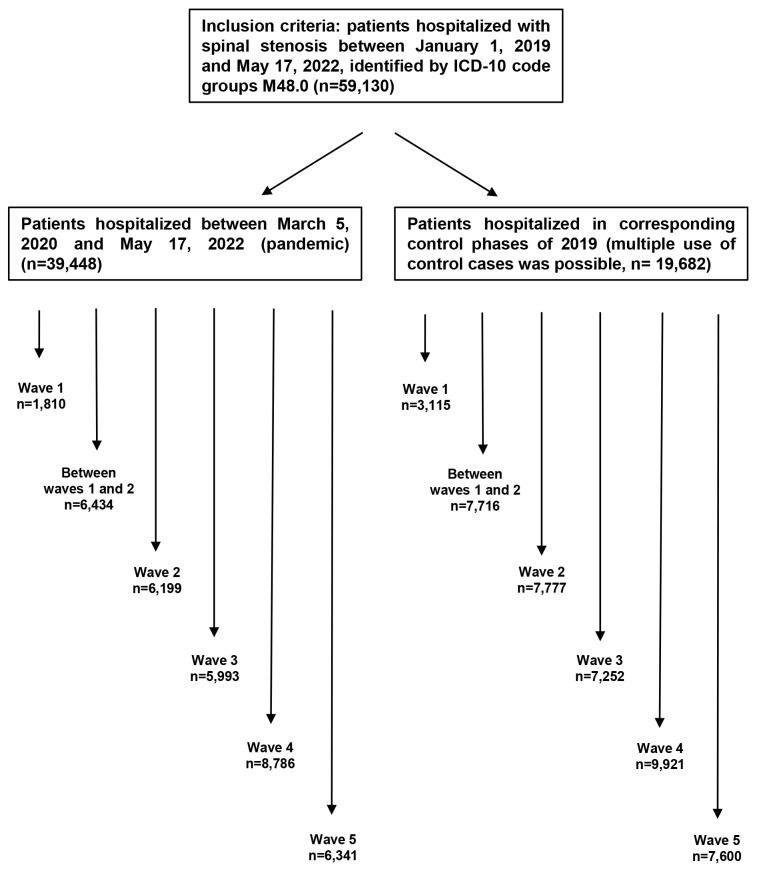
Among the 59,130 patients with spinal stenosis, 39,448 were hospitalized during the pandemic, and 19,682 in 2019. During the pandemic, the proportion of patients with high frailty rose from 4.7%-5.5% to 6.2%-7.3% (p < 0.01), except in pandemic wave 5. Among low frailty patients, rates of decompressive surgery increased from 42.4%-46.0% to 48.4%-52.8% (p<0.001), and of fusion surgery from 15.7%-16.6% to 19.2%-22.8% (p<0.001). Throughout the pandemic, in-hospital mortality rates increased from 0.8%-1.0% to 1.0%-2.5% (p<0.017), yet without differences across frailty groups.
CONCLUSIONS
Among those hospitalized for spinal stenosis during the COVID-19 pandemic in Germany, frailty increased and low frailty was associated with rising rates of spine surgery.
目的
研究新冠疫情期间腰椎管狭窄症患者的衰弱变化情况,以及与干预措施和预后的相关性。
方法
本回顾性分析比较了德国76家医院网络中腰椎管狭窄症患者在疫情前阶段(2019年1月1日至12月31日)和疫情阶段(2020年3月5日至2022年5月17日)的管理类型和院内死亡率,采用逻辑广义线性混合模型。使用医院衰弱风险评分(HFRS)对衰弱进行量化,并分为低(<5分)、中(5-15分)和高(>15分)三个类别。
结果
在59130例腰椎管狭窄症患者中,39448例在疫情期间住院,19682例在2019年住院。在疫情期间,除疫情第5波外,高衰弱患者的比例从4.7%-5.5%上升至6.2%-7.3%(p<0.01)。在低衰弱患者中,减压手术率从42.4%-46.0%上升至48.4%-52.8%(p<0.001),融合手术率从15.7%-16.6%上升至19.2%-22.8%(p<0.001)。在整个疫情期间,院内死亡率从0.8%-1.0%上升至1.0%-2.5%(p<0.017),但各衰弱组之间无差异。
结论
在德国新冠疫情期间因腰椎管狭窄症住院的患者中,衰弱情况有所增加,且低衰弱与脊柱手术率上升有关。
 Zotero 插件