
沙特社区居住老年人中虚弱与抑郁并存与身体活动不足及生活质量的关系:一项横断面研究。
Coexisting frailty and depression associated with low physical activity and quality of life in Saudi community-dwelling older adults: a cross-sectional study.
作者信息
Alhwoaimel Norah A, Alqahtani Bader A, Alshehri Mohammed M, Alhowimel Ahmed S, Alenazi Aqeel M
机构信息
Department of Health and Rehabilitation Sciences, Prince Sattam Bin Abdulaziz University, Al-Kharj, Saudi Arabia.
Department of Physical Therapy, Jazan University, Jazan, Saudi Arabia.
出版信息
Front Public Health. 2025 May 23;13:1531101. doi: 10.3389/fpubh.2025.1531101. eCollection 2025.
BACKGROUND
Frailty and depression are common conditions in older adults, but their coexistence and combined impact on physical activity and quality of life remain understudied, particularly in Saudi Arabia.
OBJECTIVE
To examine the independent associations of depression, frailty, and their coexistence with physical activity levels and quality of life among Saudi older adults.
METHODS
A cross-sectional study was conducted among 395 community-dwelling adults aged 60 years and older (mean age 66.4 ± 7.1 years, 60% women) in Saudi Arabia. Frailty was assessed using the FRAIL scale, depression using the Patient Health Questionnaire 9 (PHQ-9), physical activity using the Physical Activity Scale for the Elderly (PASE), and quality of life using the SF-12. Participants were categorized based on the results of FRAIL and PHQ-9 scale into four groups: coexisting frailty and depression, frailty only, depression only, or neither.
RESULTS
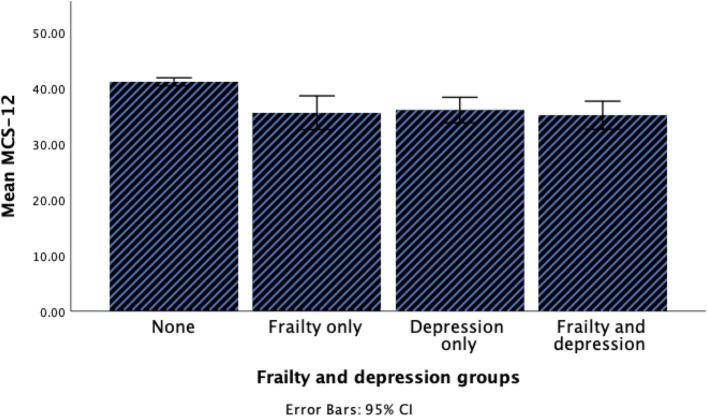
The prevalence of coexisting frailty and depression was 8.6%. Participants with coexisting frailty and depression were more likely to be sedentary (OR = 4.37, 95% CI: 1.41-13.55, = 0.011) compared to those without frailty or depression. Frailty only group ( = -3.55, = 0.003) and coexisting frailty and depression ( = -2.55, = 0.033) were significantly associated with lower physical quality of life. Depression, frailty, and their coexistence were all significantly associated with lower mental quality of life ( < 0.001 for all).
CONCLUSION
The coexistence of frailty and depression in older adults is associated with a higher likelihood of sedentary behavior and lower quality of life. These findings highlight the need for comprehensive geriatric assessments and targeted interventions addressing both physical and mental health in older adults.
背景
衰弱和抑郁是老年人的常见状况,但它们的共存及其对身体活动和生活质量的综合影响仍未得到充分研究,尤其是在沙特阿拉伯。
目的
探讨抑郁、衰弱及其共存与沙特老年人群身体活动水平和生活质量之间的独立关联。
方法
在沙特阿拉伯对395名年龄在60岁及以上的社区居住成年人(平均年龄66.4±7.1岁,60%为女性)进行了一项横断面研究。使用衰弱量表评估衰弱情况,使用患者健康问卷9(PHQ-9)评估抑郁情况,使用老年人身体活动量表(PASE)评估身体活动情况,使用SF-12评估生活质量。根据衰弱量表和PHQ-9量表的结果将参与者分为四组:衰弱和抑郁共存、仅衰弱、仅抑郁或两者皆无。
结果
衰弱和抑郁共存的患病率为8.6%。与无衰弱或抑郁的参与者相比,衰弱和抑郁共存的参与者久坐不动的可能性更高(比值比[OR]=4.37,95%置信区间[CI]:1.41-13.55,P=0.011)。仅衰弱组(P=-3.55,P=0.003)和衰弱与抑郁共存组(P=-2.55,P=0.033)与较低的身体生活质量显著相关。抑郁、衰弱及其共存均与较低的心理生活质量显著相关(所有P<0.001)。
结论
老年人衰弱和抑郁的共存与久坐行为的可能性增加和生活质量降低有关。这些发现凸显了对老年人进行全面老年评估以及针对身心健康的有针对性干预措施的必要性。

 Zotero 插件